
Most gym owners pour money into broad marketing campaigns and wonder why their cost per lead stays high while membership growth stays flat. The answer is not better ads. It is a better strategy. Understanding why niche marketing for gyms matters is one of the most overlooked shifts a fitness business owner can make. Instead of competing against every gym in your city on price and amenities, niching positions you as the obvious, specialized choice for a specific group of people. This article covers what niche marketing is, why it works, the data behind it, and how to start implementing it today.
Table of Contents
- Key takeaways
- Why niche marketing for gyms is not optional anymore
- The benefits of niche marketing, backed by data
- Common misconceptions about niching your gym
- How to find and implement your gym's niche
- My honest take on why gym owners resist niching
- Ready to put your niche positioning to work?
- FAQ
Key takeaways
| Point | Details |
|---|---|
| Niching beats broad marketing | Targeted marketing for fitness attracts motivated clients more efficiently than generic campaigns. |
| Specialists earn significantly more | Specialist trainers charge 30-50% higher prices than generalists, directly impacting gym revenue. |
| Niching is not exclusion | A niche is a focused communication strategy, not a barrier to accepting other clients. |
| Use the Hedgehog Method | Identify your niche at the intersection of passion, competence, and market demand. |
| Scaling is possible with online programs | Niche gyms can grow beyond their zip code through online coaching and specialized programming. |
Why niche marketing for gyms is not optional anymore
What is niche marketing for gyms? At its core, it means positioning your facility and messaging around a specific type of client, a specific fitness goal, or a specific methodology rather than trying to serve everyone. Instead of marketing yourself as "a gym for everyone in Austin," you become "the training facility for busy professionals who want sustainable strength gains" or "the only HYROX prep gym in Denver."
General marketing creates a noise problem. When your ads look like every other gym ad in town, you compete on price, and price wars are a race to the bottom. Niche marketing sidesteps that entirely.
Here is what separates a niche gym from a general one:
- Audience specificity: You are speaking to one type of person with one set of problems, not a vague "fitness-minded" demographic.
- Messaging precision: Your content, ads, and emails address pain points that feel personal to your ideal member.
- Programming depth: Your classes, coaching, and results are built around one outcome, which makes your service demonstrably better for that person.
- Perceived authority: When someone searches for "HYROX training gym near me," a specialized facility wins every time over a general gym.
The blue ocean scenario is real. Niche markets have fewer competitors, which means your marketing budget works harder and your close rate improves. You are not fighting 20 gyms for the same pool of general fitness seekers. You are the clear choice for a defined group.
Practical niche examples relevant to gyms include: endurance athlete programming, postpartum fitness, executive performance coaching, youth sport-specific training, masters weightlifting, and HYROX or functional fitness competition prep.

The benefits of niche marketing, backed by data
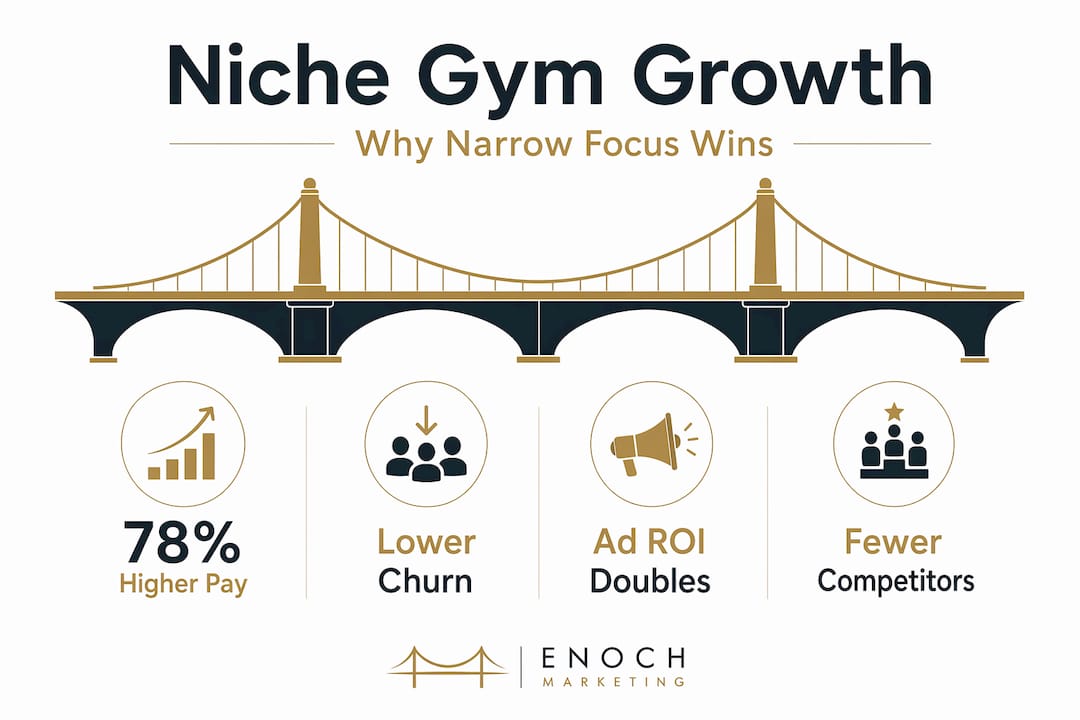
The financial case alone is enough to take this seriously. Specialist trainers earn 78% more than generalists on average. That income gap does not just apply to individual trainers. It reflects a broader truth: people pay a premium when they believe you are the best option for their specific situation.
What niche pricing actually looks like
| Niche Type | Typical Session Rate | Market Driver |
|---|---|---|
| General personal training | $60-$90/session | High supply, price competition |
| Executive performance coaching | $150-$300+/session | Perceived ROI, exclusivity |
| Sport-specific prep (HYROX, padel) | $150-$300+/session | Specialized expertise, outcome focus |
| Postpartum/prenatal fitness | $90-$150/session | Trust, safety, limited specialists |
| Masters/older adult training | $80-$130/session | Loyalty, health outcomes priority |
Pricing for premium niche segments like executive coaching and sport-specific training consistently command $150-$300 or more per session. That is not because those trainers work harder. It is because their positioning communicates specialized expertise.
Beyond pricing, the retention story is equally compelling. Clients in niche programs demonstrate higher loyalty and lower churn because their specific needs are being met consistently. That reduces your customer acquisition cost over time, which is one of the core benefits of niche marketing that most gym owners do not think to calculate.
Demographic shifts are also creating new niche opportunities. Urban gyms are losing Gen X members to suburban micro-gyms focused on specialized, routine-based fitness experiences. That 44-to-59 age bracket is increasingly underserved by large box gyms that cater to younger aesthetics-driven members.
Pro Tip: Health and longevity messaging resonates far more with Gen X and older clients than aesthetic-focused ads. If your niche targets this demographic, reframe every message around function, energy, and long-term health rather than weight loss or aesthetics.
Targeted marketing for fitness also means your ad spend goes further. When your Facebook or Google campaign speaks directly to one type of person with one specific message, your click-through rates improve, your cost per lead drops, and your leads are already pre-qualified by the time they contact you.
Common misconceptions about niching your gym
The most common reason gym owners avoid niching is a fear of turning people away. "If I focus on HYROX prep, will I lose all my other members?" That concern is understandable, but it is based on a misunderstanding of what niching actually is.
Niching is a communication strategy, not an exclusion policy. You can absolutely accept members who do not fit your primary niche. But your marketing speaks with laser focus to the one audience you want to attract most. Your general fitness member found you through a friend. Your niche member found you because your entire brand spoke directly to their exact situation.
Other misconceptions gym owners regularly run into:
- "My niche is too small to be profitable." Almost every gym owner overestimates how big their market needs to be. You do not need to be the gym for all of Austin. You need to be the gym for the right 200 people in Austin.
- "I do not have the credentials to specialize." Your niche does not have to be a specific certification. It can be your methodology, your community culture, your training philosophy, or a specific outcome you consistently deliver.
- "Niching limits my growth." In practice, the opposite happens. Focused gyms generate stronger word-of-mouth, more referrals, and better retention, all of which compound growth over time.
- "My market is already saturated." If the niche is popular, look one level deeper. Instead of "strength training for women," try "strength training for women over 40 who have never lifted before."
When selecting your niche, avoid picking something purely based on market trends if you have no genuine expertise or interest there. Passion without competence produces poor results. Competence without market demand produces poor revenue. The goal is alignment.
Pro Tip: Before committing to a niche, survey your current best members. Ask them why they chose you over other gyms, what specific result matters most to them, and what they would tell a friend about your facility. The answers will reveal your niche more accurately than any market research report.
How to find and implement your gym's niche
Identifying the right niche is not guesswork. The Hedgehog Method gives you a practical framework: find the intersection of what you are deeply passionate about, what you are genuinely good at, and what the market is willing to pay for. If you can identify one area where all three overlap, that is your niche.
Here is a step-by-step process to get started:
- Audit your current membership. Look at your most loyal, highest-paying, longest-retained members. What do they have in common? Age, occupation, goal, training background?
- Research your local competitors. Identify what every other gym in your area is marketing. Any gap in specialized programming or audience is a potential niche opening.
- Validate with a small offer. Before rebranding your entire gym, run a specialized six-week program for your target niche. Measure signups, retention, and feedback.
- Build messaging around pain points. Write your ads, website copy, and social content to address the specific frustrations and goals of your niche. Targeted messaging that speaks directly to client pain points improves both engagement and conversion.
- Create content that demonstrates authority. If your niche is masters athletics, produce video content showing your programming, member results, and your coaching approach for that specific group.
- Build partnerships within your niche ecosystem. A gym focused on endurance athletes partners with local running clubs, triathlon coaches, and physical therapists who work with athletes.
For fitness brand positioning, the most effective gyms combine a proprietary method with a specific target audience and compete on outcomes rather than general aesthetics. That is the formula that builds lasting authority in a niche.
Scaling is also very achievable. Online coaching allows niche gyms to move beyond local geography and access clients anywhere. A CrossFit gym known for masters athlete programming can sell online coaching packages to 55-year-old athletes across the country, not just the ones in their city.
For practical content ideas that demonstrate niche authority, reviewing content marketing examples for gyms can give you a concrete starting point.
My honest take on why gym owners resist niching
I have worked with enough gym owners to see the pattern clearly. The ones who resist niching are usually the ones competing hardest on price, running the most promotions, and burning out the fastest. They believe that a bigger net catches more fish. What they actually experience is a lot of work for very little return.
In my experience, the gym that stopped marketing to "everyone in the city" and started marketing exclusively to first responders grew its membership by over 40% in eight months. Not because first responders are a huge demographic. Because the gym's message finally felt personal, specific, and built for someone. That is the power of focused communication.
What I find most telling is the pricing shift. When a gym niches down, it stops having conversations about discounts. The clients who want what you specifically offer are not shopping around for the cheapest option. They want the best option for them. That fundamentally changes the sales conversation and the revenue model.
The hesitation I see most often is the fear of "what if I make the wrong choice." My answer is always the same: a wrong niche tested for 90 days teaches you more than three years of generic marketing. Start, measure, adjust. Niching is not a permanent tattoo. It is a positioning decision you can refine as your market and your skills evolve.
The gym owners who thrive long-term are not the ones with the nicest equipment or the lowest prices. They are the ones who built a community so specific and so valuable that their members would never consider going anywhere else.
— Collin
Ready to put your niche positioning to work?
If reading this article made you realize that your current marketing is too broad and not generating the members you actually want, you are not alone. Most gym owners face exactly this problem.
At Enochmarketing, we specialize in helping CrossFit gyms and fitness brands build niche-focused marketing systems that actually produce memberships, not just impressions. From paid media on Meta and Google to local SEO and brand strategy, everything we do is built around getting your specific gym in front of your specific audience. If you are ready to stop competing on price and start winning on positioning, explore our gym marketing services and book a free strategy session with our team.
FAQ
What is niche marketing for gyms?
Niche marketing for gyms means positioning your facility, programming, and messaging around a specific audience or training outcome rather than appealing to all fitness seekers. Examples include targeting HYROX athletes, postpartum women, or masters weightlifters.
Why do gyms need niche marketing?
Generic gym marketing leads to high competition and low conversion because your message looks identical to every competitor's. Niche marketing builds authority with a specific group, reduces competition, and attracts higher-paying, more loyal members.
Does niching mean I can only accept certain clients?
No. Niching is a focused communication strategy, not an exclusion policy. You market to one specific audience while remaining free to work with clients outside that niche who find you through other channels.
How do specialist trainers earn more through niching?
Specialist trainers earn significantly more because they command premium prices. Specialists charge 30-50% more than generalists, and top niches like executive coaching or sport-specific training regularly reach $150-$300 or more per session.
How do I pick the right niche for my gym?
Use the Hedgehog Method: find the overlap between what you are passionate about, what you do exceptionally well, and what your local market is willing to pay for. Then validate with a small program before committing to a full rebrand.