
Data-driven fitness marketing is defined as the practice of using member behavior, digital engagement metrics, and campaign analytics to guide every promotional decision a gym makes. Gym owners who rely on gut instinct alone leave real membership growth on the table. The importance of data in fitness is no longer a competitive advantage reserved for large chains. It is the baseline for any fitness brand that wants to grow predictably. This article breaks down which data types matter most, how analytics sharpens campaign decisions, where data misleads, and how you can build a practical system that drives real results.
Why data matters in fitness promotion
Data gives fitness marketers the ability to replace guesswork with evidence. Without it, you are spending ad budget on audiences who will never convert and sending emails to members who already churned. With it, you can identify exactly which campaigns bring in members who stay, and which ones attract people who cancel after week two.
The core data sources for fitness promotion fall into four categories: member attendance and CRM records, wearable and mobile app data, digital engagement analytics from your website and social channels, and direct member feedback. Each source tells a different part of the story. CRM records show you who is showing up and who is drifting away. Digital engagement data shows you which messages are landing. Wearable data gives you context about member activity between visits. Feedback fills in the human detail that numbers miss.

Fitness brands that connect these sources gain a full picture of the member lifecycle. That picture is what makes personalized, measurable marketing possible.
What types of data are most valuable for fitness promotion?
The most valuable fitness data for marketing purposes comes from systems you already own: your booking platform, your CRM, and your email tool.
- Attendance and booking data tracks class frequency, cancellation patterns, and peak usage times. A member who drops from four classes per week to one is a churn risk. Your CRM should flag that automatically.
- Digital engagement data covers website sessions, email open rates, click-through rates, and social media interactions. These metrics tell you which content resonates and which falls flat.
- Wearable and app data provides trends in member activity, recovery, and consistency. Heart rate variability and sleep quality trends are key biometric signals that inform training decisions and recovery status. Use this data directionally, not as a precise prescription.
- Survey and feedback data captures member satisfaction, goals, and preferences. Pairing subjective reports with objective metrics produces richer member profiles than either source alone.
Pro Tip: Set up a simple monthly survey of five questions sent to all active members. The qualitative answers will surface patterns your attendance data cannot show, like why members feel stuck or what class formats they want next.
Fitness coaching programs that integrate adaptive training data over time show how adjusting programs based on trends, rather than single data points, produces better member outcomes and stronger retention.
How does data analytics improve decision-making in fitness marketing?
Analytics converts raw numbers into decisions. The process follows a clear sequence for gym owners who want to run campaigns that perform.
- Segment your audience by behavior. Group members by attendance frequency, class type preference, and engagement history. A member who attends three strength classes per week responds to different messaging than a drop-in yoga client. Personalized fitness marketing built on behavioral segments consistently outperforms generic broadcast campaigns.
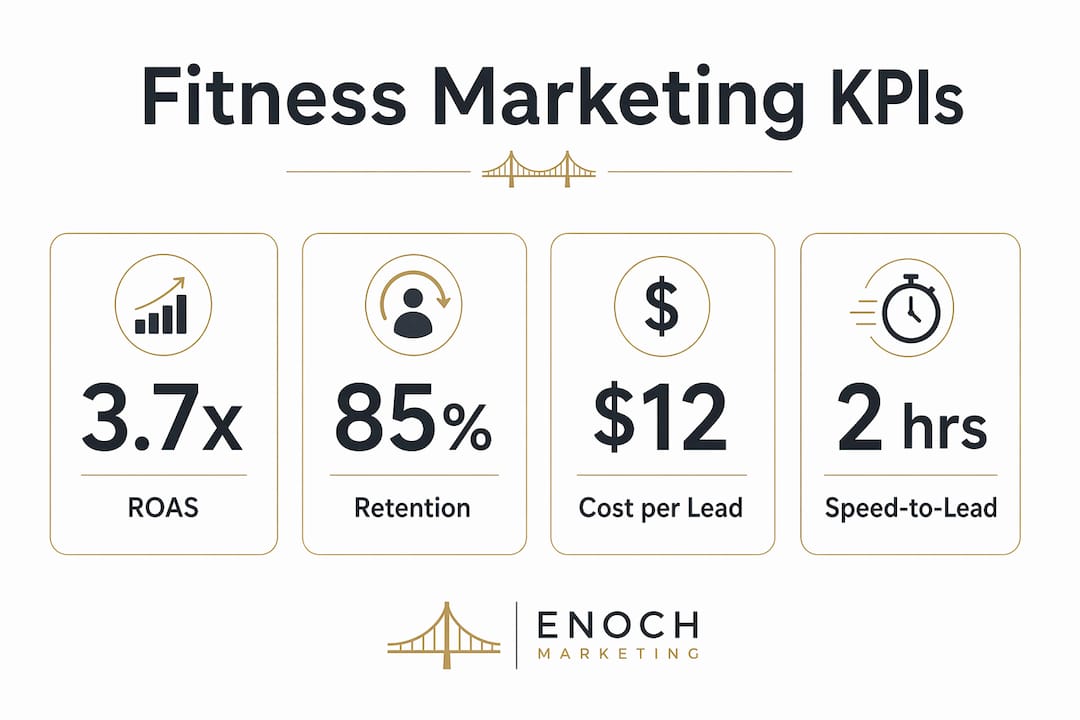
- Define your KPIs before you launch. Return on ad spend (ROAS), cost per lead, retention rate, and speed-to-lead are the metrics that matter for gym marketing. Set targets before the campaign runs, not after.
- Use predictive budget allocation. Cross-channel measurement and AI-powered budget reallocation let you shift spend toward what is working in real time. AI-driven budget reallocation improved ROAS by 13% for a major fitness brand. That result shows what happens when spend follows performance signals instead of fixed schedules.
- Automate triggers based on attendance patterns. Behavior-triggered outreach based on rolling attendance data outperforms generic date-based email campaigns. A message sent when a member misses three consecutive classes lands at exactly the right moment.
Pro Tip: Build a simple dashboard that tracks speed-to-lead, weekly retention rate, and ROAS side by side. Reviewing these three numbers every Monday morning will surface problems before they become expensive.
| KPI | What it measures | Why it matters for gym marketing |
|---|---|---|
| ROAS | Revenue generated per ad dollar spent | Shows which campaigns pay for themselves |
| Retention rate | Percentage of members who stay month over month | Predicts long-term revenue stability |
| Speed-to-lead | Time between inquiry and first contact | Faster follow-up converts more leads |
| Cost per lead | Ad spend divided by leads generated | Controls acquisition costs as you scale |
What are the challenges and limitations of using data in fitness promotion?
Data is a powerful tool, but it produces bad decisions when misread. Fitness marketers face three recurring problems.
- Wearable accuracy gaps. Consumer fitness trackers vary significantly in calorie expenditure, sleep staging, and recovery metrics compared to clinical tools. Treating a member's wearable data as exact will lead to programming errors and misplaced confidence in the numbers.
- Disconnected data sources. Most fitness organizations collect large amounts of data but lack the systems to convert it into useful foresight on client adherence and risk. A CRM that does not talk to your email platform and a booking system that does not feed your analytics tool creates blind spots.
- Calendar-based automation. Sending a "we miss you" email every 30 days regardless of what a member actually did last week is not data-driven marketing. It is scheduled noise. Behavior-driven triggers, tied to real attendance events, produce far better engagement.
"Overreliance on imperfect algorithms leads to missed signals. Expert validation is needed to correctly interpret injury risk and training load insights. Combining human judgment with structured data systems is what separates effective fitness marketing from automated mediocrity."
The fix is not to abandon data. The fix is to treat it as directional evidence that still requires human interpretation. Data analytics in fitness coaching works best when coaches validate what the numbers suggest before acting on them. The same principle applies to marketing.
How can gym owners implement data-driven fitness promotion?
Implementation does not require an enterprise tech stack. It requires the right habits applied consistently.
- Set up rolling attendance triggers. Configure your CRM or marketing automation tool to flag any member whose class attendance drops by 50% over a two-week rolling window. Send a personalized check-in message within 24 hours of that flag. Messages referencing specific attendance outperform generic campaigns by a wide margin.
- Build unified member profiles. Combine CRM data with any wearable or app data your members share. Add survey responses to each profile. The goal is a single view of each member that includes behavior, preferences, and goals.
- Apply cross-channel measurement. Track every lead source: paid social, Google Ads, organic search, referral, and in-person events. Knowing which channel produces your highest-retention members is more valuable than knowing which channel produces the most leads.
- Use AI-powered budget reallocation. Platforms that shift ad spend dynamically based on real-time performance data remove the lag between "this ad is underperforming" and "we stopped spending on it." That lag is where budget gets wasted.
- Review your analytics dashboard weekly. Speed-to-lead, retention rate, and ROAS reviewed together tell you whether your marketing is producing members who stay or members who churn.
The gym owner's marketing workflow that works in 2026 is built around these five habits. Gyms that follow them consistently reduce wasted ad spend and increase the lifetime value of each member they acquire.
| Approach | Generic marketing | Data-driven marketing |
|---|---|---|
| Audience targeting | Broad demographic segments | Behavioral segments from CRM and attendance |
| Campaign triggers | Fixed calendar dates | Rolling attendance and engagement events |
| Budget allocation | Set monthly by channel | Dynamic, performance-based reallocation |
| Messaging | Same message to all members | Personalized by behavior and goal |
| Success measurement | Leads generated | Retention rate and ROAS combined |
Key Takeaways
Data-driven fitness marketing works because behavioral data, combined with real-time analytics and human judgment, produces campaigns that attract members who stay and reduces spend on those who do not.
| Point | Details |
|---|---|
| Behavior triggers beat calendars | Attendance-based outreach converts better than fixed-date email campaigns. |
| Wearable data is directional | Treat consumer tracker metrics as trends, not precise measurements. |
| KPIs must be set before launch | Define ROAS, retention rate, and speed-to-lead targets before any campaign runs. |
| AI budget allocation improves ROAS | Dynamic spend reallocation based on real-time performance data lifted ROAS by 13% in a documented fitness brand case. |
| Human judgment completes the picture | Data surfaces patterns; experienced marketers decide what to do with them. |
Data tells you where to look, not what to think
I have worked with gym owners who collected more data than they knew what to do with and gym owners who ran every campaign on instinct. Neither extreme produces consistent growth.
The mistake I see most often is treating a behavior trigger as a complete strategy. A member misses three classes, the automation fires, and the gym owner assumes the problem is solved. What the data cannot tell you is whether that member is traveling, injured, or quietly deciding to cancel. The message you send matters as much as the timing. Data gets you to the right moment. Your judgment determines what you say in it.
The shift I find most valuable in 2026 is moving from channel-specific reporting to cross-channel measurement. When you can see that your Meta Ads produce leads who cancel in month two while your Google Ads produce members who stay for a year, your budget decisions become obvious. Most gym owners are not making that comparison because their data lives in separate tools. Fixing that integration is the single highest-return change most fitness marketers can make right now.
Behavior-triggered automation and AI-powered budget reallocation are not replacements for a clear marketing strategy. They are amplifiers. Get the strategy right first, then let the data sharpen it.
— Collin
How Enochmarketing helps gym owners use data to grow
Enochmarketing builds data-driven marketing systems specifically for CrossFit gyms and fitness brands across the United States. The agency runs paid media on Meta and Google Ads, builds lead funnels, and applies cross-channel analytics to show gym owners exactly which campaigns produce members who stay.
If your current marketing relies on referrals and gut instinct, the gap between where you are and where you want to be is a data problem. Enochmarketing's gym growth services cover everything from campaign audits to AI-assisted budget allocation, giving you a clear picture of what is working and a system to scale it. Book a free strategy session and find out what your data is already telling you.
FAQ
Why does data matter in fitness promotion?
Data removes guesswork from marketing decisions. It shows which campaigns attract members who stay, which messages drive engagement, and where ad budget is being wasted.
What is the most useful data for gym marketing?
Attendance and CRM data are the most directly useful. They reveal churn risk early and enable personalized outreach at the right moment, before a member decides to leave.
Are wearable fitness trackers reliable for marketing data?
Consumer wearables show accuracy gaps compared to clinical tools. Use wearable data to identify trends in member activity, not as a precise measure of individual performance.
What KPIs should gym owners track?
ROAS, retention rate, cost per lead, and speed-to-lead are the four metrics that most directly reflect whether a gym's marketing is producing sustainable growth.
How does behavior-triggered automation work in fitness marketing?
Behavior-triggered automation sends personalized messages based on real member actions, such as a drop in class attendance, rather than fixed calendar dates. This approach produces stronger engagement because the message arrives when it is most relevant.