
Multi-channel marketing means reaching customers across several independent platforms simultaneously, with consistent branding but separate operations on each channel. Think email campaigns running alongside paid search ads, Instagram posts, and in-store promotions, all carrying the same core message but tailored to fit each platform's native format. The goal is simple: meet people where they already spend time, rather than forcing them to come find you.
The 70/20/10 budget rule is the standard framework for allocating spend across these channels: 70% goes to proven performers, 20% to channels you're actively scaling, and 10% to experiments. That structure keeps you from spreading resources too thin while still leaving room to test what's next.
Multi-channel marketing differs from omnichannel marketing in one key way. Multi-channel treats each platform as its own operation, with separate metrics and independent creative. Omnichannel goes further by connecting those channels into a unified customer journey, so a person who clicks an email ad and then walks into a store gets a continuous, personalized experience rather than two disconnected ones. Both approaches use multiple platforms. The difference is whether those platforms talk to each other.
Common channels in a multi-channel strategy include:
- Email marketing for direct, personalized outreach
- Paid search (Google Ads) for capturing active demand
- Social media (organic and paid) for awareness and engagement
- Retail or physical locations as offline touchpoints
- SMS and mobile messaging for time-sensitive offers
- Display advertising and content marketing for brand building
Why multi-channel marketing gives your brand a real edge
The most direct benefit is reach. Every channel you add opens a door to an audience segment that may never have found you otherwise. A customer who ignores email might respond to a retargeted Instagram ad. Someone who skips social media entirely might click a Google search result. Running multiple independent channels means you're not betting the whole business on one platform's algorithm.
Brands using 3 or more channels achieve 287% higher purchase rates compared to single-channel strategies, and those coordinating 5 or more channels see purchase rates jump to 412% higher. Customer retention also improves by up to 91% when customers engage across multiple channels. Those aren't marginal gains.
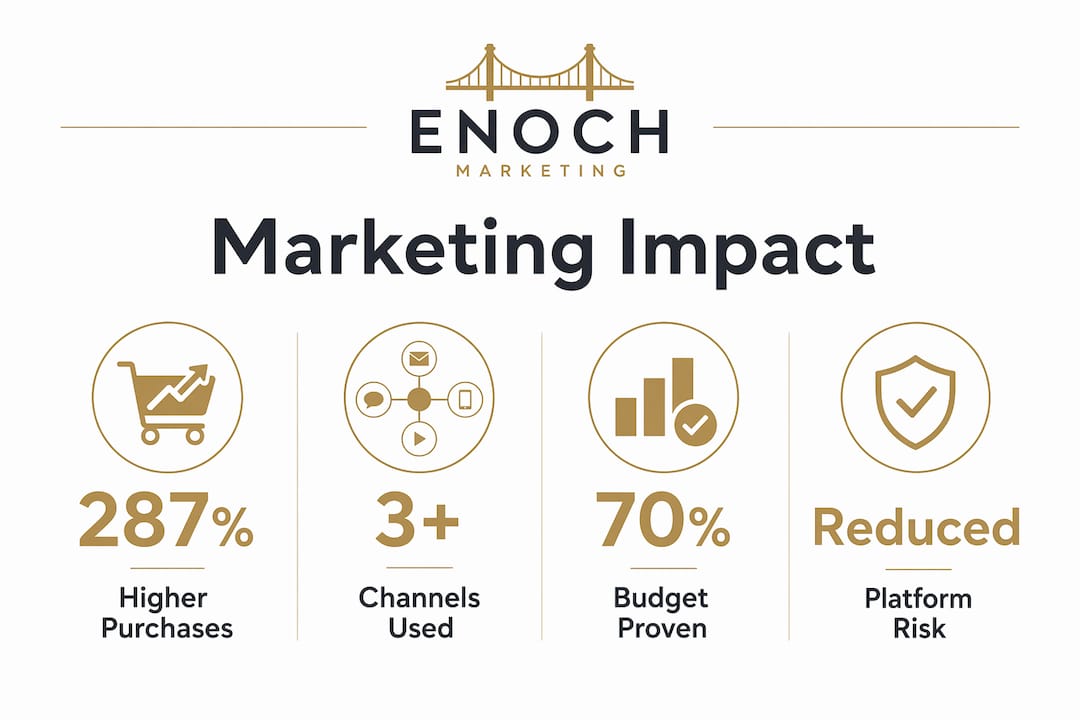
Diversifying your channel mix also reduces platform risk. If Meta changes its ad auction, or Google updates its algorithm, a business that relies entirely on one source of traffic feels the full impact. Spreading across channels means a disruption on one platform doesn't stop the whole operation.
Pro Tip: Don't just show up on multiple channels. Optimize each one for its native format. A Facebook video ad and a Google search ad serve completely different moments in the buyer's journey. Treating them as interchangeable wastes both.
Key benefits at a glance:
- Expanded reach across audience segments that prefer different platforms
- Higher purchase and retention rates with coordinated multi-channel presence
- Reduced platform dependency by diversifying traffic sources
- More customer touchpoints that build familiarity and trust over time
- Better data from multiple channels to inform smarter budget decisions
Challenges you'll face running a multi-channel strategy
Fragmented data is the most persistent headache. Each platform runs its own attribution model, and they rarely agree. Google Ads defaults to a 30-day last-click window, while Meta uses a 7-day click and 1-day view window. When both platforms claim credit for the same conversion, your reported ROI looks better than reality. Without a centralized analytics layer that normalizes these windows, you're making budget decisions on flawed data.
Resource dilution is the second major risk. Adding channels without adding budget or headcount means each channel gets less attention, and quality drops across the board. A poorly managed Instagram account or a stale email list can actively hurt brand perception rather than help it.
Maintaining consistent messaging across platforms is harder than it sounds. Each channel has its own tone, format, and audience expectation. What works as a punchy tweet falls flat as an email subject line. The challenge is adapting creative for each platform without letting the core brand message drift into something unrecognizable.
Common operational challenges:
- Attribution conflicts between platforms with different measurement windows
- Budget dilution when channel count grows faster than total spend
- Inconsistent brand voice when channel-specific teams operate without shared guidelines
- Campaign timing gaps when channels aren't coordinated on launch schedules
- Data silos that prevent a clear view of overall campaign performance
How to build a multi-channel marketing strategy that actually works
Start with two or three channels, not ten. Identify where your audience is most active and concentrate there first. Spreading across every available platform before you've mastered the core ones is how budgets get wasted and campaigns underperform.

Once you've chosen your core channels, develop channel-specific creative that still carries a unified brand voice. The visual identity, tone, and core offer should be recognizable across every platform, but the format and copy should fit each channel's native environment. This is what "variation within coherence" means in practice: your Instagram ad looks like an Instagram ad, not a screenshot of your email newsletter.
Apply the 70/20/10 budget framework deliberately. Put 70% of spend into the channels already delivering results, 20% into channels showing growth potential, and 10% into tests. That last 10% is where you find your next proven channel, but only after the 70% is working well.
Steps to execute:
- Audit your audience to identify which 2–3 platforms they use most actively
- Set channel-specific KPIs so each platform is measured on its own terms
- Build a shared brand guide covering voice, visual identity, and core messaging
- Create native content for each channel rather than repurposing the same asset
- Allocate budget using the 70/20/10 rule and review it quarterly
- Centralize your analytics in a single dashboard to normalize attribution data
- Scale channel count only as total marketing spend grows, not before
Avoid the temptation to add new channels because a competitor is using them. Add a channel when you have the budget, the creative resources, and a clear hypothesis about why it will reach your audience. Premature diversification is one of the most common reasons multi-channel campaigns underperform.
Which channels belong in a multi-channel marketing mix?
No single channel works for every business, but certain platforms consistently earn their place in a well-built strategy.
Email marketing remains one of the highest-ROI channels available. It's direct, personal, and you own the list. A well-segmented email sequence can move a prospect from awareness to purchase without any paid spend.
Paid search captures demand that already exists. When someone searches "CrossFit gym near me," a Google Ads campaign puts you in front of them at exactly the right moment. It's not about creating awareness; it's about being there when intent is highest.
Organic and paid social media serve different functions. Organic builds community and brand familiarity over time. Paid social, particularly on Meta platforms, excels at reaching new audiences with targeted creative. Both matter, and they work better together than either does alone.
Retail and physical locations remain powerful offline touchpoints, especially for fitness businesses. A gym's front desk, class schedule board, and member events are all part of the channel mix, even if they don't show up in a digital dashboard.
SMS and mobile messaging work best for time-sensitive communication: class cancellations, limited-time offers, event reminders. Open rates on SMS far exceed email, but the channel demands restraint. Overuse kills it fast.
Content marketing and display advertising build brand presence over time. A well-written blog post can drive organic search traffic for years. Display ads keep your brand visible to audiences who've already shown interest. Neither drives immediate conversions reliably, but both contribute to the longer purchase journey.
Each channel requires its own creative approach. A display ad and an SMS message serve completely different moments and mindsets. Treating them as the same medium produces weak results on both.
How fitness brands use multi-channel marketing to grow memberships
Fitness businesses face a specific version of the multi-channel challenge. Their audience is fragmented across Instagram, TikTok, Google Search, and local community platforms, and they often rely too heavily on referrals or a single social media account to drive new memberships. When that one channel slows down, so does growth.
CrossFit gyms, in particular, benefit from a multi-channel approach because their audience spans multiple demographics with different platform habits. A young adult discovering CrossFit might find the gym through a TikTok video, while a professional might click a Google search result. A local parent might see a Facebook event. No single channel captures all of them.
Multi-channel marketing for fitness brands isn't about being everywhere at once. It's about being present on the specific platforms where your local community already spends time, with messaging that speaks to why they should walk through your door rather than a competitor's.
A practical fitness multi-channel strategy might look like this: Google Ads targeting local search intent, Meta ads retargeting website visitors with a free trial offer, email sequences nurturing leads who downloaded a class schedule, and organic Instagram content showing real member results. Each channel operates independently but carries the same offer and visual identity.
The risk of single-platform dependency is real for fitness brands. A gym that built its entire lead pipeline on organic Facebook reach in 2018 felt the full weight of that platform's algorithm changes. Diversifying across channels protects against that kind of disruption and creates multiple entry points for new members.
Pro Tip: For fitness studios, local SEO and Google Business Profile optimization function as a channel in their own right. A prospect searching "CrossFit gym in [city]" who finds a well-maintained profile with recent reviews is already halfway to booking a trial class.
Enochmarketing works specifically with CrossFit gyms and fitness brands to build these kinds of coordinated channel strategies. The approach starts with identifying which 2–3 channels are already driving results, then building out the creative and paid infrastructure to scale them before adding new platforms. You can explore how that process works for fitness marketing services or read more about fitness studio channel selection to see which platforms are performing best for gyms in 2026.
Key Takeaways
Multi-channel marketing works when you concentrate on the right channels first, maintain consistent messaging across all of them, and use centralized data to measure what's actually driving results.
| Point | Details |
|---|---|
| Start with 2–3 channels | Focus budget and creative on the platforms where your audience is most active before expanding. |
| Use the 70/20/10 rule | Allocate 70% to proven channels, 20% to scaling ones, and 10% to experiments. |
| Normalize your attribution data | Different platforms use different measurement windows; centralize analytics to get accurate performance data. |
| Adapt creative, not the message | Keep the core brand message consistent while tailoring format and tone to each channel's native environment. |
| Multi-channel vs. omnichannel | Multi-channel runs independent channel operations; omnichannel connects them into a unified customer journey. |