
If you're still thinking about omni-channel marketing for fitness as just "being on Instagram AND sending emails," you're leaving real money on the table. Omni-channel isn't about showing up everywhere independently. It's about creating one connected experience that follows your members from Instagram to your website to your gym floor and back again. Fitness businesses that get this right see dramatically higher engagement, stronger retention, and more revenue per member. This guide breaks down exactly what omni-channel means for gyms, why it works, and how to build it without losing your mind.
Table of Contents
- Key takeaways
- What is omni-channel marketing for fitness businesses
- Why omni-channel marketing drives better results for fitness brands
- Building the technology stack for omni-channel fitness marketing
- Mapping member journeys for omni-channel success
- Common mistakes when implementing omni-channel in fitness
- My take on omni-channel after years in fitness marketing
- How Enochmarketing helps fitness brands execute this
- FAQ
Key takeaways
| Point | Details |
|---|---|
| Integration beats presence | Omni-channel connects all channels into one experience, while multichannel just maintains separate ones. |
| Data is the foundation | Unified member data prevents fragmented experiences and powers personalized communication at every stage. |
| Members spend more | Omni-channel customers in fitness spend 1.5x more per month than single-channel members. |
| Channel roles matter | WhatsApp, SMS, and email each serve different purposes and should not be used interchangeably as blast tools. |
| Start phased, optimize always | Implement channels gradually, measure results by member journey stage, and adjust before scaling. |
What is omni-channel marketing for fitness businesses
At its core, omni-channel marketing means creating a single, unified experience across every touchpoint a member or prospect encounters. Your app, your front desk, your email sequences, your social ads, your text messages. They all pull from the same member data and tell the same story.
That's fundamentally different from multichannel marketing, which most gyms already do. Multichannel vs. omni-channel comes down to one word: integration. Multichannel means you're present on several platforms. Omni-channel means those platforms talk to each other and respond to your members as individuals.
Here's a quick comparison that makes the distinction concrete:
| Multichannel | Omni-channel |
|---|---|
| Channels operate independently | Channels share data and context |
| Member repeats information each time | Member history travels with them |
| Campaigns are platform-specific | Messaging adapts based on behavior |
| Success measured per channel | Success measured by customer journey |
| Siloed team responsibilities | Integrated marketing workflows |
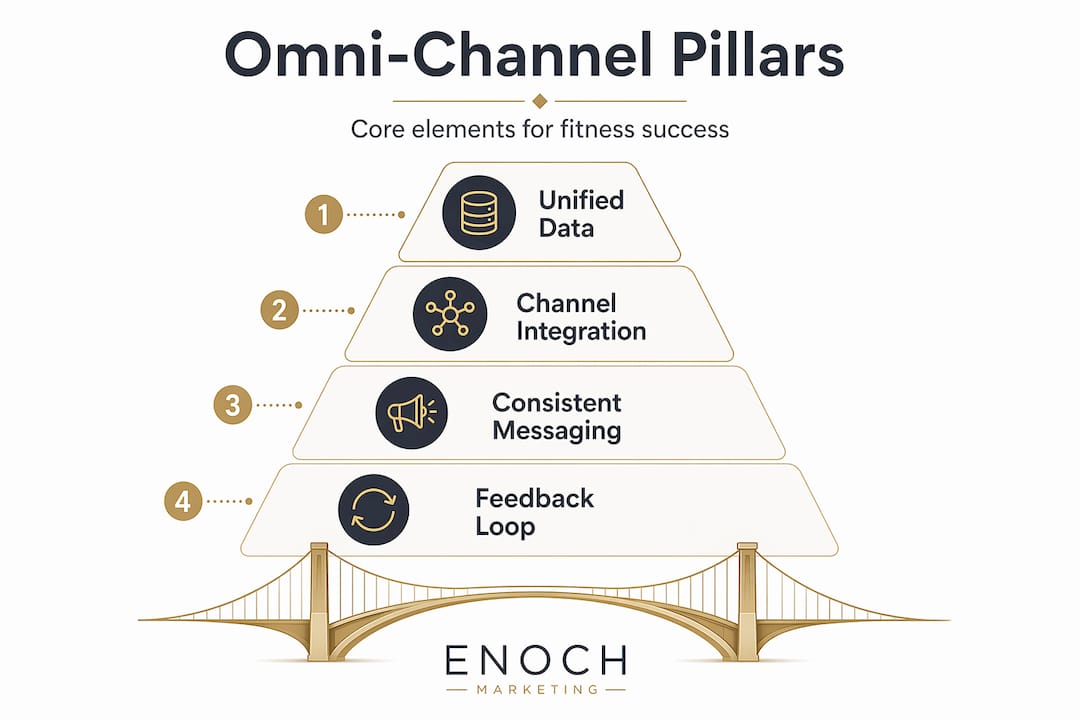
The four pillars that hold omni-channel together are unified customer data, channel integration, consistent messaging, and ongoing optimization. For a gym or fitness studio, that means your CRM knows when a member missed three classes, your email system sends a check-in automatically, and your front desk staff sees that context when the member walks in. The member never has to explain themselves. That's the experience people pay to keep.
Why omni-channel marketing drives better results for fitness brands
The business case is clear, and the numbers back it up. Omni-channel customers spend 1.5 times more per month than members who only interact through a single channel. More touchpoints create more commitment, and more commitment creates more revenue.
Retention is where the financial impact really compounds. 20% of gym members quit due to exhaustion or stress, 15% cite lack of time, and 7% dislike their experience. Each of these is a solvable problem with the right omni-channel touchpoints. A member showing signs of burnout gets a recovery-focused email. A time-strapped member gets an SMS with your new 6 AM class opening. A member who had a bad experience gets a personal follow-up call triggered by their feedback score.
The benefits that matter most to gym owners include:
- Higher monthly revenue per member through cross-sells and upsells delivered at the right time
- Lower churn rates by catching at-risk members before they ghost
- Better lead conversion because prospects receive consistent, relevant messaging across ads, email, and follow-up calls
- Stronger brand loyalty because members feel recognized, not marketed to
The best customers interact across multiple channels and demonstrate higher loyalty and value. That's not coincidence. Multiple touchpoints build a relationship, and relationships keep people enrolled.
Pro Tip: Before you add a new channel to your marketing mix, ask yourself: "Will this connect to our existing member data?" If it can't share data with your CRM, it adds complexity without adding the experience upgrade that makes omni-channel worth it.
Email marketing for fitness is one of the highest-return channels in the mix. Research shows email can yield approximately $36 for every $1 spent in the fitness space. That number only climbs when email is coordinated with your other channels instead of operating in isolation.
Building the technology stack for omni-channel fitness marketing
Good omni-channel strategy runs on good data infrastructure. Your CRM or customer data platform is the central engine. Every interaction, including class check-ins, purchases, app logins, and email opens, should feed into one member profile. Unified customer data platforms prevent members from repeating their history to every staff member they talk to. That alone changes how members perceive your gym.
Here's a practical breakdown of how to assign channels in a fitness context:
- Mobile app handles class booking, progress tracking, and push notifications for schedule updates. It's where members go proactively.
- Email manages low-urgency communication: welcome sequences, monthly newsletters, billing receipts, and long-form onboarding. This is where automated email and SMS workflows save you hours every week.
- SMS is for urgent, time-sensitive messages: class cancelations, flash promotions, and appointment reminders. Short, direct, and infrequent.
- WhatsApp works for warm, conversational outreach. New leads, personal check-ins, and relationship-building with prospects who haven't committed yet.
- Social media drives awareness and retargeting. It's the top of the funnel, not where you close memberships.
- In-gym touchpoints including kiosks, staff conversations, and signage, complete the physical side of the experience.
Channel-specific roles matter because members choose channels based on context. WhatsApp for warm interaction, SMS for urgent alerts, email for onboarding and low-urgency content. Blasting the same message across all three doesn't just feel lazy. It trains members to ignore you.
Pro Tip: AI-driven Meta campaigns can reduce cost-per-acquisition by 15 to 25% and increase reach three to four times within 14 days compared to manual targeting. Use AI for paid acquisition at the top of your funnel, and reserve human-written messaging for the relationship-building stages.
Mapping member journeys for omni-channel success
Understanding what your member actually experiences at every stage is the step most gym owners skip. They build the technology stack, then wonder why engagement is flat. The problem is usually that the channels aren't aligned to the real member journey.
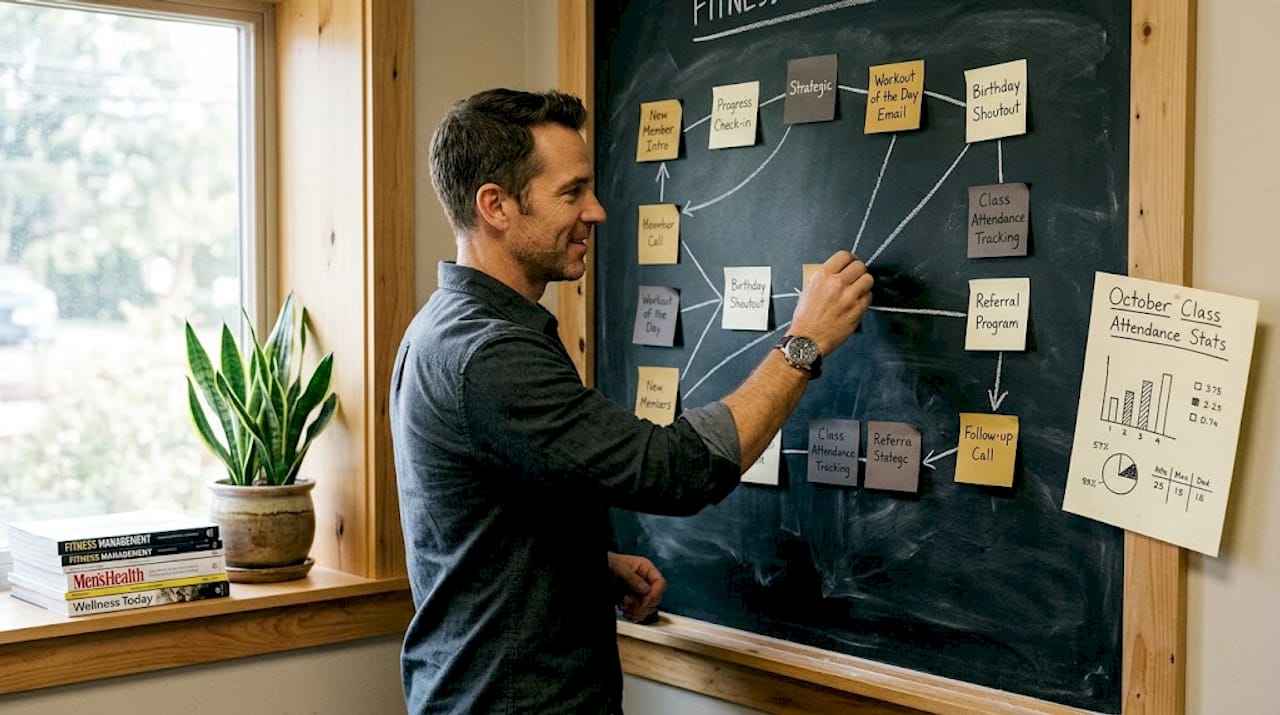
Map every touchpoint across the member lifecycle: discovery, consideration, conversion, onboarding, engagement, and retention. At each stage, ask three questions. What does the member need right now? What channel are they most likely using? What does success look like at this step?
The most common friction points to address through personalized fitness marketing include:
- Booking friction: A prospect sees your ad, visits your site, but can't book a free trial in under 60 seconds. You lose them. Fix this with one-click booking tied directly to your CRM.
- Silent onboarding: A new member signs up, receives a generic welcome email, and hears nothing for two weeks. Use a multi-step email and SMS sequence tied to their first class date.
- Invisible milestones: Members who hit 30 days, 60 days, or their first PR never get acknowledged. Automate milestone recognition through your app or email.
- Poor re-engagement: Members who drop off get nothing until their card fails. Set a behavioral trigger at three missed classes that fires a personal outreach via WhatsApp or a staff call.
Customers prefer to interact in the channel best suited to their current need. Your job is to anticipate that need and be ready in the right place. Real-time data from your CRM and booking platform makes this possible without requiring your staff to manually monitor every member.
Common mistakes when implementing omni-channel in fitness
Most gyms don't fail at omni-channel because the strategy is wrong. They fail because of execution errors that are entirely avoidable.
The most damaging mistakes include:
- Treating channels as independent silos. Each platform has its own team or vendor with no shared data. The member experience is disjointed and the marketing is redundant.
- Sending the same message everywhere. Mass blasting a promotion via email, SMS, and push notification simultaneously trains members to tune you out.
- Over-automating without human fallback. Over-automation harms retention when there's no human available to handle edge cases, complaints, or complex conversations.
- Ignoring speed-to-lead. Leads engaged within the first five minutes via automated multi-channel responses convert at dramatically higher rates. Waiting hours or days to follow up kills conversions that would otherwise be easy wins.
- Building everything at once. Launching five new channels simultaneously creates operational chaos. Start with two or three well-integrated channels and expand from there.
Pro Tip: Run a simple audit before any new campaign: follow the exact path a brand-new prospect would take from seeing your ad to booking a class. Every broken link, confusing page, or delayed response is a conversion killer. Fix those before you spend another dollar on ads.
Sustainable omni-channel programs in fitness are built in phases. Month one is about data infrastructure and CRM setup. Month two is adding one or two automated sequences. Month three is layering in paid channels tied to that data. Omni-channel marketing is shifting fitness businesses from channel-focused metrics to member journey-focused metrics, and that shift takes time to execute well.
My take on omni-channel after years in fitness marketing
I've reviewed dozens of gym marketing setups, and the pattern is almost always the same. The gym is on Instagram, has an email list, runs some Google ads, and maybe sends the occasional text. Everything looks like omni-channel from the outside. But when I dig in, none of it talks to each other. The email platform doesn't know who clicked the ad. The front desk doesn't know who opened the welcome sequence. The member feels like a stranger every single time they interact with the brand.
What I've learned is that the technology is almost never the problem. The mindset is. Most gym owners think about marketing as campaigns. Omni-channel requires thinking about it as a relationship. And relationships don't get paused between campaigns.
I've also seen gyms dramatically overthink this. You don't need ten channels perfectly integrated on day one. You need your CRM, your email, and one real-time channel like SMS or WhatsApp, all pulling from the same member data. That alone puts you ahead of 90% of the market. The sophistication comes later, after you've built the foundation and know what your members actually respond to.
The gyms I've seen win with omni-channel aren't the ones with the biggest budgets. They're the ones who treat every touchpoint as a chance to make a member feel known.
— Collin
How Enochmarketing helps fitness brands execute this
If the omni-channel strategy described above sounds like exactly what your gym needs but you're not sure where to start, Enochmarketing was built for this.
Enochmarketing works exclusively with CrossFit gyms and fitness brands across the United States, which means the strategies, tools, and workflows we build are designed for your specific business model and member base. From paid media and lead generation to email automation, local SEO, and full-stack omni-channel campaign management, Enochmarketing handles the pieces that most gym owners don't have time to learn. The work is performance-focused, built around your actual membership growth goals, and backed by real experience in the fitness sector. If you're ready to stop guessing and start growing, book a free strategy session to see what a real omni-channel system looks like for your gym.
FAQ
What is the difference between omni-channel and multichannel marketing for gyms?
Multichannel marketing means your gym operates on multiple platforms separately, while omni-channel connects all those platforms through shared member data to create one continuous, personalized experience.
How much more do omni-channel fitness customers spend?
Research shows that omni-channel customers spend 1.5 times more per month than members who only engage through a single channel, making integration directly tied to revenue.
What channels should a gym prioritize in an omni-channel strategy?
Start with a solid CRM, email automation, and one real-time channel such as SMS or WhatsApp. Add social media retargeting and a mobile app once the core data infrastructure is in place.
How quickly should gyms follow up with new leads?
Leads contacted within the first five minutes via automated multi-channel responses convert at significantly higher rates, so automated immediate follow-up is not optional in a competitive market.
Can small gyms realistically implement omni-channel marketing?
Yes. Start with two or three well-connected channels before expanding. A CRM tied to email and SMS automation is enough to outperform most competitors and delivers measurable results without a large budget.