
The highest-impact ways to showcase gym culture are: coach-modeled behavior, cohorted programming, visible member recognition, facility branding and visual cues, public community events, and consistent social media content. Get those six right and you will see trial-to-paid conversion climb and first-30-day retention hold.
Start here within the next 72 hours:
- Today: Have every coach post a workout photo or PR on your gym's Instagram story and pin it to your profile.
- Day 2: Write three member names on a whiteboard PR board at the front of your floor. Photograph it.
- Day 3: Send a personal text to every member who joined in the last 30 days. No pitch. Just check in.
The single metric to watch first: first-30-day retention rate. If a new member attends at least three times in their first month, they are far more likely to stay past month three. Everything below is designed to move that number.
Key Takeaways
Showcasing gym culture consistently, through coach behavior, cohorted programming, visible recognition, and regular content, is the most reliable path to improving both trial-to-paid conversion and long-term member retention.
| Point | Details |
|---|---|
| Coaches are the culture | Hire coaches who train publicly and celebrate members by name; their behavior sets the standard. |
| Engineer the first friendship | Assign new members to a recurring cohort and send a personal text on day 7 to reduce early cancellations. |
| Recognition drives referrals | A PR board, Member of the Month, and weekly shout-outs convert culture into visible social proof that attracts similar members. |
| Track first-30-day retention first | This single metric signals whether your onboarding and community rituals are working before churn becomes visible. |
| Enochmarketing executes the strategy | The agency handles content, paid ads, local SEO, and referral funnels built specifically for CrossFit gyms and fitness studios. |
Table of Contents
- Why visible gym culture drives sign-ups and retention
- How staff behavior sets the cultural tone
- How your facility communicates culture before anyone speaks
- Programming and rituals that make culture stick
- How to spotlight members and build social proof
- Events that make your culture visible to non-members
- How to showcase culture online: content, cadence, and sample posts
- Turn culture into a referral and loyalty engine
- What to track: KPIs and measurement routines
- Your 30–90 day rollout checklist
- The culture lever most gym owners underestimate
- Enochmarketing turns gym culture into membership growth
- Sources
Why visible gym culture drives sign-ups and retention
Culture you can see and feel does something that a discount offer cannot: it signals belonging before a prospect ever pays. When someone walks into your gym and sees coaches training alongside members, a PR board covered in names, and photos of real people on the walls, they are not reading a brochure. They are watching social proof operate in real time.
The mechanism is straightforward. Belonging reduces perceived risk. When a prospect sees that people like them are already thriving at your gym, the mental barrier to signing up drops. That same sense of belonging is what keeps existing members from quietly canceling when life gets busy. According to Nutripy's retention research, members who received a timely personal "commitment interaction" were significantly less likely to cancel in the following month. That figure comes from a single reported example, but the direction is consistent with what gym operators see repeatedly: small, personal gestures beat big one-off events for retention.
Referral rates follow the same logic. Members who feel genuinely connected to a community bring people who are like them. That self-selection keeps your culture coherent as you grow.
How staff behavior sets the cultural tone
Coaches are the primary cultural vector. Not your logo. Not your website. Your coaches. The PTDC's analysis of gym culture makes this explicit: coaches who model the desired behavior and openly celebrate members act as the primary cultural anchor for a facility. Hire and train for that, and the rest of your culture work gets easier.

What to look for when hiring
Screen for three things beyond certifications:
- Authenticity: Does this person actually train? Ask to see their training log or recent PRs. A coach who doesn't train publicly sends a quiet but powerful signal that fitness is a job, not a practice.
- Public recognition habit: In the interview, ask them to describe the last time they celebrated a member's progress. The best coaches recall specific names and moments without hesitation.
- Comfort with vulnerability: Culture-building coaches share their own struggles. Ask how they handle a bad training day in front of members.
Onboarding and ongoing training
New coaches should shadow a senior coach for at least two weeks before leading a class solo. Monthly coach meetings should include one agenda item on culture: a recent member win to celebrate, a behavior to reinforce, and a short debrief on what's working. Keep it to 20 minutes. Consistency matters more than depth here.
Reward coaches publicly. Post their PRs on your social channels. Give them a "coach spotlight" month. Commission structures tied to member retention (not just new sign-ups) align financial incentives with cultural ones.
Pro Tip: Schedule one "coach workout" session per week where coaches train together on the gym floor during open hours. Members notice. It signals that your coaches are practitioners, not just instructors, and it creates natural conversation between coaches and members who are training at the same time.
How your facility communicates culture before anyone speaks
Your floor layout, signage, and walls communicate who belongs at your gym before a coach says a word. A cluttered front desk with no member photos says "transactional." A hero wall covered in before-and-afters, a chalk PR board, and a coach's handwritten programming note on the whiteboard says "community."
Here is a practical shot list for photos you should have on your walls and online:
- Full class energy mid-WOD (wide shot, real sweat, no posing)
- Coach coaching: hands-on correction, eye contact with a member
- PR board close-up with a member pointing at their name
- Post-class group photo with coaches included
- Behind-the-scenes: coaches setting up equipment before 5 AM class
For your physical space, run through this checklist:
- Front desk: Member photos visible, not just promotional flyers
- Hero wall: At least 6 member transformation or milestone photos, updated quarterly
- Whiteboard: Daily programming written by hand, coach name included
- PR board: Erasable, updated weekly, visible from the entrance
- Merch display: Branded apparel placed near the front, not buried in a corner
Small physical gestures matter too. A chalk bowl near the barbell rack, a water cooler with your logo, branded coffee available at the front desk. These details add up. Branded coffee, for example, can reinforce community identity while generating modest additional revenue. For apparel, small-batch branded gym wear gives members a visible way to carry your culture outside the building.
Programming and rituals that make culture stick
Repeatable rituals and cohorted schedules create the familiarity that turns members into a community. A member who sees the same 10 faces every Tuesday and Thursday at 6 AM will build friendships. A member who drops into random classes never will.
An onboarding flow that engineers first friendships
- Greet by name at the door on day one. Coach introduces the new member to two existing members before class starts.
- Assign to a cohort: Place new members in a recurring beginner or foundations class for their first four weeks. Same time, same group.
- Follow up personally on day 7 and day 30. A text from the coach, not an automated email, asking how they feel and what they have noticed.
This three-step sequence is the core of what Nutripy describes as a retention system: engineer one introduction per newcomer, funnel them into a recurring cohort, and follow up personally.
Rituals that build visible culture
- Monthly PR board reset with a celebration class
- Membership anniversary shout-outs (posted on social and announced in class)
- Coach-led micro-competitions: a monthly skill challenge with a simple leaderboard
- "Bring a friend" Saturdays: one Saturday per month where members can bring a guest at no charge
Consistent class times beat a fully flexible drop-in model for community-building. When members know that "the 6 AM crew" exists as a real social group, they protect that time slot. Flexibility is a selling point; consistency is a retention tool.
How to spotlight members and build social proof
Public recognition converts culture into social proof that attracts similar members. When a prospect sees a real person's name on your PR board or reads a genuine member story on Instagram, they are not seeing marketing. They are seeing evidence. Public recognition and member spotlights reduce churn and generate referrals when members consent to being featured.
Recognition formats that work
- PR board: Physical, updated weekly, photographed and posted online
- Member of the Month: One member featured on your website, social channels, and in-gym signage. Rotate the criteria (longest streak, biggest PR, most improved, most helpful to others).
- Weekly shout-outs: Coach calls out two or three members by name at the end of each class. Takes 30 seconds. Costs nothing.
A simple testimonial process
Before sharing any member story or photo publicly, get written consent. A one-sentence text confirmation works: "Hey [name], I'd love to share your story/photo on our Instagram. Totally fine to say no — just let me know!" Screenshot and save it.
For a written testimonial, ask three questions: What were you struggling with before you joined? What changed? What would you tell someone who's on the fence? Those three answers, lightly edited, produce a more compelling story than any marketing copy you could write.
To keep recognition from feeling staged, build a cadence: Member of the Month announced on the first Monday, weekly shout-outs every Friday class, PR board updated every Sunday. Predictability makes it feel like a real tradition rather than a promotional campaign. Member success stories, collected and shared this way, are among the most reliable drivers of gym growth.

Events that make your culture visible to non-members
The right public events create grassroots visibility that paid ads rarely replicate. A free Saturday park bootcamp reaches people who would never click a Facebook ad. A charity WOD brings in community members who want to give back. Both create a first impression of your culture that no landing page can match.
Event formats worth running:
- Free park bootcamp: Monthly, 45 minutes, no equipment required. End with a clear next step: "We're running a free two-week trial for anyone who wants to keep going."
- Charity WOD: Partner with a local nonprofit. Members pay a small entry fee that goes to the cause. Promotes itself through the nonprofit's own channels.
- Beginner workshop: A 90-minute Saturday session covering foundational movements. Converts well because attendees self-select as serious.
- Employer open day: Partner with a local company to offer a free class for their team. One converted employee often brings colleagues.
Free outdoor fitness events and local partnerships create organic visibility and drive qualified leads when paired with a clear next-step offer. The offer matters as much as the event itself.
Post-event follow-up is where most gyms leave retention on the table. Within 24 hours of any event, send a personal message to every attendee who gave you their contact information. Invite them to a specific class at a specific time. Not "come check us out." "We have a foundations class at 9 AM Saturday. Want me to save you a spot?"
How to showcase culture online: content, cadence, and sample posts
Consistent, member-led content that shows real moments converts better than polished promotional posts. A shaky iPhone video of a member hitting a PR gets more genuine engagement than a studio-produced ad. Behind-the-scenes posts, trainer introductions, PR boards, and member-focused content are high-value, repeatable formats that build trust and local discovery on Instagram and TikTok.
A 4-week content calendar
| Week | Monday | Wednesday | Friday | Saturday |
|---|---|---|---|---|
| 1 | Coach intro Reel (30 sec, personality-driven) | Member PR video or photo | Behind-the-scenes: 5 AM setup | Event highlight or class energy photo |
| 2 | "How we coach [movement]" teach clip | Member of the Month post | Coach training alongside members | Community photo: post-class group |
| 3 | Programming explainer (why we do this) | Member testimonial (text + photo) | PR board close-up | Throwback: member progress over 6 months |
| 4 | Coach Q&A story series | Beginner tip video | Weekly shout-out post | Event preview or recap |
Platform tactics
Instagram: Use Reels for reach, carousels for saves, and Stories for daily behind-the-scenes. Your Google Business Profile benefits from the same photos. Profiles with many recent photos receive substantially more calls and website visits, so upload new GBP photos at least twice a month.
TikTok: Personality-driven clips outperform polished content. Coach-led "day in the life" videos, reaction clips to member PRs, and quick movement tips perform well with no production budget.
For paid ads, short testimonial clips (15–30 seconds, member speaking directly to camera) and event-driven offers ("Free Saturday class this weekend — link in bio") outperform generic gym ads. Keep captions under 150 characters for feed posts. Always include location tags and relevant local hashtags (#[CityName]CrossFit, #[CityName]Fitness).
A proven social media strategy for gym memberships pairs this organic content with targeted paid campaigns to amplify reach beyond your existing followers.
Turn culture into a referral and loyalty engine
Referrals from engaged members are the cheapest, highest-fit leads you will ever get. Design offers that reward cultural participation, not just discounts.
Sample referral structures:
- Bring-a-friend trial: Referring member gets one free month add-on when their friend completes a 30-day trial. Friend gets the trial free. Both parties win.
- Tiered referral rewards: 1 referral = branded merch. 3 referrals = one free month. 5 referrals = a named spot on the PR board or a "founding member" badge.
- Culture-tied rewards: Members who attend a community event AND refer a friend get a bonus reward. This ties the referral program to cultural participation, not just transactions.
For automation, use your gym management software (Wodify, Mindbody, or similar) to tag referring members and trigger a thank-you message when their referral converts. A personal text from the head coach at that moment costs nothing and lands differently than an automated email.
Loyalty tiers can reinforce cultural milestones rather than just purchase history. A member who hits their one-year anniversary gets a public shout-out, a small gift, and a "veteran member" badge on your app or member portal. Tiered gym loyalty programs that recognize milestones keep long-term members feeling seen. For a deeper look at referral program structures, gym referral programs that actually work covers sample offers and automation recommendations in detail.
What to track: KPIs and measurement routines
Measure a handful of direct signals: retention rate, attendance frequency, referral rate, social engagement, and trial-to-paid conversion. Those five tell you whether your culture work is producing business results.
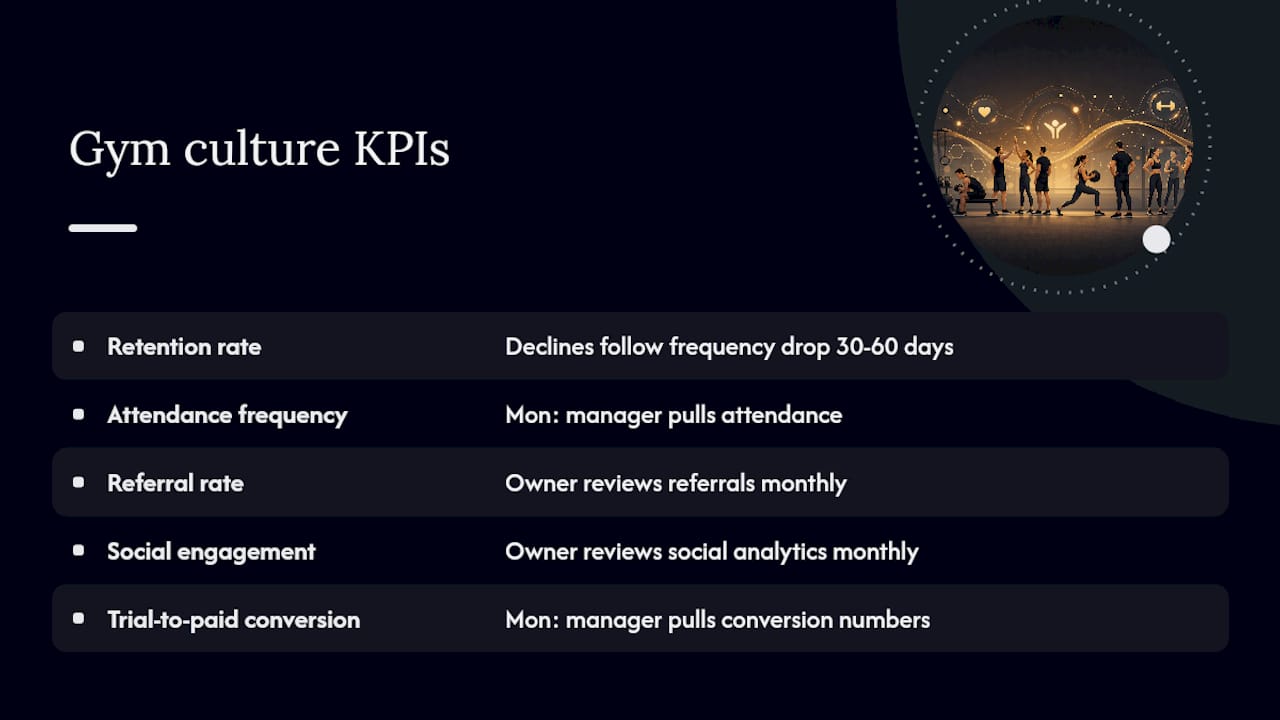
Measurement routine: Every Monday morning, the manager pulls attendance and conversion numbers from the gym software. The head coach reviews the member list for anyone who attended fewer than twice in the past two weeks and sends a personal check-in. Once a month, the owner reviews referral source data and social analytics together.
When a KPI dips, start with attendance frequency. A drop there usually precedes cancellations by 30–60 days. If frequency drops, check whether the cohort schedule has been disrupted, whether a coach has changed, or whether recognition rituals have slipped. Fix the operational cause before running a promotion.
Your 30–90 day rollout checklist
A lean 30–90 day plan focusing on the highest-impact moves first will produce visible results without overwhelming a small team.
Days 1–30: Build the foundation
- Owner: Audit the facility. Install or refresh the PR board, hero wall, and coach photos. Order branded merch if you don't have it.
- Head coach: Run the first "coach workout" session on the floor during open hours. Post it.
- Head coach: Implement the three-step onboarding flow (greet, cohort assign, day-7 text) for every new member going forward.
- Manager: Pull your first-30-day retention rate as a baseline. Record it.
- Marketing: Post three times per week using the content calendar above. Prioritize member PRs and coach personality content.
Days 31–60: Add recognition and events
- Owner: Launch Member of the Month. Announce the first recipient in class and on social.
- Head coach: Start monthly PR board reset celebration.
- Manager: Plan and promote your first free public event (park bootcamp or beginner workshop). Set a date 3–4 weeks out.
- Marketing: Set up a referral tracking tag in your gym software. Draft the bring-a-friend offer.
- All coaches: Begin weekly in-class shout-outs every Friday.
Days 61–90: Measure, adjust, and scale
- Owner: Review the KPI dashboard. Compare first-30-day retention to baseline.
- Head coach: Debrief the first public event. How many attendees gave contact info? How many converted to a trial?
- Manager: Launch the referral program formally. Send an email and text to your full member list.
- Marketing: Run a short testimonial ad on Meta using the best member story from the past 60 days.
- Owner: Hold a 30-minute coach culture meeting. Review one win and one behavior to reinforce.
The culture lever most gym owners underestimate
The most reliable culture lever is not a big event or a polished content calendar. It is the engineered introduction: one coach, one new member, two existing members, before the first class starts.
Gyms that build this into their standard operating procedure, and then follow it with a personal text on day seven, consistently outperform gyms that rely on class energy alone to create connection. The math is simple. A new member who knows two people by name after their first week has a social reason to come back. One who doesn't is just a customer.
The anecdote that stays with me from working with lean gym operations: a two-coach box in a mid-size market cut its 90-day cancellation rate meaningfully by doing exactly three things. They assigned every new member to a specific 6 AM cohort for their first month. The head coach sent a personal text on day seven. And they put the new member's name on the PR board after their first benchmark workout, even if the score wasn't impressive. No new ad spend. No redesign. Just three small moves, done consistently.
The operators who see the fastest retention gains are not the ones who run the most events. They are the ones who make every new member feel known within the first two weeks.
Enochmarketing turns gym culture into membership growth
Most gym owners know their culture is their best asset. The gap is execution: turning authentic moments into content, ads, and local visibility that consistently bring in new members.
Enochmarketing specializes exclusively in CrossFit gyms and fitness studios across the United States, which means every service is built around how fitness communities actually grow. The agency handles social media content development (including the kind of member-spotlight and coach-personality content described above), Meta and Google paid campaigns, local SEO and Google Business Profile management, referral funnel setup, and event amplification. No generalist agency learning curve. No long-term contracts locking you in before results appear.
If you want a team that already knows how to translate your gym's culture into measurable membership growth, review Enochmarketing's service packages and pricing and book a free strategy session.
Sources
- Be the change to a better gym culture — The PTDC
- How to grow gym memberships via gym culture — Clover Blog
- Building gym community culture: A retention system — Nutripy
- Local marketing for gyms: Google, community & partnerships — Rework Resources