
The fastest way to fill a gym challenge is to combine team accountability, a frictionless signup funnel, and a 3–4 week multichannel pre-launch. That combination consistently outperforms a single announcement posted to Instagram the week before. Here are the channels and mechanics to prioritize first:
- In-gym staff asks: A coach mentioning the challenge during class converts better than any ad.
- Email sequence: Five emails from teaser to final call, spaced across three weeks.
- Meta Reels: Short coach-led clips with a direct signup link in bio or Stories.
- Local micro-influencers: Partner with one or two local creators for authentic trial-pass offers.
Run two to four major challenges per year, with one- to two-week mini-challenges between them to maintain momentum. Research confirms that running challenges twice a year avoids fatigue while still driving registrations and engagement.
Key Takeaways
Team formats, a 3–4 week phased pre-launch, and a 7–10 day post-challenge conversion offer are the three mechanics that separate a challenge that builds membership from one that just fills a class.
| Point | Details |
|---|---|
| Choose team format | Team challenges deliver 20–40% higher enrollment and 15–20% better 90-day retention than solo formats. |
| Launch pre-launch 4 weeks out | A phased announce-educate-prove-close campaign converts better than a single announcement post. |
| Use 5-email sequence | Teaser, overview, proof, early-bird, and final-call emails drive signups across the registration window. |
| Track conversion within 7–10 days | The window right after a challenge ends is when non-members are most likely to convert to paid memberships. |
| Enochmarketing runs the system | Enochmarketing builds Meta ads, funnels, and email sequences specifically for CrossFit gyms and fitness studios. |
Table of Contents
- What are the best ways to promote gym challenges fast?
- Which channels actually drive gym challenge signups?
- How do incentives and team formats affect participation?
- What KPIs should you track for a gym challenge?
- A 6-week promotion and engagement calendar you can copy
- Ready-to-copy templates for every channel
- Why promotion strategy beats luck every time
- Enochmarketing builds the promotion engine for your next challenge
- Sources
What are the best ways to promote gym challenges fast?
You can launch a credible challenge in a single afternoon with the right setup sequence. Here is the 90-minute path from idea to live signup:
- Choose your theme (10 min): Pick one format: a 4–6 week transformation, a team step challenge, or an attendance streak. Team formats deliver 20–40% higher enrollment and 15–20% better 90-day retention than solo formats.
- Build your landing page (20 min): Use a simple form with name, email, and payment. Make signup and payment happen in one step and set a hard registration deadline to push conversions.
- Set up your tracker (10 min): A Google Sheet works for under 30 participants. For larger groups, Trainerize or Strava handle progress tracking and keep participants accountable without manual follow-up.
- Build a 5-email sequence in Mailchimp (20 min): Teaser, overview, social proof, early-bird offer, final call. Schedule them before launch day.
- Create 3 social posts (10 min): One teaser Reel, one overview post, one countdown story. Schedule them in Meta Business Suite.
- Print in-gym signage and brief staff (10 min): One poster with a QR code to the signup page. Tell every coach to mention it in class for the next two weeks.
Pro Tip: Use Trainerize to automate participant onboarding. When someone pays and registers, Trainerize can send their welcome message, program access, and first check-in prompt automatically, cutting your admin time to near zero.
Challenges are one of the strongest lead-generation tools a gym has, and filling them only with existing members leaves conversion revenue on the table.
Which channels actually drive gym challenge signups?
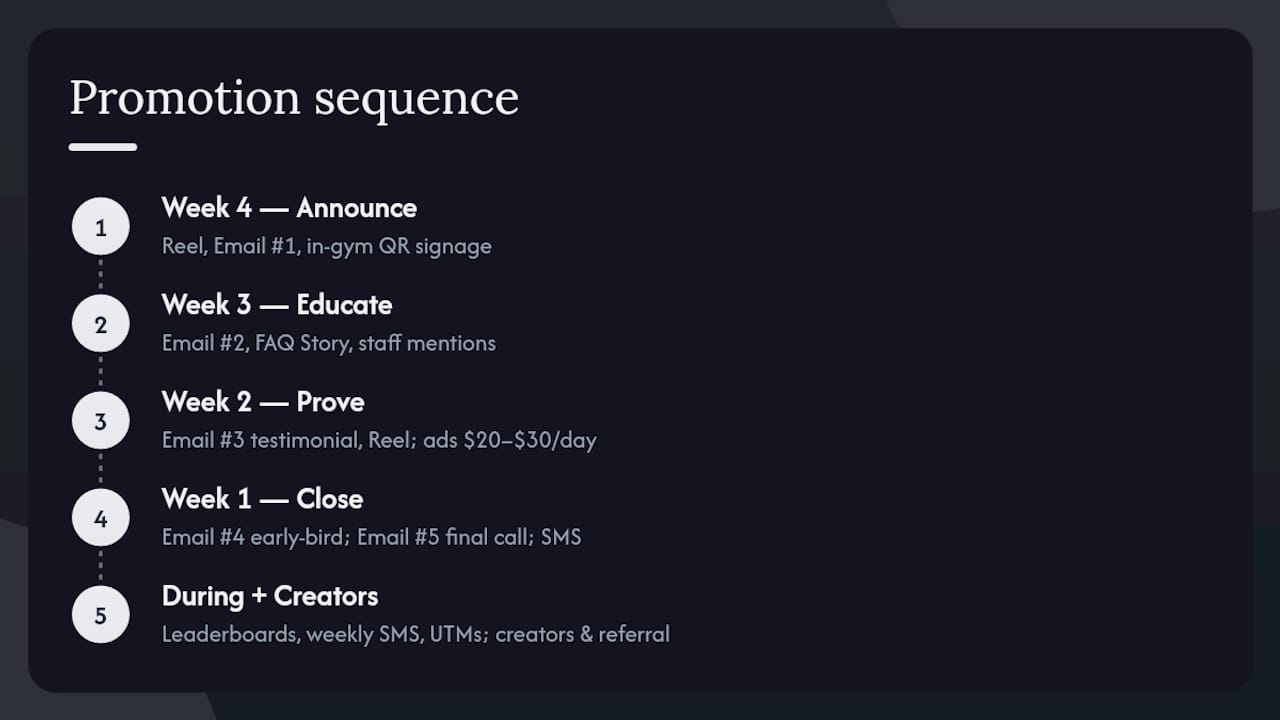
Channel selection matters less than sequencing. A phased four-step campaign (announce, educate, prove, close) over a 3–4 week runway consistently converts better than a single launch post. Here is how to run it:
Week 4 (pre-launch teaser): Post one Reel of a coach explaining the challenge concept. Send email #1 with subject line: "Something big is coming to [Gym Name]." Put up in-gym signage with a QR code.
Week 3 (educate): Email #2 covers format, duration, and what participants actually do. Post a FAQ-style Story. Staff should mention it in every class.
Week 2 (prove): Email #3 features a past participant result or a coach testimonial. Run a Meta Reel with a direct CTA. This is the week to launch paid ads. Meta and short-form Reels are the highest-impact paid discovery channels for gyms; a $20–$30 daily budget on a well-targeted Reel can materially increase reach without a large spend.
Week 1 (close): Email #4 is the early-bird offer. Email #5 is the final-call reminder sent 48 hours before registration closes. Send one SMS to your existing member list: "Last 48 hours to join [Challenge Name]. Spots are limited. Sign up here: [link]."
During the challenge: Post weekly leaderboard updates, member shoutouts, and mid-challenge Reels. Send one SMS per week as a progress nudge. Use UTM parameters on every link so you can see exactly which channel drove each signup.
Local micro-influencers with authentic followings often outperform paid ads on cost-per-trial. A creator with 3,000 engaged local followers promoting a free-pass offer can generate 15–30 trial signups at a fraction of what Meta charges per lead. Budget $200–$500 for one or two creator posts and give them a unique signup link to track results. For more on short-form video and posting cadence, the social media strategy guide from Enochmarketing covers the creative formats that work best for gyms.
Starting promotion 3–4 weeks out with teasers, email sequences, in-gym signage, and referral incentives materially increases participation. Add a referral incentive: one free month or a branded item for every non-member a current participant brings in.
How do incentives and team formats affect participation?
The structure of your reward system determines whether people finish the challenge or drop off by week three.
Team accountability, progressive difficulty, and external meaning (like a charity-linked goal) sustain engagement longer than individual leaderboards alone. Teams create social pressure that keeps people showing up even when motivation dips.
| Format | Enrollment lift | Retention impact | Best for |
|---|---|---|---|
| Individual (solo leaderboard) | Baseline | Moderate | Competitive members |
| Team-based | 20–40% higher | 15–20% better at 90 days | Community building |
| Charity-linked | Moderate lift | High long-term re-enrollment | Culture-driven gyms |
Reward structures that work across all formats:
- Daily micro-rewards: A shoutout on the gym's Story for completing a daily habit keeps mid-challenge energy up.
- Sweepstakes entries: Each logged activity earns an entry into a prize draw. Simple to administer and hard to game.
- Milestone badges: Digital badges at 25%, 50%, and 100% completion give participants visible progress markers.
- Team prizes: A group dinner, branded gear, or a free month split across the winning team.
To prevent gaming, define every activity clearly (what counts as a "completed workout"), require coach verification or app check-in, and cap daily entries at one per activity type.
Pro Tip: Pair a small daily win (a shoutout, a badge, an entry) with one big end prize. The daily win keeps people engaged through week three, when dropout rates peak. The big prize pulls them across the finish line.
What KPIs should you track for a gym challenge?
| KPI | What it tells you | Tool |
|---|---|---|
| Registrations | Total demand and channel effectiveness | Landing page + UTM |
| Show-up rate (day 1) | Conversion from signup to actual participation | Trainerize / sign-in sheet |
| Active participation rate | Weekly logged activity or class check-ins | Trainerize / Strava |
| Completion rate | Challenge stickiness and format quality | Trainerize |
| Post-challenge conversion | % who join as members within 7–10 days | CRM / Mailchimp |
| Email open and click rates | Message relevance and list health | Mailchimp |
| Ad CTR and cost per signup | Paid channel efficiency | Meta Ads Manager + UTM |
Check registrations and show-up rate daily during launch week. Review active participation and email metrics weekly. The conversion window is tight: the 7–10 days after a challenge ends are when participants are most likely to convert to paid memberships. Have your offer ready before the final session. For broader acquisition funnel advice, the gym member attraction guide from Enochmarketing covers conversion mechanics in detail.
A 6-week promotion and engagement calendar you can copy
Use this timeline for any 4–6 week challenge. Adjust the channel mix to your budget.
- Week -4 (announce): Teaser Reel + email #1 + in-gym poster goes up. Staff briefed.
- Week -3 (educate): Email #2 (format and rules) + FAQ Story + coach mention in every class.
- Week -2 (prove): Email #3 (testimonial or past result) + Reel with CTA + Meta ads launch.
- Week -1 (close): Email #4 (early-bird offer) + email #5 (48-hour final call) + SMS blast.
- Week 1 (kickoff): Welcome email to all registrants + kickoff-day Story + leaderboard post.
- Weeks 2–4 (mid-challenge): Weekly leaderboard update post + one Reel per week + one SMS nudge per week.
- Week 5–6 (final push): Countdown posts + celebration Reel + conversion offer email sent 7 days before challenge ends.
For seasonal timing, the strongest windows are January, April, September, and November. Alternating challenge types across the year prevents fatigue: run major challenges in those windows and one- to two-week mini-challenges between them. Avoid launching during major local events or the same week as a gym-wide campaign. The seasonal marketing playbook from Enochmarketing maps these windows in detail.
Ready-to-copy templates for every channel
Email subject lines:
- Teaser: "Something big is coming to [Gym Name] — are you in?"
- Overview: "Here's exactly how [Challenge Name] works"
- Social proof: "[Member Name] did it. Here's what changed."
- Early bird: "Save $30 — registration closes [Date]"
- Final call: "48 hours left to join [Challenge Name]"
SMS (send to existing member list only): "[Gym Name]: [Challenge Name] starts [Date]. Last chance to sign up — [link]. Reply STOP to opt out."
Instagram Reel script (coach-led, 15 seconds): "We're running a [X]-week [Challenge Name] starting [Date]. Here's what you'll do: [one sentence]. Spots are limited. Link in bio to sign up."
In-gym poster copy: "[Challenge Name] — [Start Date]. [X] weeks. [One-line description]. Scan to sign up."
Leaderboard callout (weekly Story): "Week [X] leaderboard is live. [Team/Member Name] is in the lead. Are you catching up? Check the board at the front desk."
Pro Tip: Frame all messaging around habits and community, not body transformation. "Build a 30-day movement habit with your team" converts better and avoids the liability of promising physical outcomes you cannot guarantee.
For beginner audiences, soften the language: replace "competition" with "challenge" and "leaderboard" with "progress tracker." For experienced members, lean into the competitive framing and specific performance metrics. The community event ideas guide has additional in-gym copy formats worth adapting.
Why promotion strategy beats luck every time
Most gym owners treat a challenge launch like a single event: they post once, send one email, and wonder why only twelve people signed up. The research is clear that a phased pre-launch campaign converts better than any single announcement, but the deeper issue is that most gyms skip the conversion mechanics entirely.
The gyms that see real membership growth from challenges build the conversion offer before the challenge ends, not after. A structured pre-launch that answers objections early, combined with a clear membership offer in the final week, turns a fun community event into a reliable acquisition channel. One gym running a 6-week team challenge with a proper pre-launch and a 7-day post-challenge conversion window saw the majority of non-member participants move to paid memberships. The challenge itself was not the product. The promotion and the follow-up were.
If you run challenges twice a year without a conversion plan, you are leaving the most valuable part of the campaign on the table.
Enochmarketing builds the promotion engine for your next challenge
Running a gym challenge is straightforward. Running one that fills with non-members and converts them into paying clients takes a system most gym owners do not have time to build alone.
Enochmarketing builds that system for CrossFit gyms and fitness studios across the United States: Meta ad campaigns targeting your local zip codes, landing-page funnels that capture registrations and payments in one step, email and SMS sequences timed to your challenge calendar, and social content your coaches can actually use. Every service is built specifically for gyms, not adapted from a generic agency template.
If your last challenge filled slowly or your post-challenge conversion rate was low, a free strategy session is the fastest way to find out what to fix. Book your session and get a clear plan before your next launch.
Sources
- How to get the most out of a corporate wellbeing challenge
- How to Run Fitness Challenge Programs That Boost Revenue and Retention | StudioStackTools
- Gym Challenge Launch Content That Fills Signups | AttentionClaw
- Best Advertising for Gyms & Fitness Centers (2026)
- Fitness Challenge Ideas for Gyms | Member Solutions
- How to market and sell a fitness challenge: all you need to know