
Market positioning in fitness is the deliberate choice of how your gym or studio is perceived in a prospect's mind relative to every competitor in your local market. It is not your logo, your color palette, or your tagline. It is the strategic answer to three questions: Who do you serve? What makes you different? Why should they choose you over the gym down the street? The four Ps framework — product, price, place, and promotion — forms the operational backbone of any positioning decision. Get this right, and your marketing dollars work harder, your members stay longer, and your pricing holds up under competition.
What is market positioning in fitness?
Market positioning is the strategic act of shaping how your target customer perceives your fitness business compared to alternatives. Most gym owners confuse it with branding aesthetics. Branding is the visual and verbal expression of your position. Positioning is the underlying strategic decision that branding communicates. If you skip the strategy, your branding is just decoration.
The fitness industry makes this mistake constantly. A gym invests in a polished logo and a motivational Instagram feed, but the messaging says nothing specific. "We help everyone reach their goals" is not a position. It is a placeholder that signals you have not made a real choice yet.

Effective positioning shapes customer perception relative to alternatives, filtering in ideal clients and filtering out mismatches. That filtering function is what makes positioning so powerful for local gyms. You are not trying to win everyone in your zip code. You are trying to win the right people, consistently and profitably.
What are the key components of market positioning in fitness?
Every credible fitness market position is built from four core components. Miss one, and your position becomes vague or unconvincing.
-
WHO (target customer): Define your ideal member by demographics, psychographics, and specific fitness goals. "Adults aged 30 to 50 who want structured strength training without a big-box gym environment" is a real target. "Anyone who wants to get fit" is not. The tighter your WHO, the more your messaging resonates with the people most likely to join and stay.
-
Category (fitness niche): Identify where you sit in the fitness market. Are you a boutique studio, a CrossFit affiliate, a functional fitness gym, a yoga and mobility center, or a generalist facility? Your category sets the frame of reference prospects use to evaluate you. It tells them what game you are playing before they ever walk through the door.
-
Differentiation (your single competitive advantage): This is the one reason your ideal member chooses you over every other option. It could be your coaching quality, your community culture, your programming methodology, your location, or your results track record. Limiting your message to one differentiator improves clarity and conversion throughout your sales funnel. Stacking three or four differentiators dilutes all of them.
-
Payoff (the specific outcome): What does the member actually get? Not "better health" in the abstract. Something concrete: lose 20 pounds in 12 weeks, run their first 5K, deadlift twice their body weight, or recover from a back injury through corrective movement. The payoff is what makes the promise real and worth paying for.
The fitness market position is not about logos or aesthetics. It is about who you serve, what problem you solve, and how you are different. Nail those four components and you have a foundation that every piece of marketing can build on.
How to map your fitness studio's market position
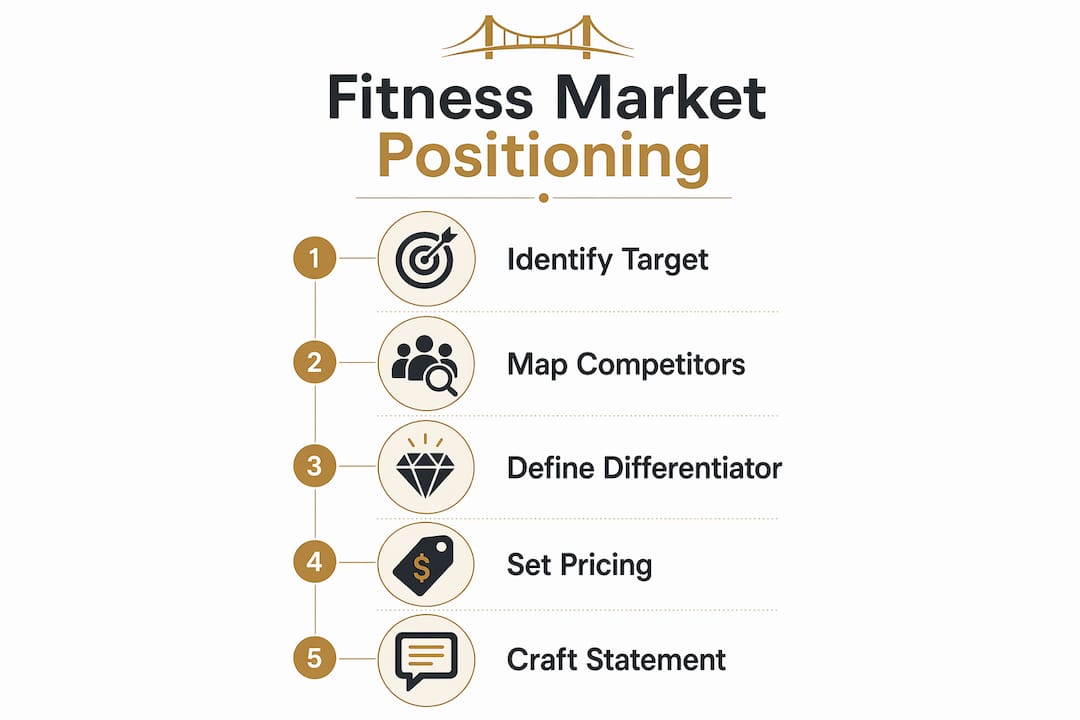
The most practical tool for understanding your competitive position is a 2x2 positioning grid. The Rework framework places fitness businesses along two axes: specialization (generalist to specialist) and price signal (accessible to premium). The intersection of those two axes produces four distinct quadrants.
| Quadrant | Description | Example |
|---|---|---|
| Luxury niche | Premium price, specialist focus | High-end CrossFit affiliate, $200+/month |
| Luxury generalist | Premium price, broad offering | Full-service health club with spa amenities |
| Accessible niche | Low price, specialist focus | Budget HIIT studio, $40/month drop-in model |
| Accessible generalist | Low price, broad offering | Big-box gym, $10 to $30/month |
To use this grid, plot every gym within a five-mile radius of your location. Be honest about where each one sits. Then look for the white space. If your market has three accessible generalists and two luxury generalists, but no specialist at the premium tier, that gap is your opportunity. Identifying white space through competitor mapping improves marketing effectiveness and client acquisition directly.
The risk of skipping this exercise is landing in "accidental positioning." You open a gym, set a mid-range price, offer a mix of classes, and end up competing with everyone while winning no one. Prospects cannot place you in a mental category, so they default to whoever is cheapest or most convenient.
Pro Tip: When mapping competitors, note their price points and their primary marketing message, not just their class menu. A gym that markets "community" at $150/month is positioned very differently from one that markets "results" at the same price.
Operationalizing your fitness market positioning
Choosing a position on paper means nothing if your operations contradict it. Operational elements such as class caps, amenities, pricing tiers, and service levels must align with your chosen position to make it credible and sustainable.
Here is what alignment looks like in practice:
-
Set pricing that signals your tier. Accessible gyms typically charge $60 to $80 per month, while premium studios charge significantly more and deliver upgraded experiences to justify it. If you want to be perceived as premium, pricing at $80/month sends the wrong signal before a prospect ever visits. Price is not just revenue strategy. It is a positioning statement.
-
Cap class sizes to match your promise. A luxury niche gym that promises personalized coaching cannot run 40-person classes. Small class caps, typically 8 to 15 members, enforce the premium experience operationally. They also create scarcity, which supports premium pricing psychology.
-
Match your facility to your category. A boutique studio like The Colosseum Charleston invests in curated equipment, clean aesthetics, and a specific atmosphere that signals premium positioning the moment a prospect walks in. A generalist gym with the same pricing but a cluttered, dated facility creates cognitive dissonance. Clients feel the mismatch even if they cannot articulate it.
-
Align your membership policies with your positioning. Month-to-month contracts signal accessibility and low commitment. Annual memberships with onboarding calls signal investment and community. Neither is wrong. Both send a positioning signal.
The most common operational mistake is charging premium prices while delivering a mid-tier experience. Boutique gyms charging $200 per month outcompete $10/month gyms by making their unique value obvious before prospects ever make contact. That clarity comes from operational alignment, not just marketing copy.
Pro Tip: Audit your gym from a first-time visitor's perspective once a quarter. Walk in cold and ask: does every touchpoint, from the parking lot to the locker room to the first coach interaction, confirm the position you claim in your marketing?
Crafting a positioning statement for local fitness marketing
A positioning statement is the internal compass that guides every external message your gym sends. It is not a tagline. It is a structured sentence that forces clarity before you write a single ad or social post.
The WHO + differentiation + payoff structure from Product Marketing Alliance is the most reliable format for fitness businesses:
- WHO: "For busy professionals in their 30s and 40s..."
- Category + differentiator: "...our CrossFit gym offers coach-led, 60-minute strength and conditioning sessions with no more than 10 members per class..."
- Payoff: "...so they build real strength and lose body fat without wasting time or figuring out programming on their own."
That is a position. It excludes people (college athletes, casual gym-goers, budget shoppers) and attracts exactly the member who will stay, refer friends, and pay a premium without negotiating.
Strong positioning statements share three traits:
- They name one differentiator, not four. Adding "and we also have great community, and flexible scheduling, and nutrition coaching" collapses the message.
- They describe a specific outcome the member cares about, not a feature the gym is proud of.
- They are written for the prospect, not the owner. "We have certified coaches" is owner-centric. "You get a coach who knows your name and adjusts your program weekly" is prospect-centric.
Once your statement is written, it should appear in adapted form across your website homepage, your Meta and Google ad copy, your sales conversations, and your onboarding materials. Fitness brand positioning examples show how the best studios translate this internal statement into every client-facing channel without sounding repetitive. Consistency across channels is what builds the mental "place" that positioning theory describes.
A vague "for everyone" message dilutes your offer and reduces member retention. Specificity is not exclusion for its own sake. It is the mechanism that makes your marketing land with the people who will actually stay.
Key takeaways
Market positioning in fitness is a strategic decision about who you serve, how you differ, and what outcome you deliver, and every operational and marketing choice must reinforce that decision consistently.
| Point | Details |
|---|---|
| Positioning is strategic, not visual | Define WHO, category, differentiator, and payoff before designing any marketing. |
| Use the 2x2 grid to find white space | Map competitors on specialization and price axes to identify untapped market opportunities. |
| Operations must match the position | Class caps, pricing, and facility quality either confirm or contradict your positioning claim. |
| One differentiator beats four | Limiting your message to a single competitive advantage improves clarity and conversion. |
| Pricing signals your tier | Setting price points that match your target segment is a positioning decision, not just a revenue decision. |
Why most gyms get positioning wrong before they open
I have worked with enough gym owners to say this plainly: most positioning problems are not marketing problems. They are decision-avoidance problems. Owners are afraid to exclude anyone, so they write messaging that includes everyone, and then wonder why their ads produce low-quality leads.
The counterintuitive truth is that the gyms I see winning locally are the ones willing to say no. A CrossFit affiliate in a mid-size city that positions itself specifically for working parents with limited time and a need for structured programming will outperform a generalist gym targeting "anyone who wants to get fit" every single time, even with a smaller ad budget. The specificity does the filtering work that a sales team would otherwise have to do manually.
Competitor mapping is the step most owners skip because it feels like extra work before the "real" marketing starts. It is actually the most valuable hour you will spend on your business this year. Knowing that your three nearest competitors are all accessible generalists tells you exactly where the premium niche is sitting empty. That is not a guess. That is a data-driven local market strategy.
The other mistake I see constantly is treating positioning as a launch exercise. You write a positioning statement, build a website around it, and then never revisit it. Markets shift. Competitors open. Your member base evolves. Positioning is a living strategy that should be reviewed at least annually, ideally every time you notice your lead quality dropping or your churn rate climbing.
If your gym is struggling to convert leads or retain members, the problem is almost always upstream in the positioning, not in the ad creative or the email sequence.
— Collin
How Enochmarketing helps gyms build and own their market position
Enochmarketing works exclusively with CrossFit gyms and fitness brands across the United States, which means every strategy we build starts with positioning clarity, not ad spend. Before we run a single Meta or Google campaign, we audit where your gym sits on the specialization and price grid, identify the white space in your local market, and build messaging that attracts the members most likely to stay and refer.
From there, our gym growth services cover the full stack: paid media, local SEO, lead funnel creation, social content, and web design, all aligned to the position we define together. If your current marketing feels generic or your leads are the wrong fit, the fix starts with a positioning conversation. Book a free strategy session with Enochmarketing and find out exactly where your gym stands and what it would take to own your local market.
FAQ
What is market positioning in fitness?
Market positioning in fitness is the strategic process of defining how your gym or studio is perceived relative to competitors in your local market. It involves deliberate choices about target audience, pricing, specialization, and the specific outcome you deliver to members.
How is fitness positioning different from fitness branding?
Fitness branding is the visual and verbal expression of your position, including logos, colors, and tone. Positioning is the underlying strategic decision about who you serve and why you win. Branding without positioning is decoration without direction.
Why does pricing matter for fitness market positioning?
Pricing acts as a direct signal of your market tier. Accessible gyms typically charge $60 to $80 per month, while premium studios charge significantly more and back it up with upgraded facilities and service levels. Setting a price that mismatches your operational reality creates confusion and churn.
What is a fitness positioning statement?
A fitness positioning statement is a structured internal sentence that defines your target customer, your category, your single differentiator, and the specific payoff the member receives. It is the compass that guides all external marketing copy, from your website to your ad campaigns.
How do I find white space in my local fitness market?
Plot every competitor within your target radius on a 2x2 grid using specialization and price as the two axes. Studios with a defined niche report 23% lower member churn and attract more qualified leads. The empty quadrant on that grid is your white space opportunity.