
Use instant lead forms when you need fast validation and volume on a tight budget. Use landing pages when you're selling a priced offer and want to build a real data asset over time. Neither wins outright: measure both by cost per booked visit or cost per new member, not by cost per lead, and you'll usually land on a mix of the two rather than an all or nothing pick.
TL;DR:
- Using instant lead forms can lower cost per lead by 30 to 50 percent but often results in lower-quality leads with less intent to convert.
- Landing pages, while more expensive per lead, typically produce a higher booking rate and better qualify leads through detailed offer explanations.
- The true measure of ad effectiveness is cost per booked visit or new member, not just cost per lead, making a combined strategy more cost-efficient.
- Testing both formats with the same offer, creative, and audience over several weeks provides a clearer picture of which yields better cost per booked visit.
- Speed of follow-up, ideally within five minutes, significantly impacts booking rates regardless of whether a lead comes from a form or a landing page.
Table of Contents
- Landing Page vs Lead Form for Gyms: Where Each One Wins
- What Gym Marketing Benchmarks Actually Say
- How to Choose Between a Landing Page and a Lead Form
- Testing Both Formats the Right Way
- Why We Don't Pick One Format and Stop There
- Get Help Running the Funnel, Not Just Picking a Format
- Sources
- FAQ
Landing Page vs Lead Form for Gyms: Where Each One Wins
The two formats aren't really competing for the same job. A Meta instant form lives inside the app, takes a prospect three taps to submit, and auto-fills their name, email, and phone from their profile. A landing page sends that same prospect to a page you control, where they read your offer, see your price, and type in their own information by hand.
That difference in friction changes everything downstream. Instant forms typically produce a 30 to 50 percent lower cost per lead than landing pages, but a meaningful share of those leads never intended to book anything. Landing pages cost more per lead and convert a noticeably larger share of submissions into actual booked visits, because typing your own phone number is a small commitment that filters out casual browsers.
Here's how the two stack up on the factors that matter for a gym's ad budget:
- Speed to set up: a lead form can go live in minutes inside Ads Manager; a landing page takes hours to days depending on your builder and copy.
- Typical CPL direction: forms run cheaper per lead; landing pages run more expensive per lead but often cheaper per booked visit.
- Lead quality (lead to appointment): auto-filled form submissions skew lower intent; manually typed landing page submissions skew higher intent.
- Data and pixel ownership: landing pages feed first-party data you own and can retarget forever; form data mostly lives inside the ad platform.
- Ability to explain an offer: landing pages can show pricing, testimonials, and a real booking calendar; forms give you a headline and a few lines of text.
If your offer is a free trial class, a form usually gets you enough volume without much loss in quality. If you're selling a $97 intro offer with a specific start date, a landing page that actually explains the deal tends to convert better once you account for no-shows.
What Gym Marketing Benchmarks Actually Say
Most gym owners compare cost per lead and stop there. That's the wrong number to anchor on, because a cheap lead that never shows up costs more in wasted ad spend than an expensive lead who books and joins.
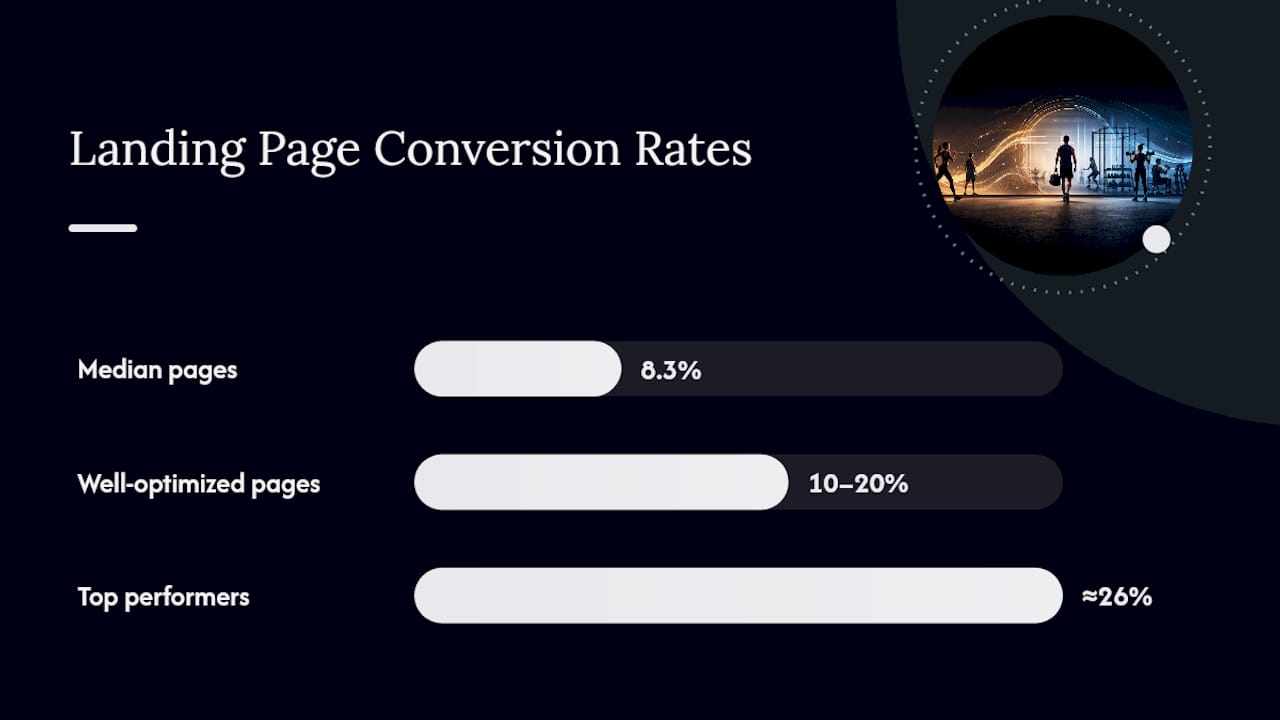
Fitness landing pages convert at a median of 8.3 percent, with well-optimized gym pages reaching 10 to 20 percent and top performers hitting around 26 percent. That spread mostly comes down to structure: single-action pages with an offer-first headline, minimal fields, and a visible price consistently outperform generic "learn more" pages.
On the follow-up side, the numbers are more dramatic. Industry data shows the average lead-to-appointment rate sits around 28 percent, while top performers hit 42 to 58 percent, largely because they call back fast. Response speed alone moves the needle: the median gym takes about 47 hours to respond to a lead, while gyms that call within five minutes see dramatically higher booking rates. That five-minute window is one of the cheapest wins in fitness marketing and it requires zero ad spend to fix.
To calculate what actually matters, run this math:
- Cost per booked visit = total ad spend ÷ number of appointments booked (not leads generated).
- Cost per new member = total ad spend ÷ number of new members signed.
If you spend $500 and get 40 leads at $12.50 each but only 8 book a visit, your real cost per booked visit is $62.50. Compare that number across formats, not the raw CPL, and the picture usually flips.
How to Choose Between a Landing Page and a Lead Form
Run through this before you launch anything:
- Match the offer to the format. A free guest pass or open house works fine behind a form. A priced intro offer, a 6-week challenge with a specific start date, or anything requiring a deposit belongs on a landing page where you can explain the terms.
- Confirm your follow-up capacity. If nobody on your team can call a lead within five minutes during business hours, fix that first. Speed to contact matters more than the format you chose.
- Check technical readiness. Test your page's mobile load time, make sure the headline on the page matches the promise in the ad, and confirm your pixel is firing correctly before you spend a dollar.
- Set your time horizon. Use a form when you need proof of concept fast on a new offer or a new location. Move to a landing page once you know the offer works and you want to build retargeting audiences over months, not days.
- Run the go/no-go check. If you can answer yes to "can we call this lead in under 5 minutes" and "does our page match our ad," you're ready to launch either format.
Pro Tip: Never send paid traffic straight to your homepage. Every ad should point to one page or one form built around a single offer. Splitting attention across a navigation menu is one of the fastest ways to waste a media budget.
Routing matters as much as the format itself. A well-built gym sales funnel tracks a lead from first click through booked visit through paid membership, so you can see exactly where each format is losing people.
Testing Both Formats the Right Way
A fair test holds three things constant: the same offer, the same creative, and the same audience, run over the same time window. Comparing a $19 trial promoted with a form against a $99 challenge promoted with a landing page tells you nothing about which format actually works better.
Run parallel campaigns with identical ad creative, split by format, over at least two to three weeks or until each side has a reasonable sample of bookings, not just clicks. Judge the winner by cost per booked visit, never by CPL alone.
A practical mixed funnel for most gyms looks like this:
- Cold traffic goes to an instant form set to "higher intent" mode, with manual phone entry required and one custom qualifying question about their goal or timeline.
- Warm and retargeting traffic goes to a landing page that explains the offer in full and captures a first-party data record for future campaigns.
- Every visitor gets tagged with UTM parameters so you can trace bookings back to the exact ad and format that produced them.
Small tweaks like requiring manual phone entry on a form filter out a real share of low-intent submissions with only a minor bump in CPL.
Why We Don't Pick One Format and Stop There

Most agencies treat this as a binary decision, and that's a mistake. We favor starting cold campaigns on instant forms to validate an offer fast and cheap, then shifting budget toward a landing page once the offer proves out, because that page trains your pixel and builds a retargeting audience you'll use for years.
Speed to contact and cost per booked visit matter more than any format debate. We'd rather see a gym call a lead in three minutes off a "worse" channel than let a lead from a "better" channel sit for two days. If you want a second opinion on how your current funnel is actually performing, that's a conversation worth having before your next ad dollar goes out.
— Collin
Get Help Running the Funnel, Not Just Picking a Format
A mixed strategy uses instant forms for cold validation, landing pages that convert once an offer proves out, and follow-up systems that strive to contact leads quickly instead of after long delays.
That's the gap most gym owners fall into. They set up a form or a page, run some traffic, and never build the measurement layer that shows whether they're paying for leads or paying for members. Our paid advertising service connects Meta and Google campaigns directly to conversion-focused landing pages and lead follow-up automation, so every dollar gets tracked from click to booked visit to signed member. If you want that built specifically around your offer, book a free strategy session and get an audit of your current pricing options starting at $1,500 per month for the Get Found package.
Sources
- Instant forms vs landing pages for gyms: an honest comparison with real numbers | Pilotium
- Fitness Landing Page Statistics | Web Tonic™
FAQ
Are Landing Pages Still Worth Building in 2026?
Yes. Fitness landing pages convert at a median of 8.3 percent, and well-built pages reach 10 to 20 percent, which makes them worth the setup time for any offer with a price attached. They also build a first-party data asset that keeps working long after a single ad campaign ends.
What Are the Most Common Landing Page Mistakes Gyms Make?
The biggest mistake is sending paid traffic to a homepage instead of a single-offer page built around one goal. Cluttered navigation, missing pricing, slow mobile load times, and a headline that doesn't match the ad copy all drag conversion rates down well below benchmark.
What's the Difference Between a Landing Page and a Homepage?
A homepage serves many purposes and links to a dozen other pages; a landing page has one goal and one action, usually booking a visit or claiming an offer. Sending ad traffic to a homepage instead of a dedicated page is one of the fastest ways to waste a media budget.
Is a Landing Page the Same Thing as a Sales Funnel?
No. A landing page is one step inside a funnel, the page a lead sees right after clicking an ad. The full funnel includes the ad, the page or form, the follow-up call, the booked visit, and the eventual membership sign-up, and each stage needs its own conversion rate tracked separately.
How Much Does Enoch Marketing Charge for Landing Page and Ad Management?
Enoch Marketing's Get Found package starts at $1,500 per month, with Fill the Floor at $2,500 and Growth Engine at $4,500 per month, each bundling paid ads, landing pages, and lead follow-up. Custom Growth pricing is available on request for gyms with larger or more complex campaigns.