
Gym reputation management is the active process of monitoring, shaping, and maintaining your gym's online public image through review responses, social media engagement, and accurate business information updates. Known formally as online reputation management (ORM), this practice directly determines how many prospective members find you, trust you, and walk through your door. Platforms like Google Business Profile, Yelp, and Facebook are where your gym's reputation lives or dies. Explaining gym reputation management to your team is the first step toward turning scattered online feedback into a growth asset that works every day.
What is gym reputation management and why does it matter?
Gym reputation management is the systematic practice of tracking every mention of your gym online and responding in ways that build trust. It covers review platforms, social media comments, fitness forums, and directory listings. The goal is not just to look good online. The goal is to convert that positive perception into new memberships and retained members.
The importance of gym reputation cannot be overstated. Reputation management is not merely damage control but a routine business function tightly linked to local SEO and member conversions. That means every unanswered review or outdated phone number on Google is costing you real revenue. Prospective members search for gyms the same way they search for restaurants. They read reviews, scan star ratings, and make a decision in under two minutes.
For CrossFit gyms specifically, community perception is the product. Your members are your marketing. When someone leaves a five-star review mentioning your coaches by name, that review does more work than any paid ad you could run.
What are the essential components of reputation management for gyms?
Effective gym reputation management is built on five core components. Each one requires consistent attention, not occasional check-ins.
- Review aggregation: Pull reviews from Google, Facebook, Yelp, and fitness-specific forums into one place. Missing a review on a secondary platform is still a missed opportunity to respond and show accountability.
- Timely response: Responding within 24 hours is the standard for active reputation management. Speed signals to both reviewers and search engines that your gym is attentive and community-focused.
- Social media listening: Monitor mentions, tags, and comments across Instagram, Facebook, and TikTok. Scheduled posting keeps your gym visible between member check-ins.
- Business information accuracy: Consistent business hours, contact details, and location data across all directories prevent the frustration that turns a curious prospect into a lost lead.
- User-generated content (UGC): Member photos, testimonials, and check-ins are gold. UGC boosts ad CTR by up to 20%, which means your members' authentic voices outperform polished brand content in paid campaigns.
Pro Tip: Set up a free Google Alert for your gym's name and your head coaches' names. You will catch mentions on blogs, news sites, and forums that review platforms never surface.
The combination of these five components creates a feedback loop. Positive reviews attract new members. New members create more reviews. More reviews improve your search ranking. That cycle is the engine behind gym online reputation growth.

Manual vs. automated reputation management: which approach works best?
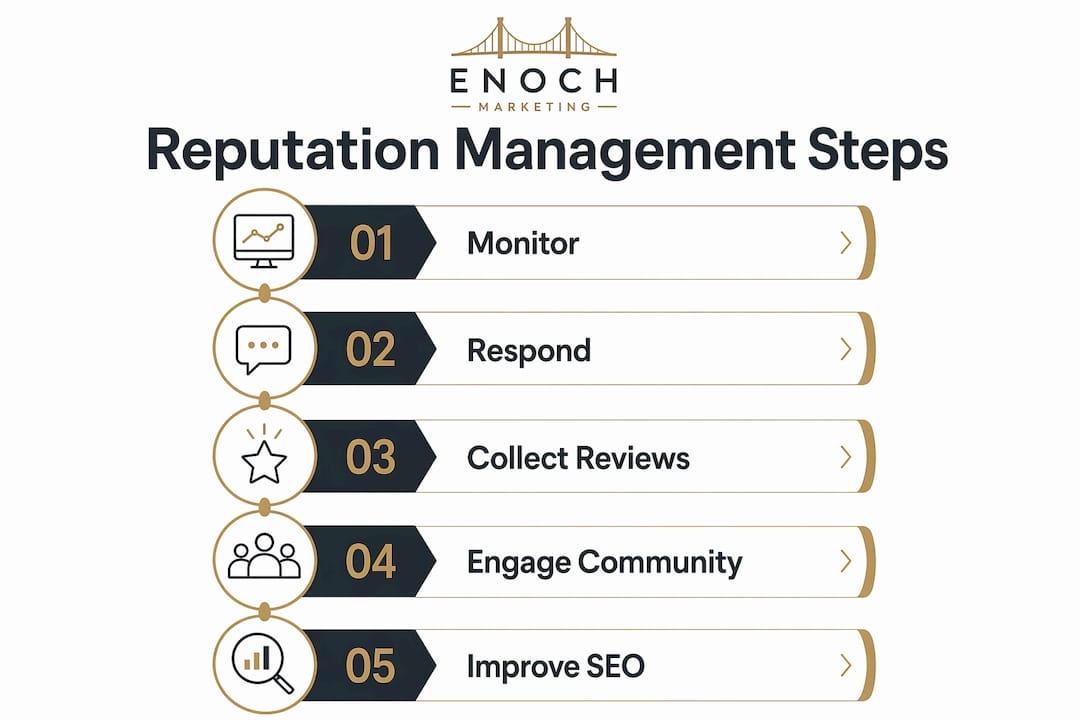
Most gym owners start with manual reputation management. They check Google reviews when they remember, respond when they have time, and rely on staff to flag complaints. This approach is better than nothing. It is not good enough to compete.
| Approach | Tools used | Time cost | Consistency | Best for |
|---|---|---|---|---|
| Manual | Spreadsheets, Google Alerts, staff roles | High | Low | Solo operators, new gyms |
| Automated | 1club, unified dashboards, AI messaging | Low | High | Multi-location, scaling gyms |
Automated platforms like 1club send personalized review requests soon after class, driving higher response rates and collecting verified feedback tied to specific sessions and instructors. That level of specificity matters. A review that mentions "Coach Sarah's 6 a.m. class" is more credible and more searchable than a generic five-star rating.
The real advantage of automation is consistency. Manual systems depend on whoever is working that day remembering to follow up. Automated software triggers review requests based on class attendance data, so no check-in goes unacknowledged. Effective reputation software integrates directly with member attendance data to trigger requests at optimal times, improving authenticity and conversion rates.
Manual intervention still matters for one critical task: responding to negative reviews. No algorithm replaces a thoughtful, human response to a frustrated member. Automation handles volume. You handle nuance.
Pro Tip: Use automation to collect reviews and flag negative feedback for human review. Set a rule that any review below three stars triggers an immediate notification to the gym manager, not just a scheduled report.
How does reputation management connect to local SEO and marketing?
Your gym's online reputation and its search ranking are not separate concerns. They are the same concern. Positive reviews improve Google ranking and local search visibility directly. More five-star reviews push your gym higher in the local pack, which is the map section that appears at the top of Google search results.
Here is what that connection looks like in practice:
- A gym with 200 reviews averaging 4.8 stars ranks above a gym with 40 reviews averaging 4.9 stars in most local searches. Volume and recency both matter.
- Member testimonials pulled from reviews can be dropped directly into Google Ads and Meta Ads copy. Real phrases from real members outperform agency-written ad copy in split tests.
- One negative review can shift search and click behavior immediately. Prospects who see a one-star review with no response from the gym assume the worst and move on.
- Review response visibility affects conversion rates at the bottom of your sales funnel. A prospect reading your reviews sees not just what members say but how you respond. A professional, empathetic response to a complaint is a stronger trust signal than ten generic five-star reviews.
The role of reviews in gym marketing goes beyond star ratings. Reviews are keyword-rich content that Google indexes. When members write about your "early morning CrossFit classes" or "personal training in Austin," those phrases improve your visibility for exactly those searches.
What practical steps can gym owners take every day?
Embedding reputation management into daily operations requires a system, not willpower. Here is a repeatable process that works for gyms of any size.
- Set up a reputation dashboard. Use a tool like 1club or a free alternative like Google Business Profile's notification settings to see all reviews and mentions in one place. Checking five separate platforms daily is not sustainable.
- Assign one owner. Assigning one person to daily reputation tasks creates accountability and prevents issues from being overlooked. This does not have to be the gym owner. A front desk manager or marketing coordinator works well.
- Create a response log. An internal log tracking review dates, platforms, issue types, and resolutions prevents lost issues and improves team accountability. A simple Google Sheet works fine.
- Ask for reviews consistently. Train coaches and front desk staff to ask members for a Google review after a great class. Follow up with an email 24 hours after a member's first session. The ask is most effective when it is specific: "Would you mind leaving us a quick Google review? It really helps new members find us."
- Respond to every review. Responding to negative reviews increases customer likelihood of visiting the business by 45%. That is not a small number. Respond to positive reviews too. A brief "Thanks for being part of our community" takes ten seconds and reinforces loyalty.
- Schedule monthly content updates. Review your Google Business Profile, Yelp listing, and Facebook page once a month. Update photos, confirm hours, and post a recent member story or class highlight.
Pro Tip: After a community event or competition, send a follow-up email to all attendees with a direct link to your Google review page. Event energy translates into review volume if you ask at the right moment.
Improving your gym image is not a one-time project. It is a daily discipline that compounds over months. Gyms that treat reputation management as a weekly habit consistently outperform those that treat it as a crisis response.
Key takeaways
Gym reputation management is the daily practice of monitoring, responding, and building your online presence to convert trust into memberships.
| Point | Details |
|---|---|
| Define ORM clearly | Gym reputation management covers reviews, social media, and directory accuracy across all platforms. |
| Respond within 24 hours | Fast responses signal attentiveness and directly increase the likelihood of a prospect visiting your gym. |
| Automate review collection | Tools like 1club tie review requests to class attendance, improving volume and authenticity. |
| Connect reviews to SEO | Positive review volume and recency improve local Google rankings and drive organic member acquisition. |
| Assign daily ownership | One accountable person with a response log prevents missed reviews and keeps the system running. |
Why I stopped treating reputation management as a fire drill
Most gym owners I talk to think about reputation management the moment something goes wrong. A one-star review appears, a member posts a complaint on Facebook, and suddenly reputation management becomes urgent. That reactive posture is the most expensive mistake you can make.
The gyms that grow consistently treat their online reputation the same way they treat their programming. It is scheduled, assigned, and reviewed regularly. The coaches who build the strongest community reputations are not the ones who respond perfectly to crises. They are the ones who have built up so much positive equity that a single bad review barely moves the needle.
I have seen CrossFit gyms with 300 five-star reviews absorb a one-star complaint without losing a single lead. I have also seen gyms with 15 reviews lose a week's worth of inquiries over one unanswered negative post. The difference is not luck. It is the daily habit of improving your gym's online presence before you need to.
Automation tools help with volume, but the culture has to come first. When your coaches understand that every member interaction is a reputation moment, the reviews take care of themselves. The software just captures what is already happening.
— Collin
How Enochmarketing helps gyms build a reputation that grows memberships
Reputation management does not exist in a vacuum. It works best when it connects to your local SEO, your paid ads, and your member experience strategy. That is exactly what Enochmarketing builds for CrossFit gyms and fitness brands across the United States.
Enochmarketing's gym marketing services include reputation management integration alongside Meta Ads, Google Ads, local SEO, and social content. The agency audits your current online presence, identifies gaps in your review strategy, and builds a system that collects, responds to, and activates member feedback as a marketing asset. If you want to stop guessing and start growing, book a free strategy session with Enochmarketing today.
FAQ
What is gym reputation management?
Gym reputation management is the ongoing process of monitoring and responding to online reviews, managing social media mentions, and keeping business information accurate across platforms like Google, Yelp, and Facebook. The goal is to build trust with prospective members and retain current ones.
How often should gym owners respond to reviews?
Gym owners should respond to every review within 24 hours. Fast, consistent response builds trust and positions your gym as attentive, and responding to negative reviews alone increases customer likelihood of visiting by 45%.
What is the best tool for managing gym reviews?
Platforms like 1club automate review requests after each class and tie feedback to specific sessions and instructors, making them well-suited for gyms that want verified, high-volume reviews without manual follow-up.
How does reputation management affect local SEO for gyms?
Positive review volume and recency directly improve a gym's ranking in Google's local search results. More five-star reviews from recent members push your gym higher in the local pack, which drives organic member inquiries.
Do CrossFit gyms need a different reputation strategy?
CrossFit gym reputation management tips center on community and coach-specific feedback, since members choose CrossFit boxes largely based on coaching quality and culture. Asking for reviews that mention specific coaches and classes produces more credible, searchable content than generic star ratings.