
Online reviews are the single most powerful trust signal in gym marketing, directly determining whether a prospect signs up or walks to your competitor. 97% of consumers read reviews for local businesses before making a decision, and fitness is one of the highest-consideration categories in local search. The role of reviews in gym marketing goes far beyond reputation management. Reviews function as a live acquisition channel, a local SEO driver, and a feedback system that tells you exactly what your members value and what they resent. Gym owners who treat reviews as a passive byproduct of good service are leaving real membership revenue on the table.
How reviews influence gym member acquisition and trust
Reviews are the first filter a prospective member applies before they ever visit your gym. A high star rating signals safety in a high-stakes decision. Joining a gym costs money, requires a schedule change, and carries emotional weight. People do not take that lightly, and they use reviews to reduce the risk of getting it wrong.
The conversion data here is striking. Adding the first review to a gym's profile increases conversion by approximately 65%. Reaching five or more reviews pushes that figure up to 270%. That means a gym with zero reviews is operating at a severe structural disadvantage compared to one with even a handful of honest, recent testimonials.

Star ratings also function as a financial lever. A one-star increase in rating correlates with a 5 to 9% revenue increase for independent local businesses. For a gym charging $150 per month per member, even a modest membership base makes that percentage meaningful. The importance of testimonials in fitness is not abstract. It translates directly into monthly recurring revenue.
Consumers also verify across platforms. Consumers use an average of six review sites when researching local businesses. This means your Google Business Profile rating alone does not tell the full story. Prospects are cross-checking Yelp, Facebook, Apple Maps, and fitness-specific platforms before they commit.
Key behaviors that reviews drive among gym prospects:
- Clicking through to your website after reading positive reviews
- Comparing your rating directly against nearby competitors
- Reading the most recent reviews to gauge current member satisfaction
- Checking how you respond to criticism before deciding to trust you
- Using review sentiment to validate or override paid ad impressions
Volume vs. rating: what gym marketers should actually prioritize
Many gym owners obsess over maintaining a perfect 5.0 rating. That instinct is understandable but counterproductive. Consumers have become sophisticated enough to distrust a flawless score.
| Factor | What it signals to prospects |
|---|---|
| Perfect 5.0 with 8 reviews | Suspicious; looks curated or fake |
| 4.6 stars with 200+ reviews | Credible, high-trust, conversion-ready |
| 4.1 stars with 15 reviews | Borderline; volume too low to feel safe |
| 4.8 stars with 50+ reviews | Strong; ideal for premium memberships |
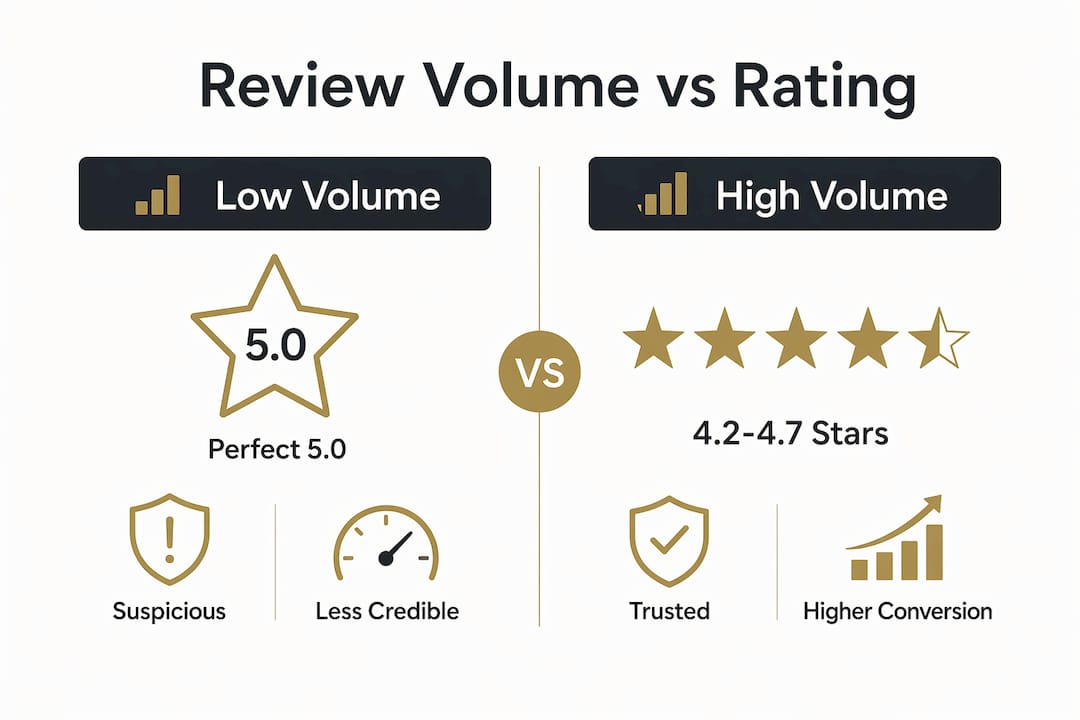
The optimal average rating for conversion peaks between 4.2 and 4.7 stars. A gym sitting at 4.5 with 80 reviews will consistently outperform a competitor at 5.0 with 12 reviews. Volume signals that real people, in real numbers, have experienced your gym and found it worth commenting on.
Consumers prefer at least 20 reviews and weight recent reviews most heavily, specifically those from the past three months. A gym that collected 40 reviews two years ago and has gone quiet since then looks stagnant. Review recency is a credibility signal in its own right.
Pro Tip: If your gym has a strong rating but low volume, prioritize a review collection push before spending more on paid ads. A Google Ads campaign driving traffic to a profile with six reviews is far less efficient than the same budget hitting a profile with 60.
Higher review counts also dilute the damage from outlier negative reviews. A single 1-star review on a 10-review profile tanks your average. That same review on a 150-review profile barely moves the needle. Volume is your insurance policy against the occasional disgruntled member.
How to collect gym reviews without violating platform policies
The most common mistake gym owners make is offering incentives for reviews. Google explicitly prohibits discounts, free classes, or gift cards tied to leaving or editing a review. Violations can result in review removal or profile penalties. The same principle applies to Yelp, which actively filters reviews it suspects were solicited through incentives.
The right approach is systematic, neutral, and timed to moments of genuine satisfaction. Here is a practical framework:
- Ask at satisfaction milestones. Tie review requests to moments like completing an onboarding session, finishing a six-week program, or hitting a personal record. Members feel good at these points and are far more likely to leave authentic, positive feedback.
- Use multiple channels. Send review requests via SMS, email, and in-person conversation. Different members respond to different channels. A single email blast will not capture everyone.
- Keep the language neutral. Say "We'd love your honest feedback" rather than "Please leave us a 5-star review." Neutral language keeps you compliant and produces more credible reviews.
- Avoid sentiment gating. Do not filter members through a satisfaction survey before sending only happy members to Google. This practice violates platform policies and produces an artificially inflated profile that consumers increasingly recognize as manipulated.
- Maintain review velocity. Review recency and response consistency are direct local SEO ranking factors. A gym that collects two to four reviews per month consistently will outrank a competitor that collects 30 in one week and then goes silent.
Pro Tip: Build review requests into your member communication calendar the same way you schedule class programming. Treat it as an operational process, not a one-off campaign.
Platforms like Wodify and Mindbody allow automated post-session messages. Use these tools to trigger review requests at the right moment without adding manual work to your front desk staff. The goal is a steady review velocity that signals ongoing activity to both Google and prospective members.
How to manage negative reviews without losing prospects
Negative reviews are not the problem most gym owners think they are. How you respond to them is what actually determines whether a prospect trusts you or avoids you.
Negative reviews cause 94% of consumers to avoid a business. But that statistic assumes the business does nothing. A professional, empathetic public response changes the calculus entirely. Prospects reading your response are not just evaluating the complaint. They are evaluating how you handle conflict, whether you take accountability, and whether you treat members with respect.
"Responding to a negative review publicly, acknowledging the issue, and outlining what has changed is one of the highest-trust signals a local business can send." — Searchlab, Online Reviews Statistics 2026
One negative review reduces revenue by 22%, and four or more can reduce it by 70%. Those numbers make response speed a business-critical metric, not a courtesy. 53% of consumers expect a response within seven days. Gyms with active review responses see 40% higher conversion rates than those that ignore feedback entirely.
Practical rules for responding to negative reviews:
- Respond within three to seven days. Longer than that signals indifference.
- Acknowledge the specific complaint. Generic responses read as dismissive.
- Avoid defensive language. "We're sorry you felt that way" is not an apology.
- Outline what has changed or what you will investigate.
- Move complex disputes offline. Offer a direct contact and resolve privately.
Negative feedback also contains competitive intelligence. If three members in one month mention that the locker rooms are consistently dirty, that is an operational priority, not just a PR problem. Review text tells you what your members care about most and where your gym is falling short. Treating that data as a feedback loop rather than a threat is what separates gyms that grow from gyms that plateau.
Key takeaways
Reviews are the highest-leverage trust asset in gym marketing, and managing them systematically drives both local search visibility and member conversion rates.
| Point | Details |
|---|---|
| Reviews drive direct conversions | Five or more reviews can increase conversion rates by up to 270% compared to zero reviews. |
| Optimal rating beats perfect rating | A 4.2 to 4.7 star average with high volume converts better than a perfect 5.0 with few reviews. |
| Recency and velocity matter for SEO | Consistent monthly review activity improves local search rankings more than a one-time review push. |
| Negative reviews require fast responses | Responding within seven days and acknowledging issues publicly increases prospect trust significantly. |
| Incentivized reviews violate Google policy | Neutral, milestone-timed requests produce compliant, credible reviews that platforms will not remove. |
Why review strategy is actually a member experience strategy
Here is the uncomfortable truth I have seen play out repeatedly with fitness businesses: gyms that chase reviews without improving the underlying experience eventually hit a ceiling. You can build a solid review collection system, respond to every comment, and still watch your rating drift downward if the coaching quality is inconsistent or the equipment is aging out.
The most effective review strategies I have encountered treat the review process as a mirror, not a megaphone. When you read your reviews the way a member reads them, patterns emerge fast. The gyms that grow steadily are the ones using that pattern data to fix real problems, not just to craft better response templates.
I also think the fitness industry underestimates how much a personalized response builds community. When a member leaves a review mentioning their coach by name and you respond acknowledging that coach specifically, you are not just doing reputation management. You are reinforcing the identity of your gym as a place where people are seen. That kind of response gets screenshotted and shared. It becomes organic marketing.
The multi-channel review strategy is also non-negotiable in 2026. Relying solely on Google is a single point of failure. Prospects who find you through Facebook or Apple Maps and see an empty review profile will not dig deeper. They will move on. Spreading your review presence across platforms is the same logic as diversifying your marketing channels. It reduces risk and increases surface area for discovery.
The gym owners I respect most treat review management the same way they treat programming: as an ongoing discipline with measurable outcomes, not a task you do once and forget.
— Collin
Grow your gym with a review strategy built for fitness brands
Review management is one of the highest-return activities a gym can invest in, but most owners do not have the systems or bandwidth to do it consistently. Enochmarketing builds review acquisition frameworks, response protocols, and local SEO strategies specifically for CrossFit gyms and fitness brands across the United States. The agency integrates review strategy with paid media, local gym marketing, and lead funnel development so your reputation works in sync with every other growth channel. If your Google Business Profile is underperforming or your review volume has stalled, a free strategy session with Enochmarketing will show you exactly where the gaps are and how to close them.
FAQ
How do reviews affect gym membership sign-ups?
Reviews directly increase conversion rates. Five or more reviews can boost conversion by up to 270% compared to a gym with no reviews, making early review collection one of the highest-return activities for new gyms.
What star rating should a gym aim for?
The optimal rating for conversion sits between 4.2 and 4.7 stars. A perfect 5.0 with few reviews often appears less credible than a 4.5 with 50 or more reviews.
Can gyms offer free classes in exchange for reviews?
No. Google prohibits incentives tied to leaving or editing reviews, including discounts and free sessions. Violations can result in review removal or profile penalties.
How quickly should a gym respond to a negative review?
53% of consumers expect a response within seven days. Gyms that respond promptly and professionally see significantly higher conversion rates than those that ignore negative feedback.
Which platforms should gyms collect reviews on?
Prioritize Google Business Profile first, then Facebook, Yelp, and Apple Maps. Consumers use an average of six review sites when researching local businesses, so a multi-platform presence reduces the risk of a prospect finding an empty or outdated profile.