
Competitive analysis for fitness is the practice of systematically evaluating other gyms, studios, and fitness alternatives in your market to understand how they attract clients, set prices, and position themselves. The industry term is "competitive intelligence," and it applies directly to fitness businesses through a structured process of mapping direct rivals, indirect alternatives, and substitute services. Boutique studios in the US see average revenue per user between $180 and $350, with operating margins between 5% and 20%. Those numbers leave almost no room for guesswork. Gym owners who skip competitor analysis often lose members to services they never tracked.
What is competitive analysis for fitness businesses?
Competitive analysis in fitness is a diagnostic process, not a copying exercise. The goal is to identify where rivals are weak, overpriced, or too generic, and then build a position your market actually needs. Most gym owners treat it as a fear-driven reaction to a new studio opening nearby. That framing misses the point entirely.
The fitness market in 2026 has polarized sharply toward two viable positions: low-cost, high-volume operations and premium, high-touch experiences. Mid-range gyms that try to serve everyone tend to struggle. Knowing where your competitors sit on that spectrum tells you exactly where the open space is.

Competitive intelligence also protects your revenue. Missing a competitor's price hike or new intro offer can cause an unexpected drop in trial signups before you even realize what happened. Tracking the market consistently prevents those surprises.
What are the main categories of competitors fitness businesses should analyze?
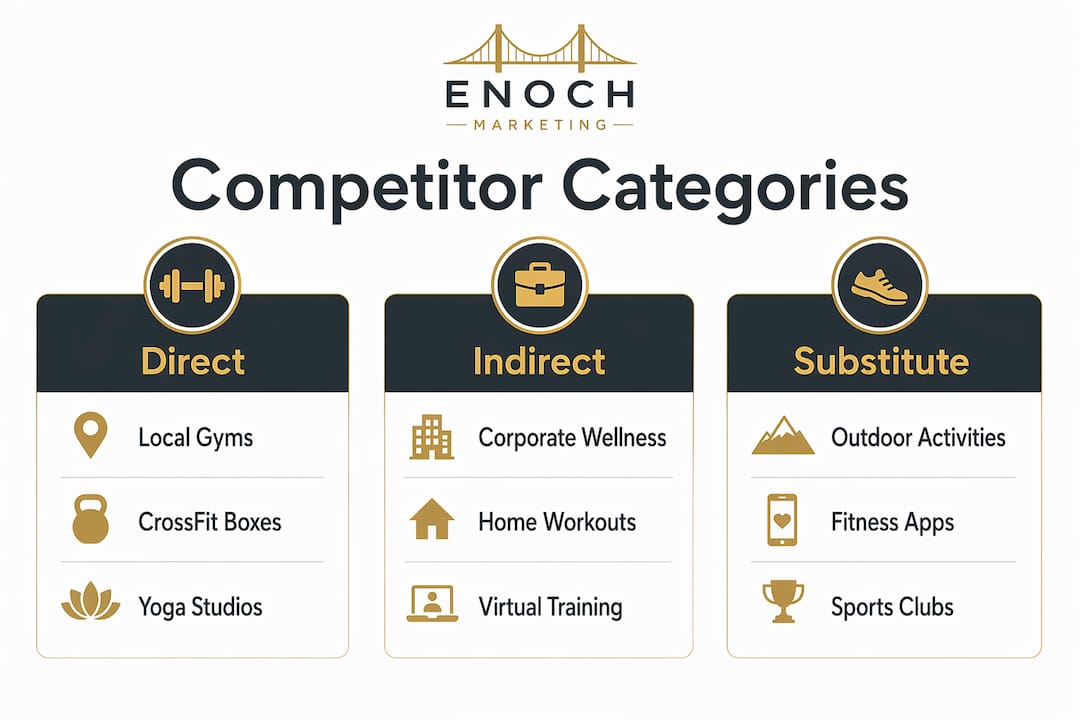
Fitness professionals often focus only on the gym down the street. That narrow view creates blind spots that cost members and revenue. Competitor analysis for gyms covers three distinct categories.
Direct competitors are other gyms, CrossFit boxes, yoga studios, and boutique fitness concepts within a realistic geographic radius of your location. These businesses target the same demographic, charge similar prices, and compete for the same time slots. They are the most visible threat and the easiest to track.
Indirect alternatives include corporate wellness programs, university recreation centers, sports clubs, and municipal parks and recreation facilities. These options reduce potential new member volume without competing on price directly. A prospect who gets a subsidized gym membership through their employer may never search for a local studio at all.
Substitutes are services that fulfill the same core need through a completely different format. This category includes:
- Fitness apps and on-demand platforms
- Outdoor group classes in parks
- Home equipment setups
- Online Pilates and virtual training programs
The table below shows how each competitor category differs in threat type and tracking priority.
| Category | Examples | Primary threat | Tracking priority |
|---|---|---|---|
| Direct | Local gyms, CrossFit boxes, boutique studios | Member poaching, price pressure | High |
| Indirect | Corporate wellness, rec centers, sports clubs | Reduced prospect pool | Medium |
| Substitutes | Fitness apps, home equipment, outdoor classes | Convenience and cost | Medium |
Ignoring indirect and substitute competitors produces an incomplete picture of your market. A gym owner who only watches other gyms may miss the fact that a new employer in town just launched a subsidized wellness benefit that quietly absorbed 200 potential members.
Which competitive factors should fitness professionals track regularly?
Effective competitive analysis covers five core dimensions: market position, pricing and contracts, social proof, digital presence, and client experience. Each dimension gives you a different signal about where a competitor is strong and where they are exposed.
-
Market position and niche focus. Identify who each competitor targets and how they describe themselves. A gym marketing to elite athletes signals a different threat than one targeting beginners or weight-loss clients.
-
Pricing models and contract terms. Look beyond the monthly rate. Examine initiation fees, freeze policies, cancellation terms, and intro offers. Low-cost intro offers often come with high-pressure sales funnels that reveal a competitor's true business model.
-
Social proof and review velocity. Track how fast a competitor accumulates new Google and Yelp reviews. Review velocity correlates with local sign-up changes, meaning a sudden spike in competitor reviews often signals a new promotion or referral push you should know about.
-
Digital presence and online engagement. Monitor their website, Meta ads, and Instagram content cadence. Paid ad activity tells you when a competitor is investing in growth. Silence on paid channels often signals financial pressure.
-
Client experience and sales funnel. Walk through their entire onboarding process as a prospective member. Note response time, follow-up sequences, tour quality, and how they handle objections.
Pro Tip: Set a Google Alert for each direct competitor's name and combine it with a monthly check of their Google Business Profile reviews. This two-step system catches most competitive moves in under 30 minutes per month.
Monitoring these dimensions together gives you leading signals, not lagging ones. One gym owner who tracked competitor review velocity noticed a sudden drop in their own trial signups. The cause was a competitor running a limited-time promotion. Catching that signal early allowed for a targeted counter-offer that reversed the losses.
How do you identify gaps in your local fitness market?
The most valuable output of competitor analysis is not knowing what rivals do well. It is knowing what they do poorly or ignore entirely. High-retention studios maintain annualized retention above 70% by owning a specific niche rather than competing broadly.
Common gaps that gym owners find through structured analysis include:
- Underserved demographics such as seniors, beginners, or postpartum clients
- Inconvenient class schedules that leave early morning or late evening slots open
- Poor onboarding that drops new members before they build a habit
- Generic programming with no specialty or community identity
- Missing recovery services like mobility work, stretching classes, or sauna access
The strongest competitive position is asymmetric. Small gyms can offer personalized onboarding, deep community, and trust-based relationships that large chains structurally cannot replicate. Competing on price against a chain is a race you will lose. Competing on belonging is one you can win.
Assessing commercial density matters too. A market with six CrossFit boxes in a two-mile radius has different gap opportunities than a suburb with none. Niche marketing for gyms works precisely because most operators chase the same broad demographic instead of owning a specific one.
The practical test is simple. Walk through your competitor's Google reviews and filter for one-star and two-star ratings. Complaints about parking, class size, coach turnover, and billing problems are all gaps you can solve. Every recurring complaint in a competitor's reviews is a feature you can build your positioning around.
What practical steps should gym owners take to implement competitor analysis?
Competitive analysis becomes useful only when it runs on a regular schedule. Four hours per quarter is enough to maintain a current competitor dataset and avoid being caught off guard by market shifts. The key is building a repeatable system, not a one-time project.
-
Build a living competitor spreadsheet. List every direct, indirect, and substitute competitor with columns for pricing, niche, review count, social following, and last observed promotion. Update it quarterly.
-
Mystery shop your top three rivals. Call them as a prospective member. Visit their website and go through their lead form. Note how fast they respond, what they say, and how they follow up. Analyzing offer architecture this way reveals their true strategy far better than reading their homepage.
-
Set up automated monitoring. Use Google Alerts for competitor names and track their Google Business Profile reviews monthly. Browser-based tools can capture ad creative and landing page changes without manual effort.
-
Feed findings into your pricing and positioning decisions. If a competitor raises prices, that is your signal to evaluate whether your own pricing still reflects your value. If they drop a class format, consider whether that audience is now available to you.
-
Incorporate retention rate as a competitive benchmark. Your annualized retention rate is the clearest signal of whether your competitive position is working. A rate below 60% means members are not finding enough reason to stay, regardless of how your marketing performs.
Pro Tip: Once per quarter, book a free trial or intro class at a direct competitor. The firsthand experience of their sales process, coaching quality, and facility condition gives you data no spreadsheet can capture.
The most common pitfall is treating this as a one-time audit. Markets shift. New studios open. Pricing changes. A competitor analysis done once in 2023 tells you almost nothing useful in 2026. The gym owners who stay ahead run this process on a calendar, not on a crisis.
Key Takeaways
Competitive analysis for fitness is an ongoing operational discipline that combines market mapping, metric tracking, and gap identification to build a defensible position in your local market.
| Point | Details |
|---|---|
| Map all three competitor types | Track direct rivals, indirect alternatives, and substitutes to avoid strategic blind spots. |
| Monitor five core dimensions | Pricing, social proof, digital presence, market position, and client experience each signal different threats. |
| Find gaps, not just strengths | Competitor review complaints and neglected demographics reveal the most profitable positioning opportunities. |
| Run analysis quarterly | Four hours per quarter keeps your competitor data current and prevents surprise revenue losses. |
| Build asymmetric advantages | Personalized onboarding and community depth are advantages chains cannot replicate, so build there first. |
Why most gym owners are doing competitor analysis wrong
I have worked with enough gym owners to see the same mistake repeat itself. They pull up a competitor's Instagram, glance at the pricing page, and call it research. That is not competitive analysis. That is confirmation bias with extra steps.
The gym owners who actually grow are the ones who treat competitor analysis as a quarterly operational habit, the same way they review their P&L. They mystery shop. They read every one-star review their rivals receive. They notice when a competitor goes quiet on paid ads, because silence usually means financial stress and an opportunity to capture their members.
The metric I push hardest is retention rate. Your brand positioning can be perfect on paper, but if members leave after three months, your competitive position is not working. Retention is the report card for everything else.
The other thing I see gym owners get wrong is competing on price. The fitness market has polarized. Trying to undercut a budget chain while also offering premium coaching puts you in a middle position that satisfies no one. Pick a lane. Own it completely. The gyms that thrive in 2026 are the ones that know exactly who they serve and make every decision from that clarity.
— Collin
How Enochmarketing helps gym owners compete and grow
Knowing your market is one thing. Acting on it with the right campaigns, positioning, and lead systems is where most gym owners get stuck.
Enochmarketing works exclusively with CrossFit gyms and fitness brands across the United States. The agency builds the full growth infrastructure: paid media on Meta and Google, local SEO, lead funnels, and brand positioning grounded in real market research. Every strategy starts with understanding your competitive position so your marketing dollars go toward the gaps your market actually has. If you want a clearer picture of where your gym stands and what it takes to grow, explore Enochmarketing's services and book a free strategy session.
FAQ
What is competitive analysis for fitness?
Competitive analysis for fitness is the process of evaluating other gyms, studios, and fitness alternatives in your market to identify their strengths, weaknesses, and positioning. The goal is to find gaps and opportunities that allow your business to attract more clients and retain them longer.
How often should gym owners run a competitive analysis?
Four hours per quarter is enough to maintain a current competitor dataset. Running it more frequently than quarterly is rarely necessary unless a major new competitor opens nearby.
What are the three types of fitness competitors to track?
The three categories are direct competitors (other gyms and studios), indirect alternatives (corporate wellness programs and rec centers), and substitutes (fitness apps, home equipment, and outdoor classes). Missing any category produces an incomplete market picture.
How do you find gaps in your local fitness market?
Filter competitor Google reviews for one-star and two-star ratings and look for recurring complaints. Underserved demographics, inconvenient schedules, and weak onboarding are the most common gaps that niche-focused gyms turn into sustainable advantages.
Why is retention rate a competitive metric?
Annualized retention above 70% signals that your positioning and member experience are working. A rate below that threshold means members are not finding enough differentiation to stay, regardless of how strong your marketing is.