
Audience segmentation in fitness is the practice of dividing gym members into distinct groups based on behavioral, psychographic, and demographic data so you can deliver marketing and communication that actually fits each person. The industry term for this practice is market segmentation, and it has moved from a corporate marketing concept to a survival skill for fitness businesses. Segmented marketing strategies can improve class attendance by 20–30% and reduce member churn by 15–25%. That gap between generic outreach and targeted communication is where most gyms either grow or stall.
What is audience segmentation in fitness?
Audience segmentation in fitness is the process of sorting your member base into groups that share meaningful traits, then crafting separate messages, offers, and experiences for each group. It is not about sending a different emoji to different age brackets. It is about understanding why someone shows up, what keeps them coming back, and what signals that they are about to leave.
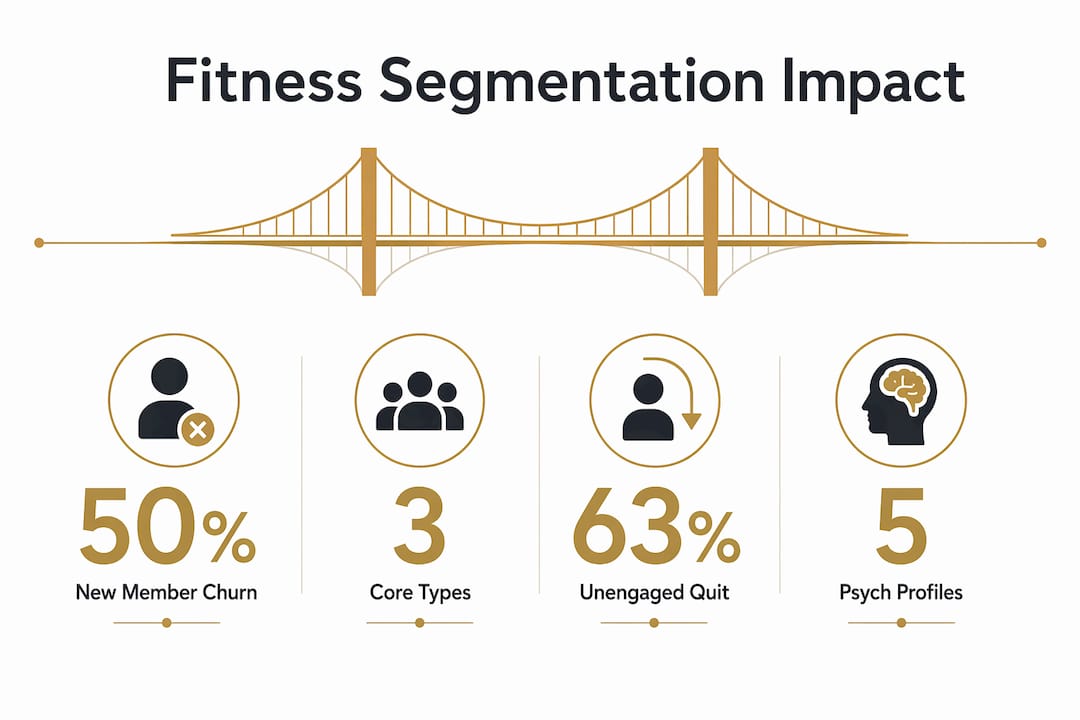
The three core segmentation types are behavioral, psychographic, and demographic. Each one answers a different question about your members, and each one has a different level of predictive power for retention and revenue.

| Segmentation type | What it measures | Business impact |
|---|---|---|
| Behavioral | Visit frequency, class preferences, monthly spend | Strongest predictor of churn and loyalty |
| Psychographic | Motivations, values, fitness identity | Drives emotional resonance and long-term retention |
| Demographic | Age, gender, income, location | Useful for targeting but weak as a standalone predictor |
Behavioral segmentation is the most operationally useful starting point. Boutique fitness operators use visit frequency, monthly spend, and consistency to identify segments like "Ride or Dies" (high loyalty), "Committed," "Situationships," and "On-Again, Off-Agains." These labels are not just clever names. They map directly to different retention risks and revenue opportunities.
Psychographic segmentation: the layer most gyms skip
Psychographic segmentation sorts members by motivation rather than habit. Five distinct psychological profiles exist among fitness members: Competitors (28%), Community Builders (22%), Status Symbols (21%), Wellness Seekers (18%), and Solo Operators (12%). Each profile needs a completely different engagement approach. A Competitor responds to leaderboards and personal records. A Wellness Seeker responds to stress relief messaging and recovery content. Sending the same campaign to both groups wastes budget and erodes trust.
Demographic segmentation alone consistently underperforms. Behavioral data outperforms demographic data for predicting member behavior, because two members with identical demographics, say a 35-year-old woman earning $80,000 a year, can have completely opposite engagement needs depending on whether she is a Solo Operator or a Community Builder.
Why does segmenting fitness audiences reduce churn?
Churn is the defining problem in fitness marketing. 50% of new gym members quit within their first six months, and 63% of cancellations happen in the first 30 days. Those numbers mean your onboarding window is short and your margin for generic communication is essentially zero.
Segmentation reduces churn because it lets you intervene before a member mentally checks out. Members do not cancel suddenly. They drift. Attendance drops from four times a week to two, then to once, then to zero. Attendance frequency is the strongest predictor of retention, and early intervention during the drifting phase is far more effective than any win-back campaign after cancellation. Recovery success rates are approximately five times higher when you engage a drifting member compared to a lapsed one.
Pro Tip: Set an automated alert in your booking or CRM system for any member whose visit frequency drops by 50% over a two-week period. That is your earliest reliable signal of drift, and it gives you a window to act before the member mentally cancels.
Different segments also respond to different incentives. A "Champion" member who attends five or more times per week does not need a discount. They need recognition, community access, or early registration for premium classes. A "Drifting" member who has dropped to once a week needs a personal check-in, a low-barrier re-engagement offer, or a class recommendation that matches their original motivation for joining. Sending the same promotional email to both groups is the fastest way to train your list to ignore you.
Psychographic segmentation shifts marketing from transactional to genuinely motivating by connecting with what members actually value. That shift is what separates gyms with 80% annual retention from gyms stuck at 60%.
How do fitness professionals implement a segmentation strategy?
Implementation starts with the data you already have. Your booking system, payment records, and class attendance logs contain enough behavioral data to build your first segments today. You do not need a sophisticated CRM to start. You need a clear framework.
-
Build attendance-based segments first. Classify every active member into one of four categories: Champions (5+ visits per week), Regulars (2–4 visits per week), Drifting (1 visit per week or fewer, declining trend), and Lapsed (no visit in 30+ days). These four groups have different retention risks and need different communication.
-
Layer in psychographic profiles. Use onboarding surveys, class preference data, and direct conversations to identify whether a member is motivation-driven by competition, community, wellness, or solo achievement. Creating detailed client avatars with specific goals and lifestyle details lets you tailor class design, gym environment, and marketing messages to each profile.
-
Build triggered communication workflows. Set up automated emails or texts that fire based on member behavior, not calendar dates. A welcome sequence for new members, a check-in message when attendance drops, a milestone celebration at the 90-day mark. Behavior-triggered email campaigns significantly outperform broadcast emails in open rates and click-through rates because they arrive at the moment they are relevant.
-
Personalize the message to the segment. A Drifting member gets a message from their primary instructor saying, "We noticed you have been busy. Here is a 20-minute class that fits your schedule." A Champion gets early access to a new program or an invitation to a members-only event. The content is different because the need is different.
-
Review and reclassify monthly. Member behavior changes. A Champion can become Drifting after a life event. A Lapsed member can re-engage after a seasonal shift. Segmentation is not a one-time setup. It is a monthly audit of where each member sits in their relationship with your gym.
Pro Tip: For your onboarding sequence, send a psychographic survey within the first 72 hours of membership. Ask one direct question: "What is your main reason for joining?" The answer tells you which profile to assign and which communication track to activate.
For gyms running paid social retargeting, behavioral segments also feed directly into ad audience targeting. Drifting members become a retargeting audience. Champions become a lookalike seed audience for new member acquisition.
What are the common pitfalls in fitness audience segmentation?
The most common mistake is treating demographic data as a complete picture. Age and income tell you who someone is on paper. They do not tell you why they train, what they fear about quitting, or what would make them refer a friend. Gyms that segment only by demographics send the same "New Year, New You" campaign to a 28-year-old Competitor and a 55-year-old Wellness Seeker. Both ignore it.
The second major pitfall is sending identical messages to Champions and Drifting members. Champions are your most engaged members. They do not need urgency-based offers. Sending them a "We miss you" email undermines the relationship and signals that your communication is automated and impersonal. Poor email segmentation is a leading cause of disengagement, and the fix is behavioral triggers, not better subject lines.
A third mistake is limiting segmentation to marketing communications. Segmentation should guide operational decisions including class scheduling, studio design, and ancillary services. If your core segment is work-from-home professionals, scheduling mid-morning classes directly increases utilization. If your dominant psychographic is Community Builders, investing in social spaces and group events drives retention more than any email campaign.
Pro Tip: Run a quarterly segment audit and compare the distribution of your member base across behavioral categories. If your Champion segment is shrinking and your Drifting segment is growing, you have a retention problem that no amount of new member acquisition will fix.
The fitness businesses that get segmentation right treat it as an ongoing system, not a one-time project. They revisit their psychographic profiles as their member base evolves, adjust class offerings to match the motivations of their core segments, and use personalized fitness marketing to build relationships that outlast any promotional offer.
Key Takeaways
Behavioral and psychographic segmentation together are the most effective tools for reducing gym member churn and building sustainable membership growth.
| Point | Details |
|---|---|
| Behavioral segmentation comes first | Sort members by visit frequency into Champions, Regulars, Drifting, and Lapsed before adding other data layers. |
| Psychographic profiles drive retention | Identifying motivations like Competitor or Wellness Seeker lets you match messaging to what members actually value. |
| Early drift intervention works | Engaging drifting members before cancellation is approximately five times more effective than post-cancellation recovery. |
| Triggered emails outperform broadcasts | Behavior-based email workflows deliver higher relevance and engagement than calendar-based campaigns. |
| Segmentation extends beyond marketing | Class scheduling, studio design, and service offerings should align with the preferences of your core member segments. |
Segmentation is not a tactic. It is a philosophy.
I have worked with enough fitness businesses to know that most gym owners understand segmentation in theory and ignore it in practice. The reason is almost always the same: it feels like extra work on top of an already full plate. What I have found is that the gyms investing the most time in segmentation are actually doing less reactive marketing, not more. They are not scrambling to fill classes or running last-minute discount campaigns. They know who their members are, what those members need, and when to reach out.
The shift that changes everything is moving from "who are our members" to "why are they here and what will make them stay." A 40-year-old man who trains for stress relief and a 40-year-old man who trains to compete in local events are the same person on a demographic spreadsheet. They are completely different people in terms of what your gym means to them. Once you see that, you cannot unsee it, and your marketing gets sharper immediately.
The gyms I have seen struggle most with retention are the ones sending the same newsletter to every member every week. The gyms I have seen grow steadily are the ones using email marketing for CrossFit growth with behavior-triggered sequences that feel personal because they are built on real member data. Automation does not replace the human touch. It creates the conditions for the human touch to happen at the right moment, at scale.
My honest prediction for fitness marketing beyond 2026 is that psychographic segmentation will become the baseline expectation, not the advanced strategy. Members will expect their gym to know them. The gyms that build that capability now will have a structural advantage that is very hard for late movers to close.
— Collin
How Enochmarketing helps gyms put segmentation to work
Knowing your segments is one thing. Building the systems to act on them consistently is another challenge entirely.
Enochmarketing works exclusively with CrossFit gyms and fitness brands across the United States, building data-driven marketing systems that turn member behavior into targeted campaigns. From Meta and Google Ads audiences built on behavioral segments to automated email workflows that trigger on attendance data, Enochmarketing's fitness marketing services are built around the same segmentation principles covered in this article. If your gym is ready to move beyond generic outreach and build a member communication system that actually reduces churn, book a free strategy session with Enochmarketing to see what a segmentation-driven approach looks like for your specific market.
FAQ
What is audience segmentation in fitness?
Audience segmentation in fitness is the practice of dividing gym members into groups based on behavioral, psychographic, or demographic data to deliver targeted marketing and personalized member experiences.
Why does behavioral segmentation outperform demographic segmentation?
Behavioral data like visit frequency and class preferences predicts retention and churn more accurately than age or income because two members with identical demographics can have completely different engagement needs and motivations.
How do I identify drifting members before they cancel?
Track visit frequency weekly and flag any member whose attendance drops by 50% or more over a two-week period. Engaging drifting members at this stage is approximately five times more effective than post-cancellation outreach.
What are the main psychographic profiles in fitness?
Research identifies five profiles: Competitors (28%), Community Builders (22%), Status Symbols (21%), Wellness Seekers (18%), and Solo Operators (12%). Each profile requires a distinct communication approach and engagement strategy.
How often should I review and update my member segments?
Review and reclassify member segments monthly. Member behavior changes with seasons, life events, and program cycles, so static segments quickly become inaccurate and lead to mismatched communication.