
The highest-impact ways to bundle fitness services are transformation subscriptions, tiered memberships with strategic add-ons, capped-frequency tiers, class packs with personal training on-ramps, and hybrid online+in-person packages. Each one solves a different revenue problem:
- Transformation subscriptions raise average revenue per user (ARPU) and cut churn by replacing transactional drop-ins with outcome-driven enrollment.
- Tiered memberships with add-ons create natural upsell paths without requiring a hard sell at the front desk.
- Capped 3x/week tiers protect class capacity while expanding total enrollment.
- Foundations/On-Ramp class packs convert new leads into committed members before they ghost.
- Hybrid online+in-person bundles capture remote revenue and retain members who travel or relocate.
Enochmarketing works exclusively with CrossFit gyms and fitness studios across the United States, and the member-behavior patterns we see consistently confirm one thing: gyms that package services around outcomes rather than sessions retain members longer and generate more predictable monthly revenue through CRM-tracked LTV and lower churn rates.
Key Takeaways
Bundling fitness services works when you build around member outcomes, price to a margin floor, and deliver value within 72 hours of purchase.
| Point | Details |
|---|---|
| Pick one bundle first | Launch one validated subscription before adding more; execution depth beats product breadth. |
| Price above your cost floor | Calculate cost-to-deliver, add 30–40% margin, then anchor to local market rates ($150–$250/month unlimited baseline). |
| Run a 6-week phased pilot | Invite your top 20–25% most-engaged members first; validate delivery before a public launch. |
| Track ARPU, churn, and activation | Measure activation rate within 14 days and cohort retention at 90 days before changing any live bundle. |
| Deliver value within 72 hours | New bundle buyers who receive a coach touchpoint in the first three days activate and retain at higher rates. |
Table of Contents
- How do you choose the right bundle strategy for your gym?
- What are the most effective fitness bundle formats?
- How should you price fitness service packages?
- How do you operationalize bundles without creating chaos?
- How do you market and launch a new bundle so members actually buy?
- Which KPIs tell you if your bundles are actually working?
- Ready-to-apply bundle blueprints for each member persona
- What mistakes kill a bundle launch before it starts?
- How do you communicate bundle benefits so members actually understand them?
- Which software platforms help you manage bundles without manual work?
- How do you differentiate your bundles from every other gym in your market?
- The bundle that actually moves the needle first
- Sources
How do you choose the right bundle strategy for your gym?
Start with your members, not your services. Three personas drive most CrossFit gym revenue:
Beginner/On-Ramp members need structure and accountability. They convert best on time-boxed intro bundles (4–8 weeks) that include coaching, a clear curriculum, and a defined next step. Committed/Core athletes (3–5 days per week) want flexibility within a routine. Capped-frequency tiers and class packs with optional add-ons fit them well. Premium/Lifestyle members want a complete experience: coaching, recovery, nutrition guidance, and community. They're your subscription buyers.
Your business model shapes which bundles are operationally viable:
| Persona | Class-Based Model | Open-Gym Model | Hybrid Model |
|---|---|---|---|
| Beginner/On-Ramp | Foundations class pack (8 sessions) | Intro PT block + gym access | On-Ramp pack + digital video library |
| Committed/Core | 3x/week capped tier | Unlimited + recovery add-on | 3x/week + online programming |
| Premium/Lifestyle | Transformation subscription | Full-access + nutrition coaching | Lifestyle subscription (training + recovery + education) |
Pro Tip: Pull your last 90 days of attendance data. Don't guess — your booking software already has the answer.
Gyms offering three or more membership tiers see a 15–20% higher retention rate than those with one or two options, and premium-tier members cancel at materially lower rates.
What are the most effective fitness bundle formats?
Eight formats cover the majority of CrossFit and boutique studio revenue opportunities. Each one maps to a specific persona and delivery model.
| Bundle Name | Components | Target Persona | Delivery Cadence | Price Shape |
|---|---|---|---|---|
| Foundations On-Ramp Pack | 8 group classes + 1 intro PT session + movement assessment | Beginner | 4 weeks | Moderate premium over drop-in rate |
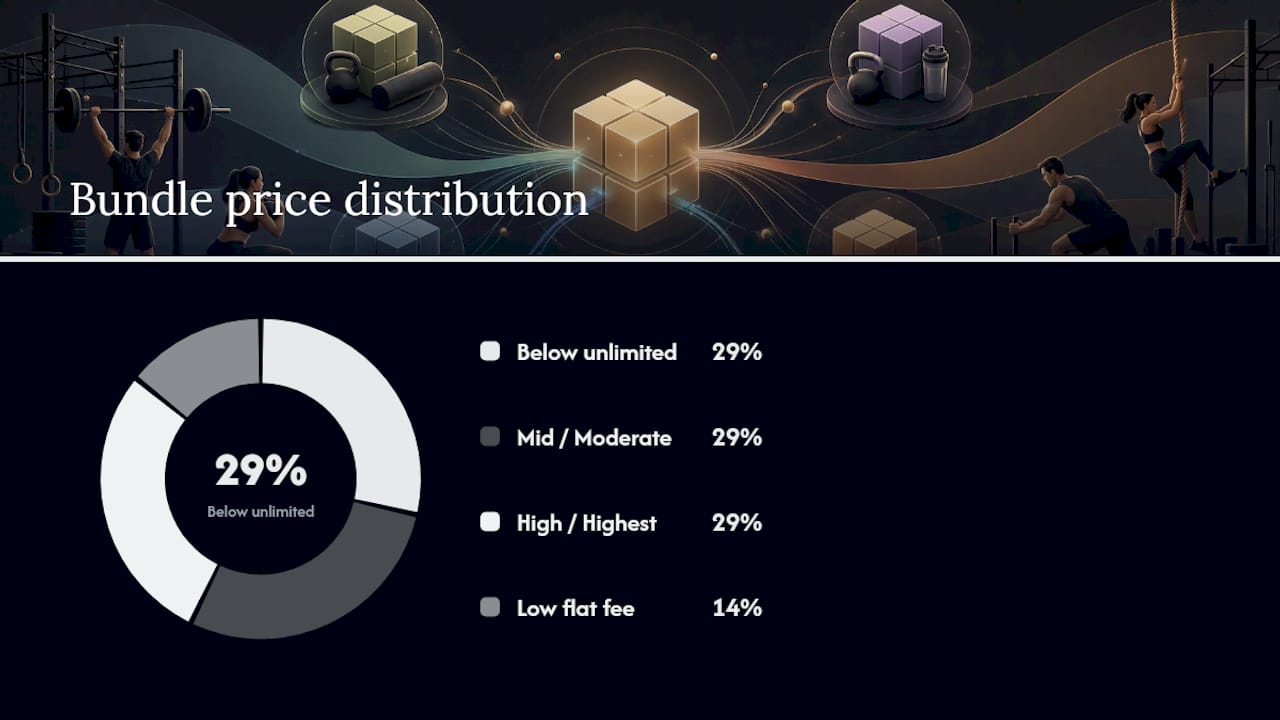
| 3x/Week Capped Tier | Unlimited classes up to 3/week + app access | Committed/Core | Monthly recurring | ~20% below unlimited |
| Transformation Subscription | Unlimited classes + bi-weekly check-ins + nutrition coaching | Premium/Lifestyle | 12-week block or monthly | Highest price tier |
| Coach + Nutrition 12-Week Block | PT sessions (2x/week) + macro coaching + progress tracking | Premium/Lifestyle | 12 weeks | High one-time or installment |
| Recovery Add-On Bundle | Compression/massage gun access + mobility class + foam roller kit | Committed/Core | Monthly add-on | Low flat fee |
| Drop-In + Digital Library | 10-class pack + 30-day access to online workout library | Beginner/Remote | Flexible | Mid-range one-time |
| Weekend Warrior Pack | Saturday/Sunday classes only + community events access | Committed/Core | Monthly recurring | ~35% below unlimited |
| Hybrid Online+In-Person | 2x/week in-box + daily online programming + coach check-ins | Remote/Traveling | Monthly recurring | Slightly below full unlimited |
A lifestyle subscription combining training, recovery, quarterly assessments, and education tends to command higher monthly revenue and stronger retention than session-based models. The psychology shifts from "I'm buying classes" to "I'm enrolled in a program."
Naming matters more than most owners realize. "Transformation Subscription" outperforms "Premium Membership" because it names the outcome. "Foundations Pack" signals a curriculum, not just a trial. Spend five minutes on the name before you launch.
How should you price fitness service packages?
Three methods apply here, and the best gyms use a hybrid of all three.
Cost-plus pricing starts with your cost-to-deliver and adds a margin. It prevents underselling but ignores what members will actually pay. Value-based pricing anchors on the outcome the member receives. A 12-week transformation that helps someone lose 20 pounds and PR their back squat is worth far more than 24 coaching sessions. Hybrid pricing uses cost-plus as a floor and value-based as the ceiling, then sets the final price based on local market anchors.
Worked example: Premium Transformation Subscription
CrossFit unlimited memberships typically run in a moderate price range for most markets in most U.S. markets, so a transformation subscription priced above the typical unlimited membership price range is defensible when the outcome is clearly communicated.
Quick pricing rules:
- Keep tier spreads at 20–30% between levels so each step feels meaningful, not arbitrary.
- Introductory discounts should be time-limited (first 30 days or first cohort only) to avoid training members to wait for sales.
- Always display your highest-priced tier first. Anchor pricing order shapes perception.
- Never price an On-Ramp pack below $150 total. Pricing it as a real curriculum, not a free trial, increases commitment and conversion.
Pro Tip: If your transformation bundle costs $153 to deliver and you're charging $179, you're not running a premium product — you're running a discount service with extra steps. Price to the outcome, not the hours.
How do you operationalize bundles without creating chaos?
Every bundle needs a one-page SOP before it goes live. Six components:
- Product definition: Name, components, duration, and what is explicitly NOT included.
- Cost-to-deliver: Line-item breakdown updated quarterly.
- Scheduling rules: Which classes count, how many per week, blackout periods.
- Coach assignments: Who delivers check-ins, how handoffs work if a coach leaves.
- Automated billing cadence: Charge date, retry logic, pause/cancel rules in your POS.
- Cancellation and pause policy: 30-day written notice minimum; one pause per 12-month period.
Your one-sentence front-desk pitch for a transformation subscription: "For $X/month, you get unlimited classes, a bi-weekly check-in with a coach, and a nutrition plan — everything you need to actually hit your goal, not just show up."
Offering add-ons at booking, at the front desk, and via post-service automation consistently increases upsell conversion because the offer lands when the member's motivation is highest. Build the upsell into your booking confirmation email, not just the front desk conversation. For more creative upselling ideas for gyms, Enochmarketing's resource library covers high-margin add-on structures in detail.

Tech checklist before launch: scheduling software configured for the new tier, POS set up for recurring billing, CRM tagged for bundle members, staff trained on the one-sentence pitch, and physical inventory (recovery kits, welcome packets) counted and reordered.
How do you market and launch a new bundle so members actually buy?
A phased launch reduces risk and generates the activation metrics you need to iterate before committing to a full rollout.
6-week launch timeline:
- Weeks 1–2 (Internal prep): Finalize SOP, set pricing, configure tech, brief staff, build email/SMS sequences.
- Week 3 (Pilot cohort): Invite your top 20–25% most-engaged members. Offer a founding-member rate. Collect feedback on delivery and perceived value.
- Week 4 (Refine): Fix any delivery gaps. Lock final pricing. Build social proof from pilot members.
- Week 5 (Limited public launch): Open to the full member base with a 72-hour early-access window. Use urgency: "First 10 spots at founding rate."
- Week 6 (Paid and referral push): Run local lookalike ads on Meta targeting your existing member list. Push a referral incentive: "Bring a friend, both get $30 off month two."
Channel tactics:
- In-box announcement at the end of a class (coach delivers it, not a flyer)
- Email sequence: Day 1 (problem + outcome), Day 3 (what's included), Day 5 (social proof + deadline), Day 7 (last chance)
- SMS on Day 5: "[Name], founding spots for [Bundle Name] close Friday. Reply YES and we'll hold one for you."
- Instagram Stories showing pilot member results (with permission)
For a deeper look at how gym offers drive memberships, Enochmarketing's blog covers funnel design specifically for fitness studios.
Pro Tip: Your pilot cohort is your marketing asset. One real member result — a before/after, a PR, a weight-loss number — converts better than any ad copy you'll write. Get that result documented in Week 3.
Which KPIs tell you if your bundles are actually working?
Track these six metrics from Day 1:
- ARPU (Average Revenue Per User): Total monthly revenue ÷ active members. Bundle adoption should push this up within 60 days.
- LTV (Lifetime Value): Average monthly revenue per member × average membership length. The goal of bundling is to extend this.
- Churn rate: Cancellations ÷ total members per month. A well-designed bundle should reduce this by creating accountability.
- Activation rate (within 14 days): What percentage of new bundle buyers complete their first check-in or onboarding step within two weeks? Below 50% signals an onboarding problem.
- Pilot conversion rate: How many pilot invitees converted to paying bundle members?
- Cohort retention at 90 days: Are bundle members still active at the 90-day mark at a higher rate than standard members?
Three quick tests to run in the first 90 days:
- Price anchor test: Show the highest tier first on your pricing page for 30 days, then reverse the order. Track conversion rate on the mid-tier.
- Onboarding upgrade test: Send a personal video welcome from the head coach to new bundle members for 30 days. Compare 14-day activation rates against the control group.
- Limited pre-order bonus test: Offer a $25 supplement store credit for the first 10 bundle sign-ups. Track whether urgency increases Week 1 conversion.
Review metrics at 30, 60, and 90 days. Don't change a live bundle's price or structure until you have at least 20 members in it. Small samples produce misleading signals.
Ready-to-apply bundle blueprints for each member persona
Six plug-and-play blueprints, built for CrossFit and boutique studio contexts:
-
Beginner On-Ramp: 8 foundations classes + movement screen + 1 PT session. Monthly cadence for 4 weeks. One coach handles delivery. Pitch: "We'll teach you everything you need to train safely and confidently." Price: moderate premium over drop-in. Flag: coach time is front-loaded; schedule carefully.
-
3x/Week Committed: Unlimited classes up to 3/week + app access. Monthly recurring. No extra staffing needed. Pitch: "Train consistently without paying for days you don't use." Price: ~20% below unlimited. Capped tiers protect class capacity while expanding enrollment — frame it as a value option, not a restriction.
-
Premium Lifestyle Subscription: Unlimited classes + bi-weekly coach check-in + nutrition coaching + quarterly assessment. Monthly recurring. Requires a dedicated coach block. Pitch: "Everything you need to actually change your body, not just maintain it." Price: 30–40% above unlimited base. Flag: highest coach time load; cap enrollment initially.
-
Weekend Warrior Pack: Saturday/Sunday classes + community events. Monthly recurring. Zero extra staffing. Pitch: "Stay in the game without rearranging your week." Price: ~35% below unlimited.
-
Remote Member Hybrid: 2x/week in-box + daily online programming + monthly video check-in. Monthly recurring. Requires an LMS or app for content delivery. Pitch: "Train with us wherever you are." Price: slightly below full unlimited. Flag: requires content infrastructure before launch.
-
Recovery and Mobility Add-On: Monthly mobility class access + foam roller/massage gun loaner + one recovery workshop per quarter. Add-on to any base membership. Minimal staffing. Pitch: "Recover faster, train harder." Price: $25–$45/month flat add-on. Flag: track equipment inventory monthly.
What mistakes kill a bundle launch before it starts?
The most common failures are preventable:
- Vague deliverables: "Includes coaching support" means nothing. Specify session count, format, and frequency.
- Informal add-ons: A recovery bundle with no defined cost-to-deliver, no SOP, and no billing setup is a liability, not a product.
- Overreliance on unlimited revenue: If 80% of your revenue comes from one unlimited tier, a single price objection can crater your month. Diversify.
- No onboarding sequence: Selling a bundle and then going silent is the fastest way to generate a refund request. Deliver value within 72 hours of purchase.
- Seasonal blindness: January and September are natural enrollment peaks. August and December are slow. Price your launch timing accordingly and don't run a new bundle's first pilot in a dead month.
Launch-readiness checklist:
- Bundle SOP written and reviewed by head coach
- Cost-to-deliver calculated with 30%+ margin confirmed
- Pricing set and displayed with anchor tier first
- Tech configured: scheduling, POS recurring billing, CRM tagging
- Staff trained on one-sentence pitch
- Pilot cohort identified (top 20–25% most engaged members)
- Liability waiver updated to cover new services (nutrition coaching, recovery equipment)
- Cancellation policy written and visible at point of sale
- Onboarding sequence built (email/SMS, Day 1 through Day 7)
- Capacity check: does this bundle cannibalize peak-hour class spots?
Pro Tip: Add a pause option to every bundle contract. Members who can pause instead of cancel tend to stay longer. It costs you one month of revenue; it saves you the cost of re-acquiring that member.
How do you communicate bundle benefits so members actually understand them?
Most gym owners explain bundles by listing features. Members buy outcomes. The communication gap between those two things is where most bundle launches stall.
Lead every member-facing message with the result, not the components. "Unlimited classes + nutrition coaching + bi-weekly check-ins" is a feature list. "Lose 15 pounds and hit a new PR in 12 weeks, with a coach tracking every step" is a reason to buy. The components become proof points, not the headline.
Set expectations explicitly at sign-up. A one-page welcome document covering what happens in Week 1, how check-ins work, and who to contact with questions reduces buyer's remorse and support requests. Members who know what to expect in the first 14 days activate at higher rates and cancel less.
For ongoing communication, a monthly progress touchpoint (even a brief SMS from the coach) keeps members feeling seen. Gym member engagement tactics built around consistent, personal contact consistently outperform broadcast emails in retention impact.
Which software platforms help you manage bundles without manual work?
Three categories of tools matter: scheduling, payment/billing, and CRM/automation.
Scheduling: Mindbody, Wodify, and Zen Planner all support tiered membership rules, class caps, and attendance tracking. Wodify is particularly common in CrossFit boxes and integrates well with CrossFit's affiliate reporting. Zen Planner handles capped-tier logic cleanly.
Payment and billing: Square for Retail or Stripe work for one-time bundle purchases. For recurring billing tied to membership tiers, your scheduling platform's native billing (Mindbody, Wodify) is simpler than a separate payment stack. Set up retry logic for failed payments from Day 1.
CRM and automation: HubSpot's free tier handles basic email sequences for smaller studios. ActiveCampaign and Klaviyo offer more sophisticated segmentation for studios running multiple bundle types. For SMS, SimpleTexting and Attentive both integrate with fitness platforms. Automating member portals, booking, and retention flows reduces staff workload and cuts churn by keeping members engaged between visits.
The minimum viable tech stack for a first bundle launch: one scheduling platform with recurring billing, one email tool with a 7-day onboarding sequence, and a spreadsheet tracking ARPU and churn until your CRM is configured. Don't wait for perfect infrastructure. Launch with what you have and upgrade as revenue grows.
How do you differentiate your bundles from every other gym in your market?
Start with a local competitor audit before you finalize pricing or naming. Check the websites and Google Business profiles of the three to five nearest CrossFit boxes and boutique studios. Note their visible pricing tiers, any named packages, and what outcomes they advertise. Most gyms list features; few name outcomes. That gap is your positioning opportunity.
Differentiation doesn't require a lower price. It requires a clearer promise. If every competitor offers "unlimited classes," your transformation subscription with bi-weekly check-ins and a nutrition component is a different product category, not just a more expensive version of the same thing.
Local market data also shapes price anchors. In high-cost metros (New York, San Francisco, Los Angeles), unlimited CrossFit memberships often exceed $250/month, which gives transformation subscriptions room to price at $350–$400. In mid-size markets, the $150–$200 unlimited baseline means your premium bundle ceiling is lower. Know your local floor before you set your ceiling.
Personalizing fitness marketing by persona — running different ad creative and email sequences for beginners versus committed athletes — consistently outperforms one-size-fits-all campaigns in both conversion rate and retention.
The bundle that actually moves the needle first
Most gym owners try to launch three bundles at once and execute none of them well. The smarter move: build one validated subscription and one high-ARPU add-on, run a 6-week pilot, and measure before expanding.
Your first 30 days should look like this: pick your highest-potential persona (check your attendance data), write the SOP, configure billing, train your front desk on the one-sentence pitch, and invite your top 20 most-engaged members to a founding-rate pilot. Deliver your first value touchpoint within 72 hours of their first payment. That single step — fast value delivery — separates bundles that retain from bundles that refund.
Enochmarketing builds the paid media funnels, email sequences, and local SEO infrastructure that fill those bundles with qualified leads. If you want a strategy session to map your first bundle launch to a full marketing system, explore Enochmarketing's CrossFit gym services or review the agency's growth packages to see what a done-for-you launch looks like.
Sources
Enochmarketing resources:
- The Ultimate Guide to Fitness Studio Memberships: Pricing, packaging and retention — Zenoti
- Upselling tips to grow your fitness & wellness business — Mindbody
- Total Gym Membership Bundles & Hybrid Coaching 2026 playbook
- CrossFit Membership Pricing: The Rate Tiers That Stop Athletes From Price-Shopping — Zatrovo Blog
- How Much Does CrossFit Cost? An Honest Pricing Breakdown | Moonshot CrossFit
External references: