
Digital lead magnets are free online assets or interactive experiences offered in exchange for contact information. The single most important selection rule: match the format to your audience's intent stage, not just your content calendar.
A visitor landing on a blog post for the first time needs something different from someone who just watched your pricing video. Pushing a free consultation at the top of the funnel creates friction; offering a checklist at the bottom wastes a high-intent moment. Get that match right and your lead magnet works. Get it wrong and you collect emails that never convert.
Here's what this article covers, in order:
- Interactive tools (quizzes, calculators, assessments)
- Templates and swipe files
- Checklists and cheatsheets
- Mini e-books and guides
- Whitepapers and benchmark reports
- Webinars and video series
- Email mini-courses
- Free trials, demos, and freemium access
- Discount codes and coupons
- Resource libraries and toolkits
- Free audits and assessments
- Community access
- Prompt libraries and AI asset packs
Each type gets concrete examples, the business models it fits best, quick-build tips, and placement guidance. A maturity matrix, compliance checklist, and fitness-specific micro-templates follow.
Key Takeaways
The most effective digital lead magnets match the format to the buyer's intent stage, deliver immediate value, and connect to a follow-up sequence that measures downstream conversion, not just downloads.
| Point | Details |
|---|---|
| Match format to intent | Top-of-funnel gets checklists and quizzes; bottom-of-funnel gets trials and audits. |
| Interactive formats convert higher | Quizzes and calculators average 8.3% conversion in campaign breakdowns, outperforming static PDFs. |
| Minimize form fields | Name and email only for top-of-funnel magnets; add role or company on the second interaction. |
| Measure downstream value | Track MQL rate and trial-to-paid conversion, not just download count. |
| Launch fast, then iterate | Build a minimum viable magnet in days, run one A/B test at a time, and improve based on data. |
Table of Contents
- Why lead magnets work — and where they fail
- The complete catalog of digital lead-magnet types
- How to match your magnet to buyer intent
- How to build, deliver, and measure a lead magnet
- U.S. email and privacy basics for lead magnets
- Ready-to-use micro-templates and fitness-specific examples
- Common mistakes and best practices for higher conversion
- Why quick-win magnets work best for local gyms
- Sources
Why lead magnets work — and where they fail
The core value proposition is simple: you give something useful, the visitor gives you their email. But the downstream benefits go further than list growth. A well-matched magnet qualifies the lead at the moment of capture. Someone who downloads a benchmark report is further along than someone who grabbed a checklist. That signal alone can cut your sales team's qualification time significantly.
The measurable outcomes stack up quickly. Faster list growth, higher email open rates (because subscribers opted in for a specific reason), and a natural entry point for segmented nurture sequences. You also get a content asset that can be repurposed across paid ads, blog content upgrades, and social posts.
Interactive tools like quizzes and calculators convert at an average of 8.3% in campaign breakdowns, often outperforming static PDFs because they deliver personalized results at the moment of peak motivation. That gap matters when you're paying for traffic.
The failure modes are just as predictable. The most common: a mismatch between the magnet and the visitor's intent stage. Offering a 40-page whitepaper to someone who found you through a "beginner tips" search is a conversion killer. So is a clunky delivery flow that makes the user wait for an email, click a confirmation link, and then hunt for the download. Every extra step loses people.
Other common failure modes worth flagging:
- Low perceived value. A generic "10 tips" PDF that could have been written by anyone signals nothing about your expertise.
- Weak follow-up. Collecting the email is step one. If your nurture sequence is a single "thanks for downloading" email, you've wasted the lead.
- Privacy missteps. Unclear consent language or missing opt-out mechanisms create compliance exposure and erode trust.
For quick-win assets like checklists and templates, short and immediately useful beats long-form for initial engagement. Save the 20-page guide for mid-funnel prospects who've already engaged with your brand.
The complete catalog of digital lead-magnet types
1. Interactive quizzes and assessments
A quiz asks the visitor a series of questions and delivers a personalized result. The result is the value. BuzzFeed-style personality quizzes work for consumer brands; competency assessments and readiness scores work for B2B and SaaS.
Interactive formats like quizzes and assessments consistently rank highly in conversion lists because the visitor invests effort before seeing the result, which creates commitment. A fitness brand might run a "What's Your Training Style?" quiz that ends with a recommended class type and a free trial offer. A marketing agency might use a "Marketing Readiness Score" that surfaces gaps and then gates the detailed breakdown.
Best for: E-commerce, fitness studios, SaaS, coaches, agencies. Quick build: Use Typeform, Interact, or Outgrow. Write 5–8 questions, map answers to 3–4 outcome buckets, and write a one-paragraph result for each. Gate the result or the detailed breakdown. Placement: Blog posts, paid social ads, landing pages.
2. Templates and swipe files
Templates give the user a pre-built structure they can fill in. Swipe files are collections of proven copy, subject lines, or frameworks they can adapt. Both deliver immediate, tangible value with minimal effort from the user.
A social media content calendar template, an email sequence swipe file, or a sales proposal framework all qualify. For B2B, a project brief template or a vendor evaluation scorecard signals expertise and helps the prospect move an internal decision forward.
Best for: Agencies, SaaS, B2B services, coaches. Quick build: Build in Google Docs or Notion, export as PDF or share a "make a copy" link. Keep it to one page for maximum perceived value-to-effort ratio. Placement: Blog posts as content upgrades, product pages, email campaigns.
3. Checklists and cheatsheets
A checklist is the fastest lead magnet to build and one of the highest-converting for top-of-funnel traffic. It solves a specific, bounded problem in a format the user can act on immediately.
"The Pre-Launch SEO Checklist" or "The Gym Owner's Monthly Marketing Checklist" are both specific enough to attract the right audience and short enough to deliver instant value. Quick-win assets like these frequently outperform long-form resources for initial engagement because they produce results in minutes, not hours.
Best for: Any business model; especially strong for local businesses and content brands. Quick build: One page, 10–15 items, organized into 2–3 logical groups. Design in Canva, export as PDF. Placement: Blog posts (as content upgrades), exit-intent popups, paid ads.
4. Calculators and spreadsheets
A calculator gives the user a personalized number: an ROI estimate, a calorie target, a pricing range, a break-even point. The personalization is what drives conversion. A generic "average ROI" stat is easy to ignore; a number tied to the user's own inputs is not.
HubSpot's Website Grader is a textbook example of an assessment-style tool that converts visitors by giving immediate, personalized site analysis. The user enters their URL, gets a score, and HubSpot captures a qualified lead who now has a concrete problem to solve.
Best for: SaaS, financial services, fitness, B2B agencies. Quick build: Google Sheets with a simple formula, embedded via Calconic or Outgrow. For fitness: a macro calculator or a "cost per member" calculator for gym owners. Placement: Pricing pages, blog posts about ROI or cost topics, paid search ads.
5. Mini e-books and guides
A short guide (8–20 pages) works when the topic genuinely requires more depth than a checklist can cover. The key word is "short." A 50-page PDF is not a lead magnet; it's a homework assignment. Keep it focused on one specific problem and one specific audience.
"The CrossFit Gym Owner's Guide to Facebook Ads" or "The SaaS Founder's Guide to Onboarding Emails" both signal expertise and attract a defined audience. The specificity of the title does more conversion work than the length of the content.
Best for: Agencies, B2B services, SaaS, content brands. Quick build: Repurpose 3–5 existing blog posts into a structured narrative. Design in Canva or Adobe Express. Placement: Landing pages, paid ads, blog post content upgrades.
6. Whitepapers and benchmark reports
Original data or a rigorous analysis of an industry problem. These are the highest-perceived-value content magnets for B2B audiences. A benchmark report that shows how 200 companies approach a specific challenge is something a prospect will share internally, which extends your reach.
B2B-specific recommendations consistently highlight benchmark reports and short whitepapers under 10 pages as top performers because they reduce buyer uncertainty and support internal decision-making. The effort to create them is higher, but so is the lead quality.
Best for: B2B SaaS, professional services, agencies, consultants. Quick build: Survey your existing customers or pull publicly available data. 8–12 pages with clear charts. Gate behind a form with company name and role fields. Placement: LinkedIn ads, industry newsletter sponsorships, gated blog posts.
7. Webinars and video series
A live or recorded webinar positions you as the expert in the room. The registration itself is the conversion event, which means you capture the lead before delivering the value. Recorded replays extend the asset's life indefinitely.
A video series works similarly but spreads the value across multiple touchpoints, which creates multiple opportunities to deepen the relationship. A 3-part video series on "How to Run Paid Ads for Your Gym" keeps the subscriber engaged across three emails.
Best for: Coaches, agencies, SaaS, professional services, fitness brands. Quick build: Record in Loom or Zoom. Host on Vimeo or YouTube (unlisted). Gate the access link behind a landing page form. Placement: Email campaigns, paid social, LinkedIn.
8. Email mini-courses
A 5–7 day email course delivers one lesson per day. The format builds habit and trust simultaneously. Each email is a touchpoint, and each touchpoint is an opportunity to introduce your product or service naturally.
A "7-Day Gym Marketing Crash Course" or a "5-Day Email Copywriting Challenge" both work because they set a clear expectation and deliver on it daily. Resource libraries, mini-courses, and gated toolkits create ongoing touchpoints and multiple conversion pathways that static downloads cannot replicate.
Best for: Coaches, SaaS, agencies, content brands, fitness studios. Quick build: Write 5–7 emails of 200–400 words each. Set up an automated sequence in MailerLite, ConvertKit, or Klaviyo. Day 1 delivers the first lesson; Day 7 includes a soft pitch. Placement: Blog posts, social bios, paid ads.
9. Free trials, demos, and freemium access
For SaaS and software products, the product itself is the lead magnet. A 14-day free trial or a freemium tier removes the purchase barrier and lets the user experience value before committing. The conversion event is trial-to-paid, not just email capture.
The qualification signal here is strong: someone who activates a free trial has demonstrated intent that a checklist download cannot match. The challenge is activation. A user who signs up but never logs in is not a qualified lead.
Best for: SaaS, software, apps, online tools. Quick build: Define the trial scope (full access vs. feature-limited), set the duration, and build an onboarding email sequence that drives activation within the first 48 hours. Placement: Pricing pages, comparison pages, paid search ads.
10. Discount codes and coupons
A percentage-off code or a free-shipping offer is the dominant lead magnet for e-commerce and local businesses with a transactional model. The conversion rate is high because the value is immediate and concrete. The trade-off: you attract price-sensitive buyers, and the lead quality varies.
It reduces the commitment barrier and gets the prospect through the door, where the real conversion happens. Gym offers like trials and discounts are proven drivers of memberships when paired with a solid follow-up sequence.
Best for: E-commerce, local businesses, fitness studios, restaurants. Quick build: Generate a unique code in your e-commerce or booking platform. Gate it behind a simple email form. Deliver via automated email immediately. Placement: Exit-intent popups, paid social ads, landing pages, Google Ads.
11. Resource libraries and toolkits
A curated collection of templates, guides, checklists, and tools gated behind a single opt-in. The perceived value is high because the user gets multiple assets at once. The ongoing value is even higher if you add new resources regularly, which gives subscribers a reason to stay engaged.
Resource libraries and gated toolkits work especially well for content brands and agencies because they create multiple conversion pathways from a single opt-in page. A fitness marketing toolkit might include a content calendar template, a Facebook ad copy swipe file, and a membership pricing calculator.
Best for: Agencies, content brands, SaaS, coaches. Quick build: Bundle 3–5 existing assets into a single download or a members-only page. Use a simple password-protected page or a tool like Memberful. Placement: Homepage, dedicated landing page, paid ads.
12. Free audits and assessments
An audit is a high-intent magnet. Requesting one signals that the prospect is actively evaluating their situation and looking for a solution. A marketing audit, a website audit, or a gym operations audit all qualify. The format can be automated (like HubSpot's Website Grader) or manual (a 30-minute call with a consultant).
Assessment-style magnets work because they give immediate, actionable diagnostics and create a natural next step: "Here's what we found. Here's how we can fix it." That transition from audit to proposal is one of the cleanest conversion paths in B2B marketing.
Best for: Agencies, consultants, B2B services, SaaS. Quick build: Build a 10-question form in Typeform. Score the responses automatically and deliver a results page with recommendations. For manual audits, gate behind a calendar booking link. Placement: Bottom-of-funnel landing pages, retargeting ads, email campaigns.
13. Community access
Gated access to a private Facebook Group, Slack community, or Discord server. The value is peer connection and ongoing learning, not a one-time asset. This format builds the strongest long-term relationship of any lead magnet type, but it requires active moderation to maintain quality.
A private community for gym owners, a Slack group for SaaS founders, or a Discord for fitness coaches all work when the community is genuinely active. Facebook Group lead generation tactics can be particularly effective for personal trainers and fitness studios when the group delivers consistent value.
Best for: Coaches, agencies, fitness brands, content creators. Quick build: Create the group, write a clear description of who it's for and what they'll get, and set up a simple landing page with an email opt-in as the entry requirement. Placement: Social media bios, blog posts, email campaigns.
14. Prompt libraries and AI asset packs
A curated collection of ChatGPT prompts, AI workflow templates, or pre-built automation sequences. This is a newer format that's growing fast because the perceived value is high and the creation cost is relatively low.
A "50 ChatGPT Prompts for Gym Marketing" or a "Meta Ads AI Prompt Pack for Fitness Studios" both attract a specific audience and signal expertise in a format that feels immediately useful. The shelf life is shorter than a benchmark report, but the download rate tends to be strong.
Best for: Marketing agencies, SaaS, coaches, content creators. Quick build: Compile and test 30–50 prompts in a specific niche. Format as a PDF or Notion page. Gate behind a simple email form. Placement: Social media posts, blog content upgrades, paid ads.
How to match your magnet to buyer intent
Lead magnets fall into two broad categories: content-based and offer-based. Content-based magnets (checklists, guides, templates) attract awareness and consideration-stage visitors, while offer-based magnets (discounts, trials, audits) attract decision-stage visitors with higher purchase intent. The intent-stage match is the single biggest lever on lead quality.
Mismatching creates friction in both directions. Push a free consultation on someone who just discovered your brand and they'll bounce. Offer a top-of-funnel checklist to someone who's been on your pricing page three times and you've missed a conversion. Aligning format with intent stage consistently produces better long-term conversion than optimizing the magnet itself.
| Intent Stage | Recommended Formats | Ease of Creation | Perceived Value to User | Typical Conversion Range | Best Placements |
|---|---|---|---|---|---|
| Top of funnel (awareness) | Checklists, cheatsheets, quizzes, short guides | Low | Medium | 15–25% on dedicated landing pages | Blog posts, social ads, exit popups |
| Middle of funnel (consideration) | Templates, calculators, email courses, webinars | Medium | High | 10–20% on landing pages | Retargeting ads, email campaigns, product pages |
| Bottom of funnel (decision) | Free trials, audits, demos, discount codes | Medium–High | Very High | 5–15% (higher intent, smaller audience) | Pricing pages, comparison pages, retargeting |
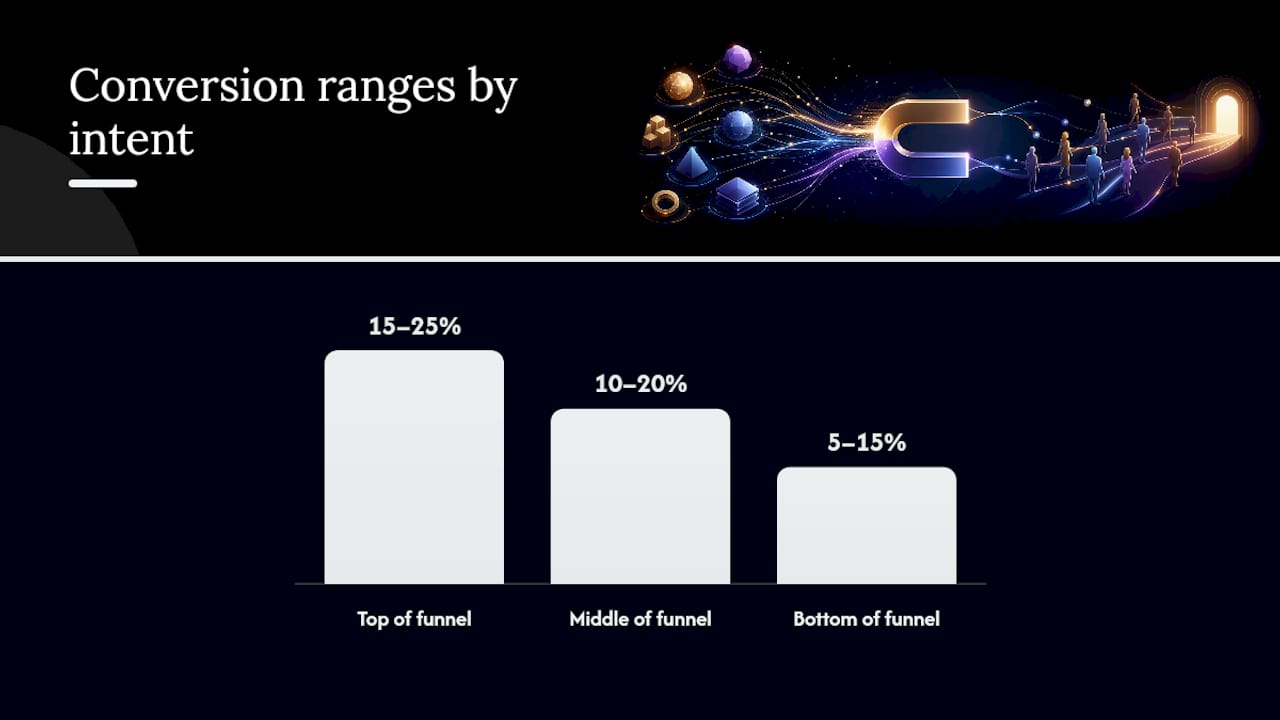
The conversion ranges above are directional benchmarks, not guarantees. Your actual numbers will depend on traffic quality, offer relevance, and landing page execution.
Pro Tip: Layer your magnets. Start with a top-of-funnel checklist to build the list, then surface a mid-funnel template or calculator to the segment that opened the delivery email. That second touchpoint filters for higher intent without requiring a new ad campaign.
How to build, deliver, and measure a lead magnet
Getting a lead magnet live in under a week is realistic. The bottleneck is usually decision-making, not execution. Here's the workflow:
Step 1: Define the audience and objective. Who is this for, exactly? What do they walk away able to do? One audience, one problem, one outcome.
Step 2: Choose the format. Use the intent matrix above. If you're targeting top-of-funnel blog traffic, start with a checklist or quiz. If you're targeting a retargeting audience, consider a free audit or trial.
Step 3: Build the minimum viable version. A checklist in Canva, a quiz in Typeform, a calculator in Google Sheets. Resist the urge to over-engineer the first version. You'll iterate based on data.
Step 4: Build the opt-in form and landing page. Keep form fields to a minimum: first name and email for top-of-funnel magnets. Add company name and role for B2B bottom-of-funnel offers. Every additional field reduces conversion rate.
Step 5: Set up delivery and tagging. Deliver the asset immediately via automated email. Tag the subscriber in your CRM by which magnet they downloaded. That tag drives segmentation for every follow-up campaign.
Step 6: Launch and measure. Track the metrics below from day one.
The minimal tech stack
- Landing page: Leadpages, Unbounce, or a native page in your website builder.
- Forms and CRM integration: HubSpot (free tier), MailerLite, or Klaviyo. Connect form submissions to your CRM and tag by magnet.
- Quiz/calculator builders: Typeform, Interact, Outgrow, or Calconic.
- File hosting: Google Drive, Dropbox, or a password-protected page.
- Email automation: MailerLite, ConvertKit, or ActiveCampaign for the nurture sequence.
Leadfeeder integrates with your CRM to identify which companies are visiting your landing pages, adding a B2B layer to your lead intelligence beyond what form submissions capture.
KPIs to track
- Landing page conversion rate: form submissions divided by page visits. Benchmark: 15–25% for top-of-funnel, 5–15% for bottom-of-funnel.
- Lead quality rate: what percentage of downloads become marketing-qualified leads (MQLs) within 30 days?
- Downstream conversion: trial-to-paid rate, audit-to-proposal rate, or sales-accepted lead rate.
- Email engagement: open rate and click rate on the delivery email and the first nurture email.
The first A/B test to run: the headline on your landing page. It has the highest leverage of any single element. Test a benefit-focused headline against a problem-focused one. Run it for at least 200 visits before drawing conclusions.
| Magnet Type | Delivery Complexity | Typical Conversion Range | Best Placement |
|---|---|---|---|
| Checklist / cheatsheet | Low | 15–25% | Blog content upgrades, exit popups |
| Quiz / assessment | Medium | 8–20% | Paid social, blog posts |
| Calculator / spreadsheet | Medium | 10–12% | Pricing pages, blog posts |
| Free trial / demo | High | 5–15% | Pricing pages, comparison pages |
| Free audit | High | 5–12% | Retargeting ads, bottom-of-funnel pages |
| Email mini-course | Low | 12% | Blog posts, social bios |
Progressive profiling note: don't ask for everything upfront. Capture name and email on the first form. On the second interaction (a webinar registration, a second download), ask for company size or role. This approach keeps initial conversion rates high while building a richer lead profile over time.
U.S. email and privacy basics for lead magnets
Collecting email addresses in the United States means operating under CAN-SPAM, which sets the floor for commercial email. The requirements that directly affect lead magnets:
- Honest subject lines. The subject line of your delivery email must reflect the content. "Your free checklist is here" is fine. "You've been selected" is not.
- Valid physical postal address. Every commercial email must include your business's physical address or a registered P.O. box.
- Clear opt-out mechanism. Every email in your nurture sequence must include an unsubscribe link that works within 10 business days of the request.
CAN-SPAM applies to the emails you send after the opt-in, not just the opt-in form itself. Your entire nurture sequence needs to comply.
State privacy considerations
California's CCPA and CPRA add a layer of requirements for any business that collects personal data from California residents. The practical steps for most small businesses and marketers:
- Disclose what you collect and why. Your opt-in form should include a brief statement like "We'll send you the checklist and occasional marketing emails. You can unsubscribe anytime."
- Link to your privacy policy. Every opt-in form should include a visible link to a privacy policy that explains how you use the data.
- Data minimization. Only collect what you actually need. If you don't use phone numbers in your nurture sequence, don't ask for them.
- Retention policy. Know how long you keep subscriber data and be prepared to delete it on request.
If you use lead data for targeted advertising or share it with third parties, additional disclosure requirements apply under CCPA. When in doubt, consult a qualified attorney familiar with U.S. privacy law.
Best-practice opt-in checklist
- Minimal fields (name + email for most magnets)
- Explicit purpose statement on the form ("Get the free checklist + weekly gym marketing tips")
- Visible privacy policy link
- Double opt-in for higher-quality lists (reduces spam complaints, improves deliverability)
- Retention policy documented internally
User expectations around privacy are rising. A clear, plain-language consent statement on your form isn't just a compliance requirement; it's a trust signal that improves conversion for privacy-conscious subscribers.
This section covers general information, not legal advice. Confirm current requirements with the FTC's official guidance or a qualified attorney.
Ready-to-use micro-templates and fitness-specific examples
General micro-templates
Checklist template (headline + value bullets):
- Headline: "The [Specific Audience] Checklist for [Specific Outcome]"
- Value bullets: "✓ [Specific task] in under [time]", "✓ [Specific result] without [common pain]"
- CTA: "Download the free checklist — no fluff, just the steps."
1-page audit outline:
- Section 1: Current state (3–5 diagnostic questions)
- Section 2: Gap analysis (what's missing vs. best practice)
- Section 3: Priority actions (ranked by impact and effort)
- Delivery: PDF or a scored Typeform with automated results
3-email nurture sequence:
- Email 1 (Day 0): Deliver the asset. One sentence on what to do with it first.
- Email 2 (Day 2): One specific tip that builds on the asset. No pitch.
- Email 3 (Day 5): Case example or result. Soft introduction to your service or product.
Quiz question set (5-question framework):
- What's your biggest challenge with [topic]?
- How long have you been dealing with this?
- What have you already tried?
- What does success look like for you?
- What's your role / business type?
Map answers to 3 outcome buckets. Gate the detailed result.
Simple calculator formula:
- Input: [Key variable 1] × [Key variable 2] ÷ [Benchmark]
- Output: "Your estimated [result] is [X]. Here's what that means for your [business/goal]."
Fitness and gym-specific executions
Trial pass funnel:
- Magnet: "Claim Your Free 7-Day Pass" (offer-based, bottom-of-funnel)
- Form fields: First name, email, phone (optional)
- Delivery: Automated email with a unique pass code and a link to book the first class
- Follow-up: Day 1 welcome email, Day 3 "How's it going?" check-in, Day 6 membership offer
- This structure maps directly to the lead funnel optimization approach that drives consistent membership growth for CrossFit gyms.
Class-fit quiz:
- Headline: "Which Class Is Right for You?"
- 5 questions: fitness goal, current activity level, schedule preference, experience with group training, what motivates you
- Result: Recommended class type + a "Try it free" CTA
- Placement: Homepage, paid social ads, Google Ads
Discount + referral magnet:
- Magnet: "Refer a Friend, Both Get 20% Off Your First Month"
- Delivery: Unique referral code via email
- Mechanic: Existing member shares the code; new lead opts in to claim it
- This format drives both acquisition and retention simultaneously.
Short video series for new member onboarding:
- 3 videos, 3–5 minutes each: "Your First Week at [Gym Name]", "How to Read the Whiteboard", "Nutrition Basics for CrossFit"
- Gate the series behind an email opt-in on the gym's website
- Repurpose clips for Instagram Reels and Facebook ads
Pro Tip: For local gyms, the fastest path to a high-converting magnet is a free trial pass combined with a 3-email follow-up sequence. Build it in a single afternoon: create the landing page, write the three emails, and connect them in MailerLite or a similar tool. Measure trial-to-membership rate, not just opt-ins. That's the number that tells you whether the magnet is actually working.
Common mistakes and best practices for higher conversion
The most expensive mistake is building the wrong magnet for the wrong audience at the wrong stage. A gym owner who creates a 20-page guide on "The History of CrossFit" for cold traffic has spent hours on something that will convert at a fraction of what a simple free-pass offer would. Matching format to intent is the highest-leverage decision in lead magnet strategy.
Other frequent errors:
- Too many form fields. Every field beyond name and email reduces conversion. Ask only for what you'll actually use in the first 30 days.
- Generic, low-value assets. A "Top 10 Marketing Tips" PDF that could have been written by anyone signals nothing about your expertise. Specificity is the differentiator.
- No follow-up nurture. The delivery email is not a nurture sequence. If you're not sending at least 3 emails after the download, you're leaving conversion on the table.
- Measuring downloads instead of downstream value. 500 downloads that produce 2 paying customers is worse than 50 downloads that produce 10. Track MQL rate and downstream conversion, not just raw opt-ins.
- Never testing anything. A lead magnet you launched six months ago and never touched is almost certainly underperforming. Run one test at a time: headline, form fields, CTA copy, or offer framing.
Best-practice checklist
- One clear CTA per page. Don't offer three different magnets on the same landing page.
- Use content upgrades. A checklist that's directly relevant to the blog post it appears in converts 2–5x better than a generic site-wide magnet. Fitness content upgrades tied to specific posts drive significantly higher opt-in rates than sidebar banners.
- Progressive profiling. Capture name and email first. Enrich the profile on the second interaction.
- Segment by magnet. Tag every subscriber by which magnet they downloaded. Send different nurture sequences to checklist downloaders vs. trial pass claimants. The intent signals are different; the follow-up should be too.
- Test one variable at a time. Headline first, then CTA copy, then form fields. Running multiple tests simultaneously makes it impossible to know what moved the needle.
- Avoid common lead generation mistakes that local businesses make repeatedly, including inconsistent follow-up and ignoring lead source data.
Pro Tip: Prioritize lead quality over raw quantity from the start. A smaller list of genuinely interested prospects is worth more than a large list of people who grabbed your freebie and never opened another email.
Why quick-win magnets work best for local gyms
The gyms that see the fastest results from lead magnets share one trait: they launch something simple, measure it quickly, and improve it. They don't spend three weeks designing a perfect 30-page guide. They build a free trial pass landing page in an afternoon, connect it to a 3-email sequence, and start driving traffic the next day.
When a gym runs a class-fit quiz paired with a free trial offer, the combination does two things at once: it qualifies the lead (the quiz answers reveal fitness goals and experience level) and it reduces the commitment barrier (the free trial removes the price objection). The result is a prospect who walks through the door already knowing which class they want to try, which makes the front-desk conversion conversation significantly easier.

The lesson for any local business: your lead magnet doesn't need to be impressive. It needs to be specific, immediately useful, and connected to a follow-up sequence that moves the prospect toward a purchase decision. A free week pass with three well-written emails will outperform a beautifully designed 20-page guide with no follow-up, every time.
If you want a done-for-you implementation of this entire system, including the landing page, the magnet, the nurture sequence, and the paid traffic to drive leads, Enochmarketing's gym marketing services are built specifically for CrossFit gyms and fitness studios across the United States.
Sources
- Lead Magnet Examples That Work: 16 Real Campaign Breakdowns | SCG
- What is a lead magnet? (Semrush blog)
- Lead Magnet Examples: 20+ Real Ones That Convert (2026)
- Creating lead generation offers from blogs (HubSpot)
- Examples of the best lead magnet types (MailerLite blog)