
SEO for fitness brands is the practice of optimizing your gym's digital presence to rank higher in local search results, attract qualified prospects, and convert organic traffic into paying members. Unlike generic search engine optimization, fitness SEO centers on hyperlocal keyword targeting, Google Business Profile management, mobile-first design, and conversion-focused content that speaks directly to someone searching for a gym within five miles of your front door. If your website isn't pulling in new leads every month, SEO is the most cost-effective fix available.
What is SEO for fitness brands and why does it matter?
SEO for fitness brands is the structured process of making your gym visible to the right people at the exact moment they're searching for what you offer. The industry term is local search engine optimization, and for gyms it operates across three layers: technical setup, on-page content, and off-page authority signals like reviews and citations.

The business case is straightforward. Paid ads cost $1 or more per click, while a well-optimized fitness website generates 500 to 1,200 organic visits per month after the initial ramp-up period. That organic traffic compounds over time, meaning the value grows without proportional cost increases. Paid ads stop the moment you stop paying. SEO keeps working.
For gym owners, this matters because most new members start their search on a phone. Over 80% of fitness-related searches happen on mobile within a five-mile radius. That single statistic defines your entire SEO strategy: you are not competing nationally, you are competing in your neighborhood, and mobile experience is the deciding factor.
The fitness brand marketing workflow that actually produces memberships treats SEO as the foundation, not an afterthought. Social media and referrals are unpredictable. Organic search is predictable, scalable, and measurable.
What are the key SEO ranking factors for fitness brands?
Google ranks local fitness businesses based on three core signals: relevance, distance, and prominence. Understanding each one tells you exactly where to invest your time.
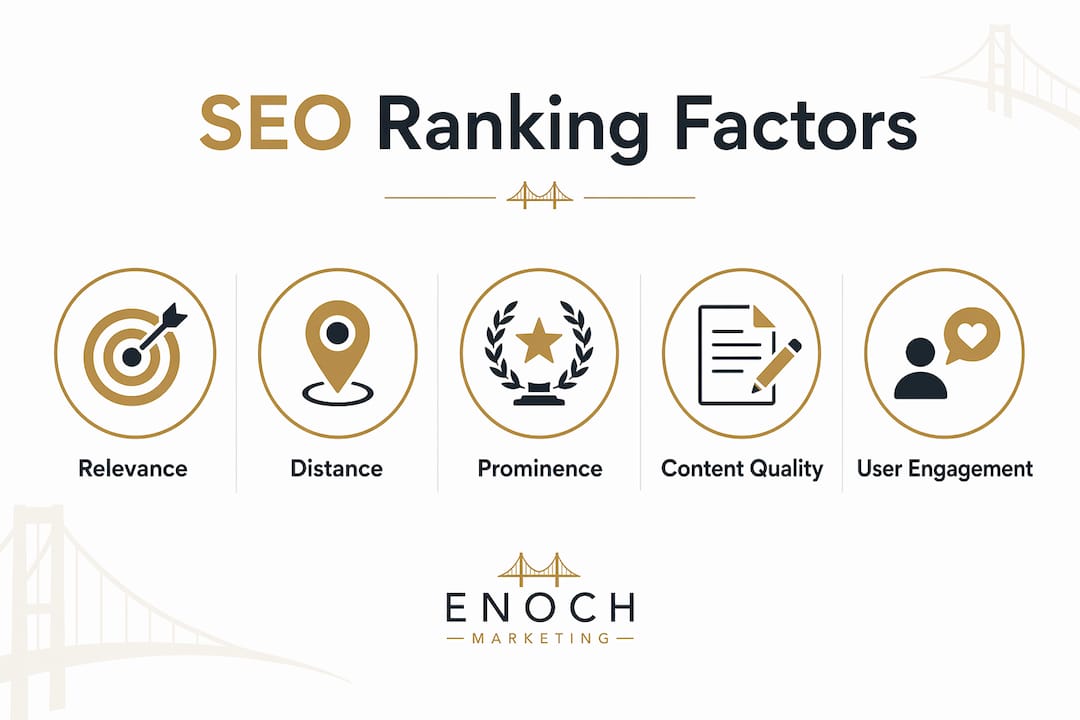
Relevance is how well your content matches what someone searched. Targeting "gym" as a keyword is a losing strategy because the competition is enormous and the intent is vague. Dominating a tight three-mile radius for specific long-tail terms like "CrossFit classes in [neighborhood]" or "personal training for women in [city]" produces faster, more consistent wins. These terms have lower competition and higher purchase intent.
Distance is largely outside your control, but you can compensate with strong local signals. Google's local pack ranking depends heavily on review volume, recency, and proximity relevance rather than brand authority. Strong citations on directories like Yelp, Apple Maps, and Bing Places reinforce your location data and help Google trust your address.
Prominence is built through reviews, backlinks, and content authority. Here is a breakdown of the primary ranking factors every fitness brand must address:
| Ranking factor | What to do |
|---|---|
| Google Business Profile | Complete every field, add photos weekly, post updates monthly |
| Hyperlocal keywords | Target neighborhood-level terms, not city-wide generic terms |
| Mobile site speed | Load in under 3 seconds on 4G; test with Google PageSpeed Insights |
| Review velocity | Aim for 5 to 10 genuine reviews per month, not batch bursts |
| On-page structure | Optimize title tags, H1 headers, meta descriptions, and URL slugs |
| Location pages | Create a dedicated page for each physical location or service area |
Pro Tip: Set up your Google Business Profile category as "Gym" or "CrossFit gym" rather than the generic "Fitness center." Specific categories match more precise search queries and improve local pack placement.
SEO strategies for fitness must align with user intent across discovery, consideration, and booking stages. A prospect searching "what is CrossFit" is at the top of the funnel. Someone searching "CrossFit gym near Bucktown Chicago" is ready to visit. Your content and keyword strategy need to serve both.
How does SEO boost local visibility and member acquisition?
Local SEO converts search interest into foot traffic, and the mechanism is the Google local pack. Those three map listings that appear at the top of a local search result capture the majority of clicks before anyone scrolls to the organic results below. Getting into that pack requires a specific sequence of actions.
Here is the process that moves a fitness brand from invisible to dominant in local search:
- Claim and fully optimize your Google Business Profile. Add your hours, services, photos, and a keyword-rich description. Incomplete profiles rank lower, period.
- Build consistent citations. Your name, address, and phone number must match exactly across Google, Yelp, Facebook, Apple Maps, and at least 20 niche directories. Inconsistencies confuse Google's location algorithms.
- Generate reviews at a steady pace. Consistent review velocity of 5 to 10 per month outperforms a one-time burst of 50 reviews followed by silence. Google interprets steady engagement as an active, trusted business.
- Respond to every review personally. Review quality matters more than quantity. A personal response to a negative review signals to both Google and prospective members that you are engaged and accountable.
- Create neighborhood-specific landing pages. If you serve multiple areas, build a dedicated page for each one with local testimonials, nearby landmarks, and area-specific keywords.
- Use your schedule and trial offers as conversion hooks. A visible, up-to-date class schedule with a clear "Book a Free Class" call to action turns organic visitors into leads the same day they find you.
Voice search is reshaping local discovery as well. Queries like "find a CrossFit gym open now near me" are conversational and location-specific. Optimizing your Google Business Profile hours and services for these natural-language queries positions you for voice-driven traffic from Google Assistant and Siri.
What content strategies work best for fitness brands' SEO?
Content is where fitness brands either build real authority or waste time producing generic posts nobody reads. The goal is topical depth on subjects your prospective members are actively searching for.
The highest-impact content types for fitness SEO include:
- Dedicated service pages for each class format, training specialty, and program. A page titled "HIIT Classes in [City]" ranks for that specific query. A generic "Classes" page ranks for nothing.
- Trainer bio pages with credentials, specialties, and client results. These pages rank for trainer-specific searches and build trust before a prospect ever walks in.
- Long-tail blog content targeting fitness goal queries like "how to lose weight with CrossFit" or "beginner strength training program for women over 40." These posts attract top-of-funnel traffic and build your site's topical authority.
- Comparison content that captures decision-stage intent. Content like "Online Coaching vs. Gym Membership" converts better than generic fitness tips because it reaches users who are actively comparing options and close to a decision.
| Content type | Primary SEO benefit |
|---|---|
| Service pages per class format | Ranks for high-intent local queries |
| Trainer bio pages | Builds trust and captures name searches |
| Long-tail blog posts | Drives top-of-funnel organic traffic |
| Comparison articles | Captures decision-stage, high-converting traffic |
| FAQ pages | Targets voice search and featured snippets |
Internal linking ties all of this together. Every blog post should link to a relevant service page. Every service page should link to a related blog or trainer bio. This structure distributes ranking authority across your site and keeps visitors moving toward a conversion. For more ideas on what to publish, the content ideas for fitness brands resource at Enochmarketing covers formats that consistently drive membership inquiries.
Pro Tip: Publish your resolution-focused content by November to capture the January fitness surge. Initial SEO traction for long-tail keywords takes 60 to 90 days, so timing your content calendar to seasonal demand spikes is a genuine competitive advantage.
Which technical SEO and UX factors affect fitness websites in 2026?
Technical SEO is the foundation that makes everything else work. You can publish great content and earn strong reviews, but if Google cannot crawl and index your site properly, none of it matters.
The most common technical mistake fitness brands make is burying their class schedule in a PDF or a third-party booking widget. Schedules buried in PDFs or proprietary widgets prevent Google from indexing that content, which means you lose visibility for every time-specific class query. The fix is straightforward: publish your schedule as HTML text on a dedicated page and add Event schema markup with instructor names, session times, and class descriptions. This unlocks rich result features for same-day class searches and puts your schedule directly in front of people looking for a class right now.
Beyond schedule indexing, these technical factors directly affect your rankings and conversion rates:
- Responsive mobile design. With over 80% of fitness searches happening on mobile, a site that renders poorly on a phone loses members before they read a single word.
- Page load speed. Google uses Core Web Vitals as a ranking signal. A fitness site loading in over three seconds on mobile loses both rankings and visitors.
- Location schema markup. Adding LocalBusiness schema to your site tells Google your exact address, hours, and service area, which strengthens local pack eligibility.
- Crawlability. Use Google Search Console to identify pages blocked by robots.txt or returning errors. Uncrawled pages cannot rank.
- Engagement metrics. Time on site, pages per session, and click-through rate from search results all influence rankings. A well-designed site with clear navigation and compelling calls to action improves all three.
Pro Tip: Run your gym's website through Google's PageSpeed Insights and address the top three mobile issues first. Most fitness sites fail on image compression and render-blocking JavaScript, both of which are fixable without a full redesign.
Top fitness operators treat their website as the primary member acquisition channel, refreshing class schedules, staff photos, and promotional offers quarterly. A stale website signals to both Google and prospective members that the business is not active.
Key takeaways
SEO for fitness brands works when it combines hyperlocal keyword targeting, mobile-first technical setup, and conversion-focused content that guides prospects from search to membership.
| Point | Details |
|---|---|
| Hyperlocal keywords win | Target neighborhood-level terms, not broad keywords like "gym," for faster and more consistent rankings. |
| Mobile optimization is non-negotiable | Over 80% of fitness searches happen on mobile, making site speed and responsive design direct ranking factors. |
| Reviews drive local pack placement | Steady review velocity of 5 to 10 per month outperforms batch bursts and signals ongoing business activity to Google. |
| Schedules must be indexable | Publish class schedules as HTML with Event schema, not PDFs, so Google can rank your pages for time-specific queries. |
| Content depth builds authority | Dedicated service pages, trainer bios, and comparison content outperform generic blog posts for high-intent fitness searches. |
Why most gym websites are invisible and what actually fixes it
After working with fitness brands across the country, the pattern is consistent: gym owners build a website, post it online, and assume people will find it. They won't. A website without SEO is a brochure nobody reads.
The mistake I see most often is chasing broad keywords. A gym owner wants to rank for "CrossFit" or "personal trainer" and wonders why they're on page seven. Those terms are dominated by national publications, aggregators, and brands with decade-long domain authority. You cannot out-spend them. You can out-local them.
The gyms that win in organic search are the ones treating their website as a living acquisition tool, not a static page. They update their schedule every week. They respond to every Google review within 24 hours. They publish one blog post per month targeting a specific question their members actually ask. None of this is complicated. Most of it is just consistency.
The other thing I'd push back on is the idea that SEO takes too long to matter. Long-tail keywords show traction in 60 to 90 days. That's two to three months before you start seeing organic leads from content you publish today. Compare that to paid ads, where you stop the moment the budget runs out. SEO is the only marketing channel where your past work keeps paying you.
SEO visibility alone is not enough, though. The content has to build trust and guide the visitor toward a clear next step. Ranking on page one means nothing if the page they land on has no offer, no social proof, and no way to book a class. Fix the traffic and the conversion at the same time.
— Collin
How Enochmarketing helps fitness brands dominate local search
Enochmarketing builds and executes SEO strategies exclusively for CrossFit gyms and fitness brands across the United States. The agency handles everything from Google Business Profile optimization and local citation building to on-page content, technical audits, and paid media campaigns that complement organic growth.
If your gym is invisible in local search or relying entirely on referrals to grow, the fitness marketing services at Enochmarketing are built for exactly that problem. The process starts with a full audit of your current digital presence, followed by a custom strategy aligned to your location, competition, and membership goals. Book a free strategy session at Enochmarketing to see where your gym stands and what it would take to rank in the local pack.
FAQ
What is SEO for fitness brands?
SEO for fitness brands is the practice of optimizing a gym's website, Google Business Profile, and online content to rank higher in local search results and attract new members organically. It combines hyperlocal keyword targeting, mobile optimization, review management, and structured content to convert search traffic into memberships.
How long does fitness SEO take to show results?
Long-tail keyword rankings typically show traction within 60 to 90 days, while competitive terms like "gym near me" take four to six months of consistent effort. Publishing seasonal content in advance, such as resolution-focused posts by November, can accelerate results.
What are the most important local SEO ranking factors for gyms?
Google ranks local gyms based on distance, review volume and recency, and relevance of your content to the search query. Strong local citations and review velocity can compensate for lower brand recognition and help smaller gyms outrank larger competitors in the local pack.
Why should fitness brands avoid PDFs for class schedules?
Schedules published as PDFs or embedded in third-party booking widgets cannot be indexed by Google. Publishing schedules as HTML with Event schema markup makes that content searchable and eligible for rich results in same-day class queries.
Is SEO better than paid ads for gyms?
SEO provides compounding returns over time, while paid ads deliver immediate but temporary traffic. After the initial ramp-up period, an optimized fitness site generates consistent organic traffic without ongoing cost per click, making SEO the stronger long-term investment for member acquisition.