
Why storytelling is the most powerful tool in your marketing arsenal
Storytelling in marketing is the practice of building narratives that connect your brand to customers through emotion, identity, and shared values rather than product specs or price points. Done well, it transforms a transaction into a relationship. The brands that consistently win attention and loyalty are not the ones with the loudest ads. They are the ones telling the most resonant stories.
Here is what storytelling actually accomplishes for a brand:
- Creates emotional connections that make customers feel seen, not sold to
- Builds trust by showing values in action rather than just stating them
- Differentiates your brand in crowded markets where features and pricing look identical
- Drives loyalty and advocacy by giving customers a narrative they want to be part of
- Unifies your message across every channel, from paid ads to customer service scripts
The core function is identity. When your story positions the customer as the hero of their own transformation, your brand stops being a vendor and starts being a guide they trust. That shift changes everything about how people engage with your marketing.
Why storytelling works so well in marketing
The answer starts in the brain. Neuroscience shows that imagining a positive future outcome activates the brain's reward centers more powerfully than processing a list of product features. When a story lets someone picture who they could become, the brain responds as if that transformation is already happening. That is a fundamentally different reaction than reading a spec sheet.

Consumers have also grown resistant to aggressive selling. Hard-sell advertising triggers skepticism, not desire. Storytelling sidesteps that resistance because it does not feel like a pitch. A brand that shares authentic stories about real struggles and real outcomes earns attention that a promotional ad never could. People lean in rather than scroll past.
The loyalty numbers back this up. Emotionally engaged customers are three times more likely to recommend a brand than customers who feel no emotional connection. That is not a marginal difference. Referrals and word-of-mouth are among the highest-converting acquisition channels, and storytelling is one of the most reliable ways to generate them.
Psychologist Jerome Bruner's research found that people remember stories 22 times more than facts and figures alone. That retention gap explains why a brand with a clear narrative stays top of mind long after a competitor's feature comparison has been forgotten.
Emotionally engaged customers are three times more likely to recommend a brand than those without an emotional connection to it.
What makes a marketing story actually work: core elements and structures
Effective brand storytelling is not just "tell a nice story." It requires three structural elements working together: plot, character, and purpose. A scholarly review of storytelling marketing found that managing these three elements consistently is what separates storytelling as a strategic asset from storytelling as a one-off creative tactic.
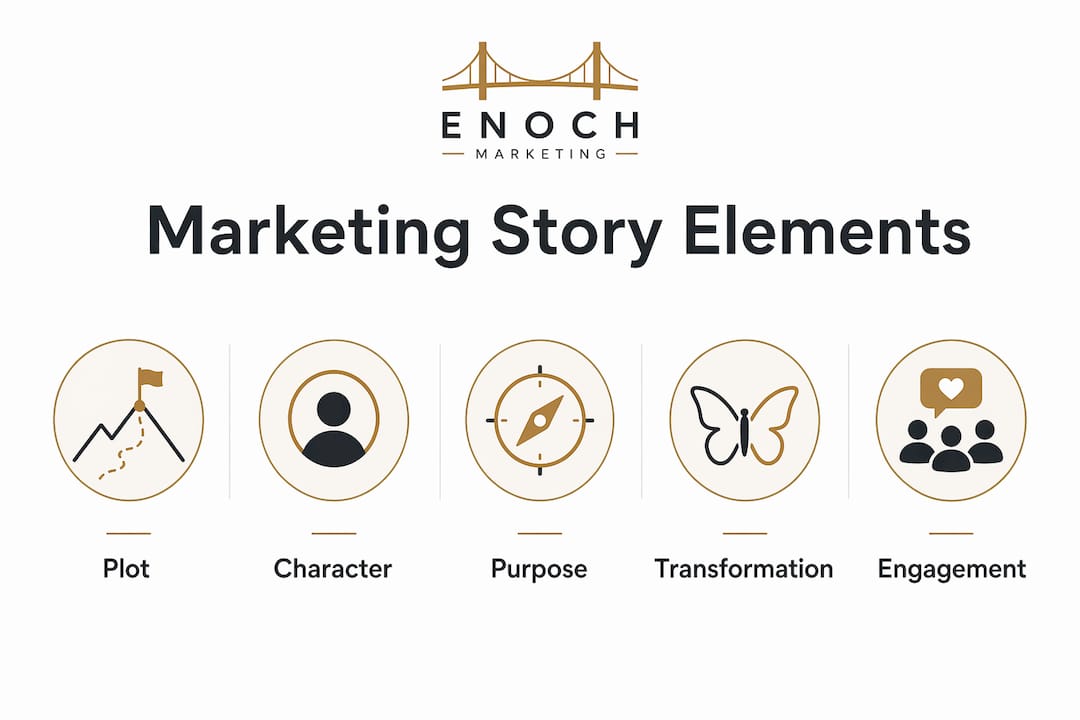
Plot gives the narrative momentum. Something has to change. Without a challenge, a turning point, and a resolution, you have a description, not a story.
Character determines who the audience roots for. The most common mistake brands make is casting themselves as the hero. The customer is the hero. Your brand is the guide, the mentor, the tool that makes the transformation possible. That reframe is not subtle. It completely changes how a message lands.
Purpose is the "why" underneath the story. It answers what the brand stands for beyond the product, and it is what makes a story feel worth sharing.
The transformation story framework puts these three elements into a repeatable structure:
| Narrative structure | Core beats | Best marketing application |
|---|---|---|
| Transformation story | Relatable challenge, brand as guide, vivid positive outcome | Testimonials, case studies, brand films |
| Hero's Journey | Call to adventure, conflict, resolution or reward | Long-form content, brand origin stories |
| Problem-Solution | Pain point, solution introduced, result achieved | Paid ads, landing pages, email sequences |
| Before-and-After | Current state, intervention, transformed state | Social proof, user-generated content |
The transformation story structure deserves extra attention because it positions the customer as the hero encountering a real challenge, with the brand stepping in as the guide that enables a breakthrough. The three beats are: a relatable struggle the audience recognizes in themselves, a guiding solution the brand provides, and a vivid representation of the positive outcome. That third beat is where most brands underinvest. Showing what life looks like after the transformation, in specific and sensory terms, is what makes the story stick.
Pro Tip: When writing a transformation story, describe the "after" state in the customer's own language, not your brand's language. Pull phrases directly from customer reviews or interviews. The more precisely the outcome mirrors how your audience already thinks about success, the more powerfully the story will resonate.
How to build storytelling into your marketing strategy
Start with a messaging audit
Before you write a single story, look at what your current marketing actually says. Pull your homepage copy, your top-performing ads, and your most recent email campaigns. Ask one question: is the customer the hero, or is the brand? Most audits reveal that the brand is talking about itself. Features, awards, years in business. That is the gap storytelling fills.
Build your transformation narrative
The foundation is a single, clear story about the customer you serve. Answer these questions in writing:
- Who is your customer, and what does their life look like before they find you?
- What is the specific struggle or frustration they are trying to resolve?
- How does your brand guide them through that challenge?
- What does their life look like after the transformation?
Keep the core narrative to 200–300 words. That constraint forces clarity. Once you have it, every piece of content you create should draw from this foundation.
Make the transformation process visible
Generic success claims do not move people. Showing the actual journey, including the struggles and the specific breakthroughs, provides social proof that goes deeper than a five-star rating. A member who describes the exact moment they stopped dreading Monday morning workouts is more persuasive than any headline you could write.

Adapt the story for each channel without losing the core
The narrative stays consistent. The format changes. A transformation story that runs as a 60-second video on Instagram becomes a written case study on your website, a subject line in an email sequence, and a talking point in a sales conversation. Social media platforms are particularly effective for shareable, emotionally resonant stories that generate user-generated content and organic advocacy.
Distribute the story across every department
This is where most brands leave value on the table. Your brand story should not live only in the marketing department. Integrating the narrative across HR, sales, and PR creates a unified voice that customers experience as consistent and trustworthy, regardless of which touchpoint they encounter first.
Pro Tip: Track storytelling impact beyond clicks and impressions. Measure engagement depth (comments, shares, saves), identity adoption (customers describing themselves using your brand's language), and narrative resonance (how often your story framework appears in customer-generated content). These signals tell you whether the story is actually landing.
Expert insights and real-world frameworks that prove the approach
The psychology behind transformation stories
The most durable insight from marketing psychology is that people do not buy products. They buy better versions of themselves. Transformation stories outperform feature lists because they appeal directly to that motivation. When a story shows a customer who looked exactly like your prospect achieving an outcome your prospect wants, the brain does not just process information. It rehearses the transformation. That rehearsal creates desire in a way that no feature comparison can replicate.
Visible struggle is part of what makes transformation stories credible. A story that skips straight from "I had a problem" to "everything is great now" feels manufactured. Authentic transformation narratives show the hard middle, the setbacks, the moment of doubt before the breakthrough. That honesty is what separates a story that builds trust from one that reads like a press release.
Consistency as a long-term brand asset
A single great story does not build a brand. A consistent narrative framework, applied across every customer touchpoint over time, does. Long-term narrative consistency signals reliability. Customers who encounter the same core story in a Facebook ad, on a website, and in a follow-up email from a sales rep develop a level of trust that one-off campaigns cannot manufacture.
"Story marketing is the practice of building a series of consistent narratives that help position your brand over time. The stories you tell center around your clients, the problems you solve for them, as well as your company's culture and experience." — American Marketing Association
How Enochmarketing applies this in fitness marketing
Enochmarketing works exclusively with CrossFit gyms and fitness brands across the United States, and the transformation story framework is central to how the agency builds campaigns that actually convert. The fitness category is saturated with gyms competing on price, equipment, and location. None of those are differentiators that build loyalty. What does build loyalty is a story about who a member becomes after joining.
Enochmarketing's approach frames the gym member as the hero of a physical and personal transformation, with the gym as the guide that makes it possible. That narrative runs through paid media on Meta and Google, through social content, through local SEO copy, and through the gym's own member communication. The gym member storytelling system Enochmarketing uses captures real member milestones and turns them into content that attracts prospects who see themselves in those stories. The result is a marketing ecosystem where the story does the selling, and the gym's team focuses on delivering the transformation it promises.
For fitness brands specifically, the role of storytelling in fitness marketing goes beyond brand awareness. It directly drives membership inquiries from people who already believe in the transformation before they walk through the door.
A practical framework for developing customer-hero narratives
Building a customer-hero narrative does not require a creative agency or a film crew. It requires a process:
- Collect raw material. Interview three to five current members or customers. Ask them to describe their life before they found you, the moment they decided to commit, and what has changed since. Record the exact words they use.
- Identify the pattern. Across those interviews, a common struggle and a common transformation will emerge. That pattern is your story.
- Write the core narrative. Draft a 200–300 word story using the transformation structure: relatable challenge, brand as guide, vivid outcome. Use the customer's language, not yours.
- Test it on one channel. Run the story as a social post, an email, or a short video. Measure engagement depth, not just reach.
- Refine and scale. Use what you learn to sharpen the narrative, then distribute it across every channel and department.
Key Takeaways
Storytelling works in marketing because it shifts the message from product promotion to identity transformation, which is what actually drives emotional connection, loyalty, and referrals.
| Point | Details |
|---|---|
| Customer as hero | Positioning the customer as the hero, not the brand, drives deeper emotional engagement and identity-based buying. |
| Emotional engagement drives referrals | Emotionally engaged customers are three times more likely to recommend a brand than those without a connection. |
| Stories are remembered | People remember stories 22 times more than facts and figures alone, giving narrative a lasting retention advantage. |
| Consistency builds trust | Applying the same narrative framework across HR, sales, PR, and digital touchpoints signals reliability over time. |
| Measure beyond clicks | Track engagement depth, identity adoption, and narrative resonance to evaluate whether a story is genuinely landing. |
Ready to put this into practice for your gym?
Enochmarketing builds transformation-driven marketing systems exclusively for CrossFit gyms and fitness brands. If your current marketing talks more about your equipment than your members' results, that is the gap we close. From paid media campaigns to social content and local SEO, every tactic we run is grounded in the story of who your members become.
Explore Enochmarketing's gym marketing services and book a free strategy session to see exactly how a narrative-first approach can grow your membership.