
Run a locked-rate founding-member pre-sale, start it six to eight weeks before you open, and set weekly signup targets tied to your break-even membership count. Lean on local outreach and referrals first, since they cost less and convert better than cold ads. Bring in paid advertising only once you have real proof points, like member photos or booked-tour numbers, to show a cold audience.
TL;DR:
- Focus on local outreach and referrals in the early weeks to build credibility before scaling into paid advertising with proven proof points.
- Set a clear, time-limited founding-member offer with a rate 15-30% below the regular price and a fixed cap to create urgency and exclusivity.
- Use a structured timeline of six to eight weeks, reporting key metrics weekly and adjusting strategies if targets are missed, rather than relying solely on discounts.
- Prioritize referral incentives and community partnerships to generate higher-quality leads and longer retention, rather than focusing on open-ended discounts or free trials.
- Work with a specialized gym marketing provider to ensure integrated campaigns, targeted messaging, and efficient lead follow-up aligned with your opening goals.
Table of Contents
- What Is Gym Pre-Sale Marketing?
- How Do You Structure a Founding-Member Offer?
- Which Marketing Channels Should You Use, and When?
- Which Promotion Structures Actually Work?
- How Should You Build Referrals and Community Buzz?
- What's the Right Timeline and Which Metrics Matter?
- How Do You Run a Launch Event That Converts?
- Why Work With a Fitness Marketing Specialist?
- How Do You Build Buyer Personas for Pre-Sale Messaging?
- How Do Local Business Partnerships Boost Pre-Sales?
- How Can Content Build Anticipation Before You Open?
- How Do Testimonials Build Credibility With No Members Yet?
- How Should You Segment Your Pre-Sale Email List?
- What Legal Rules Apply to Gym Pre-Sale Offers?
- The Founding-Member Model Rewards Discipline, Not Generosity
- Run Your Pre-Sale With a Team That Only Works With Gyms
- Sources
- FAQ
What Is Gym Pre-Sale Marketing?
Gym pre-sale marketing is the set of campaigns and offers you run before your doors open to sign paying members and fund your first months of operation. It's a distinct discipline from standard fitness center promotions because you have no facility, no classes, and no member reviews to point to. Every one of your fitness pre-sale tactics has to sell a promise instead of a product.
The engine behind that promise is the founding-member offer: a locked-in rate available only during the pre-sale window, closed the day you open or once a set number of spots sell out. Done right, it turns strangers into advocates before they ever set foot inside. Done wrong, with vague discounts and no deadline, it trains your local market to wait for a better deal that never comes.
How Do You Structure a Founding-Member Offer?
The mechanics of the offer matter more than the size of the discount. A locked rate that stays roughly the same for as long as a member keeps their account active gives people a reason to commit today rather than "wait and see." Locked founding-member discounts perform better than free-month promotions because they select for members who actually intend to show up, not bargain hunters chasing a freebie.
A few structural decisions shape whether the offer converts:
- Price the founding rate somewhere between 15% and 30% below your planned regular rate, deep enough to feel like a real reward, shallow enough that your regular price still looks fair later.
- Lock the rate for as long as the membership stays active, rather than handing out free months that expire and leave nothing behind.
- Give the tier a name, like "Founding Member" or "Charter Member," so it becomes an identity people want to claim and mention to friends.
- Set a hard close: either opening day or a fixed number of spots, whichever comes first, and hold that line publicly.
Pro Tip: Announce the founding-member cap as a number, not a vague "limited spots." "50 Founding Memberships available" gives people something concrete to race against.
Which Marketing Channels Should You Use, and When?
Sequence matters more than channel choice. Local, face-to-face channels build the credibility that makes paid ads convert later, so starting with organic and community outreach before scaling into paid media protects your budget from paying for attention you haven't earned yet.
- Weeks 1 to 2: Local organic groundwork. Post teaser content, join neighborhood Facebook groups, hang signage in your storefront window, and drop flyers with nearby businesses.
- Weeks 2 to 4: Social content sequence. Move from teasers to a full reveal, then a countdown, then member spotlights once your first founding members sign on.
- Weeks 4 to 6: Layer in paid ads once you have some proof points, like a signed-member count or a few testimonials.
- Weeks 6 to 8: Push retargeting hard against everyone who engaged but didn't book, and spike urgency as the deadline nears.
For the paid layer, target local-intent Google keywords like "gym near me" and "24-hour gym [neighborhood]," and run Meta campaigns geofenced tightly around your location rather than a broad metro radius. A practical budget split of cold, warm, and hot audiences keeps you from overspending on strangers who aren't ready to book a tour.
Whatever channel sends the click, your landing page has to match the promise exactly. If the ad says "$1 enrollment for founding members," the page headline should say the same thing, with one short form and a visible countdown or spot counter. A detailed local ads tutorial walks through campaign structure if you're building this yourself.
Which Promotion Structures Actually Work?
Free trials and no-enrollment offers generate clicks, but they attract people testing the water, not people planning to stay. A locked founding rate does the opposite: it asks for a real decision up front, which is why it tends to produce steadier revenue than open-ended discounting.
A few structures worth testing:
- Tiered founding spots, where the first 20 sign-ups get the deepest discount and the next 30 get a smaller one.
- Enrollment-fee waivers instead of a monthly discount, which protects your recurring revenue while still lowering the barrier to join.
- Bundled perks, like a branded T-shirt or one free personal training session, that add perceived value without touching your price.
Pro Tip: Never leave a founding rate open-ended. An offer with no deadline isn't urgent, it's just your regular price with extra paperwork.
How Should You Build Referrals and Community Buzz?
Referral leads convert around 30% better than other channels, and referred members retain noticeably longer, which makes referral the highest-leverage tactic available during a pre-sale.
Structure it as a dual-sided reward: both the referrer and the new member get something, whether that's a free month, merch, or an app credit. Build the ask directly into onboarding messages and your first welcome email, not as an afterthought three weeks in. Publicly recognizing early members through spotlights or coach profiles tends to generate the kind of shareable content that drives the next round of referrals. Track referral conversion rate and retention separately from your other channels so you know exactly how much weight to put behind it as you scale.
What's the Right Timeline and Which Metrics Matter?
A six-to-eight-week pre-sale window gives you enough runway to build momentum without losing urgency, provided you set weekly signup targets tied to your break-even membership count from day one.
Here's the weekly rhythm:
- Set a break-even membership number, then divide it across your remaining weeks to get a weekly target.
- Report five KPIs every week: cost per lead, cost per booked tour, show rate, cost per join, and (once you're open) day-30 and day-90 retention.
- Tag every lead in your CRM by source and campaign so you know which channel is actually producing joins, not just clicks.
- If you're behind pace two weeks running, don't discount deeper. Add a local activation, host a pop-up event, or spike urgency around the remaining spot count instead.
Missing your weekly target early is a signal to shift channels, not to panic-discount at the finish line. A full KPI breakdown for gym marketing covers how to set these benchmarks correctly for your market size.
How Do You Run a Launch Event That Converts?
Structure the event around short class previews, meet-the-coach slots, and a branded photo zone, then publicly recognize your founding members so they feel like the reason the room is full. Invite the founding members and their guests, plus local press, micro-influencers, and nearby businesses you've partnered with.
The real conversion work happens in the 72 hours after. A structured follow-up sequence within that window is often the second-highest-converting stretch of the entire launch, right behind the founding-member campaign itself. Send an immediate thank-you email, follow with an SMS reminder, and include a direct booking link for induction slots, not a generic "contact us" form.
Pro Tip: For attendees who didn't sign up on the spot, offer a short, time-limited "last call" founder rate and follow up personally rather than letting them slip into your general email list.
Why Work With a Fitness Marketing Specialist?
A specialist bundles paid media, landing pages, local SEO, and automated follow-up into one accountable system instead of five disconnected vendors. Before hiring one, ask for case studies, sample funnels, and their reporting cadence, then hand them a short brief: your target cost per acquisition, your timeline, and how often you expect updates.
- Request proof of past results, not just promises: KPI dashboards, sample landing pages, and campaign screenshots.
- Confirm reporting frequency upfront. Weekly, at minimum, during a pre-sale.
- Give them your break-even number and timeline before the first call, not after.
How Do You Build Buyer Personas for Pre-Sale Messaging?
Generic messaging ("Join our gym!") loses to specific messaging every time in a pre-sale, because you're selling to strangers with zero brand familiarity. Building two or three buyer personas before you write a single ad forces you to speak to real motivations instead of guessing.
Start by mapping who's actually near your location: busy parents who need childcare-adjacent hours, competitive lifters who care about equipment specs, or beginners intimidated by traditional gyms. Each persona should include their biggest hesitation, since that's what your ad copy needs to answer directly. A parent's hesitation might be scheduling; a beginner's might be embarrassment about their fitness level.
Once personas exist, split your ad sets and email sequences by persona rather than blasting one message to everyone. The beginner persona might respond to "no judgment, ever" messaging with a photo of a welcoming coach, while the competitive lifter responds better to equipment photos and class intensity. This is also where your founding-member naming convention can flex. "Founding Family Membership" might outperform "Founding Membership" with the parent segment specifically.
Test messaging in small batches before committing your full ad budget to one angle. A headline that performs well with one persona in week two can guide how you write copy for the remaining six weeks, saving you from guessing your way through the entire pre-sale window.
How Do Local Business Partnerships Boost Pre-Sales?
Cross-promotion with nearby businesses extends your reach into audiences who already trust a local brand, at a fraction of the cost of paid ads. A juice bar, a physical therapy clinic, or a local sports league all share your target customer without competing for the same membership dollar.
Structure these as genuine trades, not one-sided asks. Offer the juice bar's customers a founding-member discount code in exchange for a stack of your flyers on their counter, or co-host a free community workout with a local running club. Youth sports leagues and school athletic programs are particularly strong partners, since parents there are already primed to spend on fitness and often want off-season training options for their kids.

Local chambers of commerce and small-business associations can also amplify your opening through their own newsletters and event calendars, often for free or a small membership fee. The goal isn't a single big partnership. It's five or six small ones running simultaneously, each feeding a trickle of qualified local traffic into your landing page throughout the pre-sale window.
How Can Content Build Anticipation Before You Open?
A short blog and email sequence does something ads can't: it builds a narrative arc that makes people feel like they're following your story, not just seeing another ad. Start with a founder's story post explaining why you're opening this gym in this neighborhood, then follow with content about your equipment, your coaching philosophy, and your class formats.
Email deserves more attention than most gym owners give it during pre-sale. A five-email welcome sequence for anyone who joins your list, spaced two or three days apart, keeps your gym top of mind without feeling pushy. The first email can introduce the founding-member offer, the second can spotlight a coach, the third can answer common objections like parking or class scheduling, and the last can carry urgency about the closing deadline.
Blog posts don't need to be long to work here. A 400-word post titled "5 Things Your First Week at [Gym Name] Looks Like" does more to reduce first-visit anxiety than a polished ad ever will, and it's the kind of content that keeps showing up in local search results long after your pre-sale ends.
How Do Testimonials Build Credibility With No Members Yet?
The obvious problem with pre-sale credibility is you don't have members yet to quote. The workaround is borrowing proof from adjacent sources: your coaches' personal transformation stories, testimonials from a previous location or role if you've run a gym before, or reactions from your first handful of founding members captured the moment they sign.
As soon as your first five or ten founding members commit, ask them on the spot why they joined and what convinced them. A short quote like "I signed up the day I heard about the locked rate" is more persuasive on your landing page than any stock copy you could write yourself. Member-shot photos and short local video clips tend to outperform polished, generic ad creative precisely because they read as real rather than produced.
Coach bios carry weight too. A short paragraph and photo for each coach, with their certifications and a sentence about their coaching style, gives prospective members someone to picture themselves training with before opening day arrives.
How Should You Segment Your Pre-Sale Email List?
One email blast to your entire list wastes the data you're already collecting. Segment by where someone sits in the funnel: people who filled out a form but haven't booked a tour, people who booked but didn't show, and people who toured but haven't committed to the founding-member offer.
Each segment needs a different message. The no-show segment needs a simple rebooking link and maybe a mild incentive, not another sales pitch. The toured-but-undecided segment needs urgency about the closing deadline and maybe a direct reply from you addressing their specific hesitation, if your booking system captured one. The form-fill-only segment needs nurture content, like the anticipation-building blog and coach-spotlight emails described earlier.
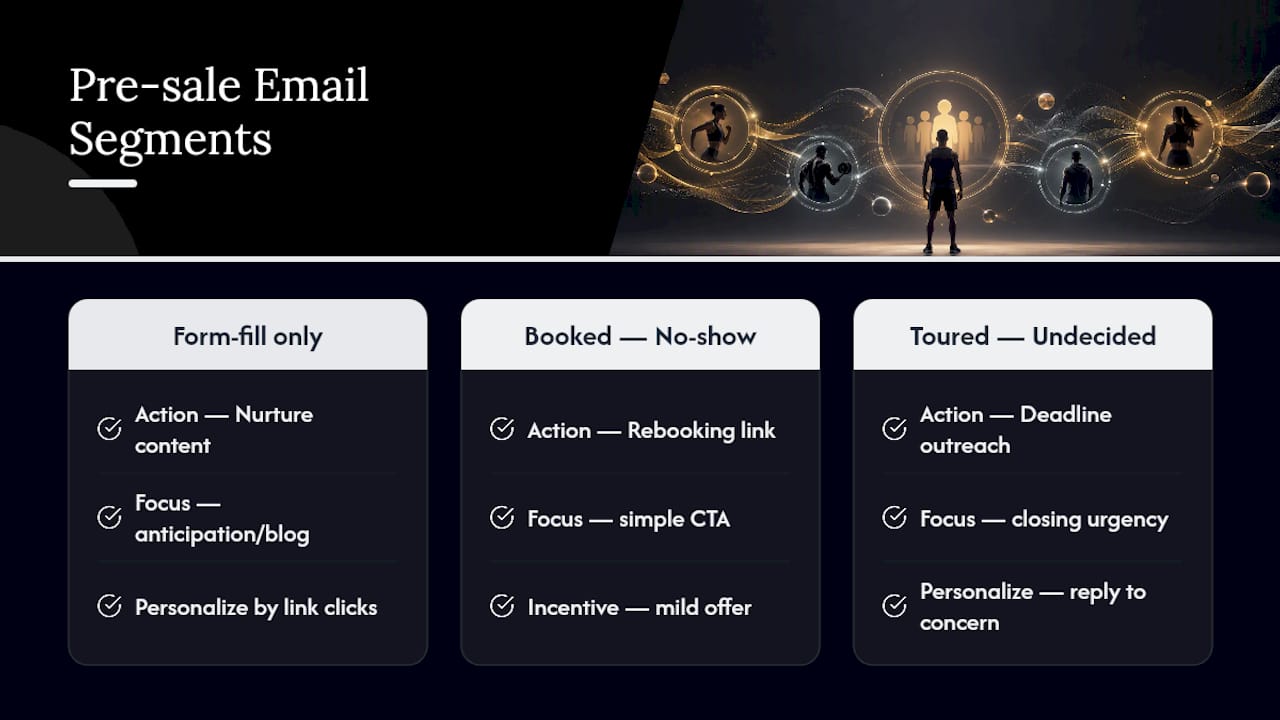
Personalization beyond first-name tags matters here too. If someone clicked a link about your morning classes, your next email to them should lead with morning-class scheduling, not evening class times. Most CRM and email platforms make this kind of behavior-based segmentation straightforward to set up, and it consistently outperforms one-size-fits-all sends during a pre-sale window when every lead matters.
What Legal Rules Apply to Gym Pre-Sale Offers?
Pre-sale promotions sit inside consumer protection rules that vary by state, so a "founding rate locked forever" claim needs to be genuinely accurate or it exposes you to complaints. Any advertised discount should reflect a real, verifiable everyday price you intend to charge, not an inflated comparison price invented to make the discount look bigger.
Contract terms matter just as much as the marketing copy. If you're collecting payment or signed agreements before your facility legally exists or before you've secured your certificate of occupancy, check your state's rules on pre-sale deposits and refund obligations. Some states require pre-sale funds to be held in escrow or refunded automatically if the gym fails to open by a stated date. Automatic renewal clauses in membership contracts also face increasing scrutiny under state auto-renewal laws, so make sure your founding-member agreement discloses renewal terms clearly rather than burying them in fine print.
None of this is a substitute for a lawyer familiar with your state's health club contract statutes, but building your offer with real deadlines, real prices, and clear renewal terms from the start avoids most of the trouble gym owners run into after the fact.
The Founding-Member Model Rewards Discipline, Not Generosity
Most gym owners over-discount because they're nervous about opening with empty class schedules. That instinct is backwards. The research on this is consistent: locked-rate offers with a real deadline outperform free months and open-ended discounts, because they select for members who intend to stay, not people testing whether you'll cave on price later.
The conventional advice to "get people in the door however you can" misses what actually determines whether a gym survives its first year: retention, not initial signups. A founding-member campaign that hits its weekly targets through referrals and local partnerships, then adds paid ads only once you have proof points to show a cold audience, will almost always outperform a campaign that leans on ads from day one because it feels faster.
If you take one thing from this, prioritize your weekly pacing targets over your total signup goal. A gym that's slightly behind pace in week three but tracking referral conversion and cost per booked tour accurately can course-correct. A gym that's "on track" by total number but has no idea which channel is driving it will discover the problem the week paid ads stop working and nothing replaces them.
— Collin
Run Your Pre-Sale With a Team That Only Works With Gyms
An alternative to piecing together a pre-sale from multiple freelancers is a single accountable system that integrates ads, landing pages, and lead follow-up tailored for gyms and fitness studios.
The engagement flow is straightforward: an audit of your market and timeline, a custom strategy built around your opening date and break-even number, a launch that covers paid media and lead follow-up together, then scaling once the doors are open. Services map directly onto everything covered above, from local SEO and reputation building to paid advertising on Google and Meta to landing pages built to convert and lead follow-up that books qualified visits. If you'd rather have someone manage your referral flows and class scheduling, Kwoon's club management software pairs well with a pre-sale campaign built this way.
Packages start at $1,500 a month with the Get Found plan, scaling up through Fill the Floor and Growth Engine depending on how much of the pre-sale you want handled for you. Book a strategy session to walk through your opening date and see which package fits your timeline.
Sources
- Promoting a Gym: 2026 Guide to Membership Growth - JoinBrands
- Gym Marketing in 2026: The Full Playbook
- Grand Opening Strategy for Fitness Studios: The Pre-Launch Campaign That Fills Your First Month — Zatrovo Blog
- 10 Gym Marketing Tactics To Grow Your Membership Base (2026) - Shopify
FAQ
What Are Some Effective Marketing Ideas for Gyms?
Locked-rate founding-member offers, referral programs with dual-sided rewards, and local business cross-promotions consistently outperform generic discount ads, especially before a gym has any members to point to as proof.
Is $40 a Month a Lot for a Gym?
It depends entirely on the local market and what's included. A rate at a full-service gym in a lower-cost area can be competitive, while the same price at a boutique studio in a dense city might undercut the everyday rate you need to hit break-even.
How Do Gyms Attract Customers?
Gyms attract early customers through local organic outreach, referral incentives, and time-limited founding-member pricing, then layer in paid ads targeted at proven, near-term buyers once they have testimonials and photos to work with.
Why Is Gen Z Obsessed With the Gym?
Younger members increasingly treat gym attendance as a social and identity marker, not just exercise, which is part of why founding-member community naming and public recognition tend to drive strong referral behavior in that age group.
How Long Should a Gym Pre-Sale Campaign Run?
Most successful pre-sale campaigns run six to eight weeks before opening day, long enough to build weekly momentum without losing the urgency that a locked-rate deadline creates.