
Good gym brand messaging fits a simple formula: name your exact member, state the one benefit that matters most to them, then add what makes your gym the only place to get it. A working example: "We help busy parents in [town] get 30 minutes stronger, three times a week, with coaches who know their name." Write your own version today, read it out loud, and cut anything a stranger wouldn't understand in three seconds.
TL;DR:
- Clear messaging should target a specific audience with a filter to improve lead quality and filter out members unlikely to stay long.
- The spoken and written message must include five key elements: a named audience, a promise, proof, a consistent voice, and matching sensory cues.
- Developing a one-sentence message involves identifying the audience, stating the transformation, adding differentiation, and testing for clarity and impact.
- The message should be consistent across all touchpoints, including the website, ads, staff scripts, and visual content, to avoid breaking trust.
- Tracking ad click-through rates, conversion, and retention, along with regular audits of messaging across channels, ensures the message remains effective and aligned with actual service.
Table of Contents
- What Is Gym Brand Messaging, and Why Does It Affect Revenue?
- What Five Elements Does Every Gym Message Need?
- How Do You Write a One-Sentence Gym Brand Message?
- What Are Some Gym Messaging Examples I Can Copy?
- Where Should Your Gym's Message Actually Show Up?
- How Do You Know If Your Messaging Is Actually Working?
- What Does a Full Messaging Audit Look Like?
- The Mistake That Quietly Kills Gym Messaging
- Get Your Gym's Message Built by People Who Only Work With Gyms
- Sources
What Is Gym Brand Messaging, and Why Does It Affect Revenue?
Gym brand messaging is the specific language you use to explain who you serve, what you deliver, and why a prospect should pick you over the gym down the street. It's not your logo, your color palette, or your Instagram grid. Those are visual identity. Messaging is the sentence a front-desk staffer says on the phone, the headline on your homepage, and the copy in your ad.
Vague messaging pushes gyms into price wars because prospects can't tell you apart from anyone else, so they shop on cost. Sharp messaging pre-qualifies leads, filtering in the members who actually want what you offer and filtering out the ones who'll churn in 60 days over a $10 price gap. Industry guidance on gym growth backs this up directly: strong positioning reduces price-driven churn by attracting people who value your specific outcomes rather than the cheapest monthly rate.
The business case in short:
- Clear messaging shortens the sales conversation because the prospect already knows what you do before they walk in.
- It raises price tolerance, since members who chose you for a specific reason resist competitor discounts.
- It improves retention, because expectations match reality from day one.
What Five Elements Does Every Gym Message Need?
An auditable gym message includes five parts. Miss one and the whole thing gets vague fast.
- A named audience. "Busy professionals" is weak. "Working parents in their 30s and 40s who have 45 minutes before daycare pickup" is a filter, and filters are what make messaging work. Being exclusionary on purpose, deliberately not trying to appeal to everyone, is what lets the rest of your copy get specific.
- A stated promise. Translate your service into the outcome the member actually wants. Not "group fitness classes" but "leave every session knowing exactly what you accomplished." The benefit is the destination; the class format is just the vehicle.
- Believable proof. Claims need backup: a named head coach with a credential, a program cap of eight members per class, or a measurable outcome like average strength gains at 90 days. Proof turns a promise into a fact.
- A consistent voice. Decide if you sound like a drill sergeant, a supportive coach, or a data-driven trainer, and hold that line everywhere.
- Sensory and visual cues that match the voice. Music, lighting, even the smell of the gym should echo the same personality as your copy; examples of how beverage branding influences choices underline the importance of sensory cues in shaping perception.
How Do You Write a One-Sentence Gym Brand Message?
Building the sentence is a five-step process, and each step has a fast test attached so you don't ship something mushy.
- Name your primary audience in plain words. Skip demographics jargon. Write it the way you'd describe a member to a friend: "new moms getting back into a routine" or "guys over 40 who used to lift and stopped."
- State the transformation simply. One sentence, no adjectives you'd find on a supplement label. "Gets you strong enough to keep up with your kids" beats "unlock your ultimate potential" every time.
- Add the differentiator. This is your mechanism or experience: small-group coaching capped at ten, a proprietary tracking app, or a community that trains together at 5 a.m. before work. Gymshark's own repositioning shows how far a single differentiator can travel. The brand narrowed its entire platform to "We Do Gym," a three-word idea built to be understood in under two seconds, and used it to filter product and marketing decisions across the company.
- Compress to one or two sentences. Then run the 3-second clarity test: show it to someone unfamiliar with your gym and time how long it takes them to explain back what you do. If they hesitate or guess, cut a clause.
- Test it in the wild before committing. Run two headline variants on your website or in an ad set and see which gets more clicks. A quick poll in your gym's group chat works too, low cost, fast signal.
Pro Tip: Write five versions of your message, then delete the three that sound like they could belong to any gym in the country. If it works for your competitor too, it's not differentiation.
What Are Some Gym Messaging Examples I Can Copy?
Different gym models need different language, even when the underlying formula stays the same. Here's starter copy for four common archetypes, ready to adapt.
CrossFit box:
- "Community-driven strength training for people who want to compete against themselves, not just show up."
- Slogan: "Sweat together. Get after it."
Boutique HIIT studio:
- "45-minute sessions for people who want results without spending their whole evening at the gym."
- Bio: "Fast, focused, and never boring."
Premium strength gym:
- "Personalized programming for lifters who are done wasting time on cookie-cutter workouts."
- Slogan: "Train with intention."
Community club:
- "A gym for every stage of life, from your first class to your fiftieth year as a member."
- Bio: "Where fitness meets neighborhood."
Keep the structure fixed. Swap tone freely, playful for a boutique studio, no-nonsense for a strength gym, but never let the customization blur who you serve or what you promise. Check comparable fitness brand positioning examples if you want more reference points before locking your version.
Where Should Your Gym's Message Actually Show Up?
Your message needs one home base first, then adapted versions everywhere else.
Start with your website homepage headline and your Google Business Profile description. Those two spots get the most cold-traffic eyeballs, and if the message isn't there, nothing else matters. From there:
- Social bios get the shortened, punchier version of the full sentence.
- Paid ad creatives need the promise up top, since Meta and Google remain the highest-ROI acquisition channels for gyms that pair strong offers with clear messaging.
- Email sequences should echo the same promise in every subject line, not a new pitch each time.
- Front-desk staff and coaches need a one-line script that mirrors the written message, so a walk-in hears the same thing they read online.
For creative style, member-shot content and micro-influencer partnerships consistently beat polished, generic stock footage for local trust and engagement. If your visuals contradict your voice, the message collapses no matter how well it's written.
Pro Tip: Print your one-sentence message and tape it inside the front desk drawer. If a new hire can't repeat it back after their first shift, your onboarding has a gap, not your messaging.
How Do You Know If Your Messaging Is Actually Working?
Track three numbers: click-to-trial rate on your ads and landing pages, trial-to-member conversion, and 30/90-day retention. If clicks are strong but trials convert poorly, your message is attracting the wrong audience or overpromising. If retention dips at 30 days, the in-gym experience isn't matching what you promised online.
Run these tests monthly:
- A/B two headline variants on your homepage or top-performing ad for two weeks minimum.
- Swap the hook line in one ad set only, and hold everything else constant.
- Ask five new members, in their own words, what they thought they were signing up for. If their answer doesn't match your message, you have a gap to close.
Positioning clarity shows up in the numbers too. Brand clarity correlates with stronger customer loyalty metrics, which for a gym translates directly into fewer cancellations and more referrals.
What Does a Full Messaging Audit Look Like?
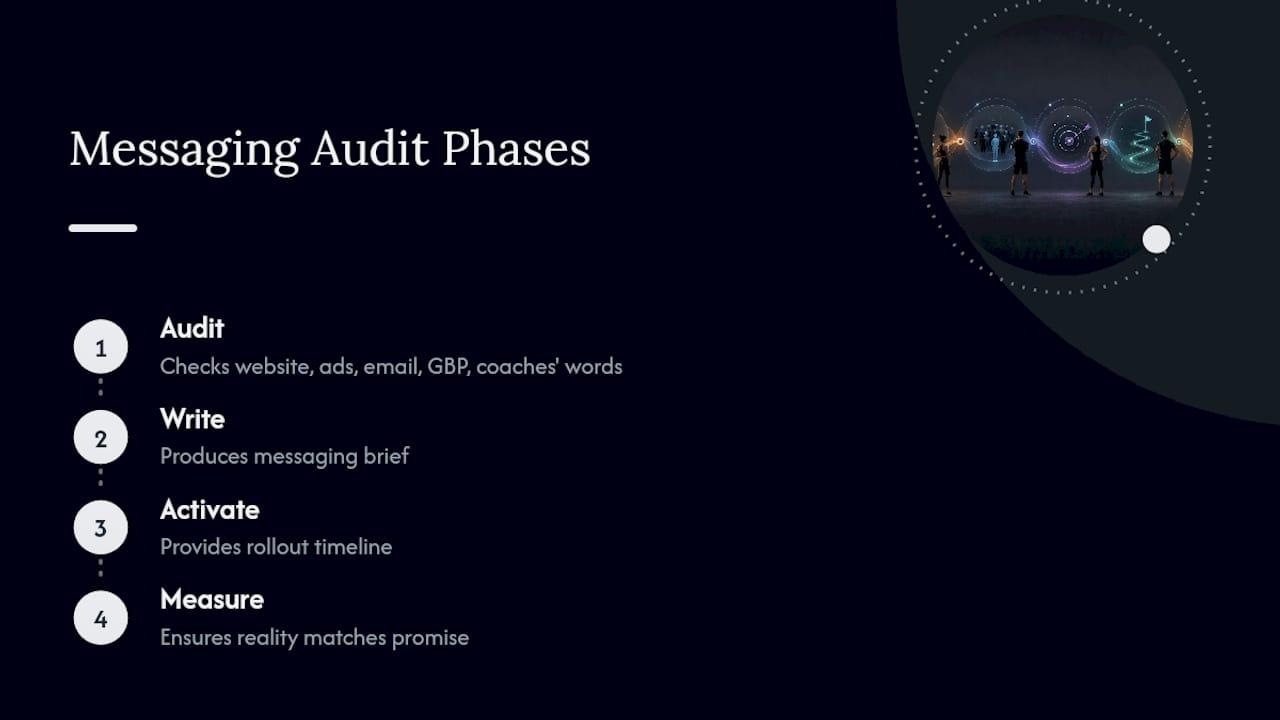
A real audit checks every touchpoint against your written message: website, ads, email, GBP listing, and the actual words your coaches use on the floor. Enochmarketing runs this in four phases, audit, write, activate, measure, so operational reality matches the promise. When vetting proposals, ask for a documented audit report, a messaging brief, and a rollout timeline as standard deliverables.
The Mistake That Quietly Kills Gym Messaging
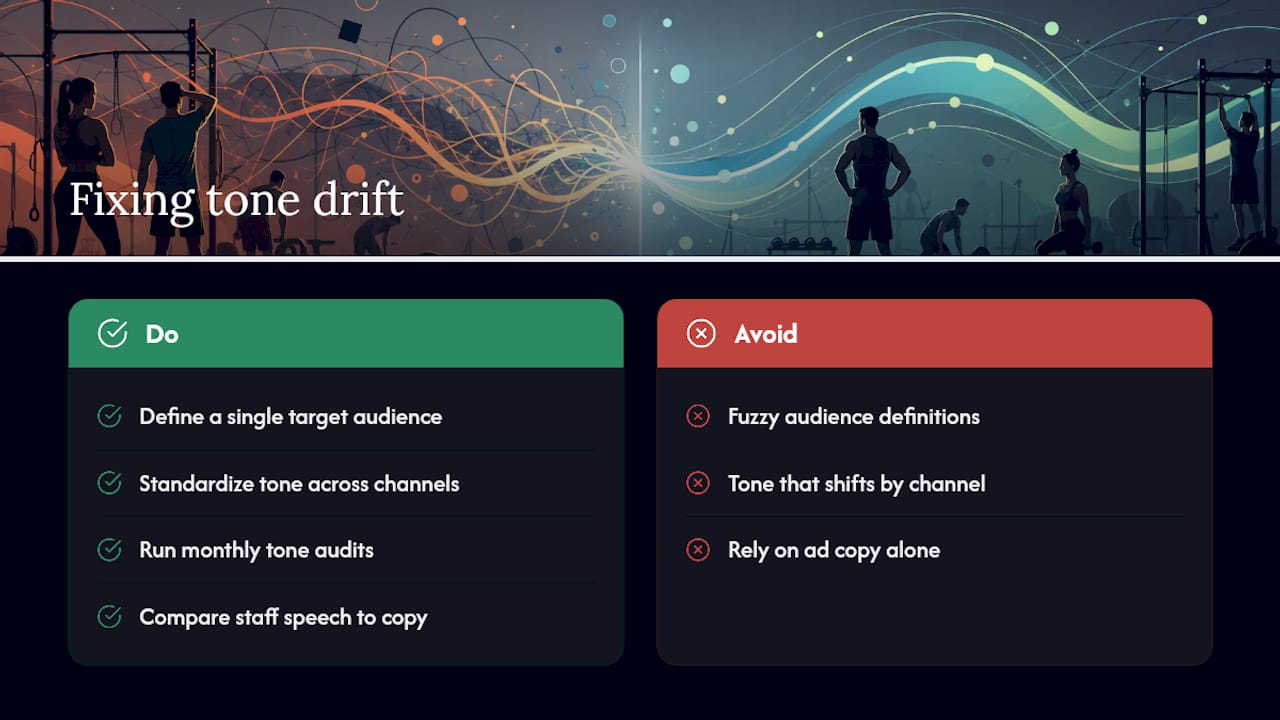
The most damaging error isn't a bad tagline. It's a fuzzy audience combined with a tone that shifts between the website, the ads, and the front desk. A message that sounds premium online but casual in person breaks trust before a prospect ever asks about price.
The fix is boring but effective: run a monthly tone audit against staff training, comparing what's written to what's actually said on the floor.
— Collin
Get Your Gym's Message Built by People Who Only Work With Gyms
You've got the formula now, but writing it is only half the job. Getting it into your ads, your homepage, your email flows, and your coaches' scripts, and keeping it consistent as you scale, is where most owners run out of time. Our team works with gyms and fitness studios, which means the messaging framework above is practical and proven. It's what we build into every client's brand strategy before a single ad dollar gets spent.
A typical engagement includes brand positioning work, creating a headline and slogan around your differentiator, ad creative that carries the message through to conversion, and rollout support so your staff says the same thing your website does. When you're comparing proposals from any agency, ask specifically for a written messaging brief and a touchpoint rollout plan, not just a list of services. If you want that built for your gym directly, start with our CrossFit gym marketing services page and book a strategy session to see where your current messaging is losing members.
Sources
- Gymshark simplifying brand platform — Marketing Week
- Gym marketing — Shopify blog
- Gym Marketing in 2026: The Full Playbook — GymRoute
- Consumer brand loyalty statistics — Statista