
This page gives you copy-and-paste front desk follow up scripts for the calls your team makes every day: appointment reminders, no-show recovery, billing questions, insurance gaps, and urgent callbacks. Below each script you'll find timing rules, objection responses, and a short weekly workflow so your team can start using them this week, not after a training cycle.
TL;DR:
- Appointment reminder calls should be made 48 to 72 hours before the appointment, with a second reminder 24 hours prior, mainly via SMS.
- Same-day no-show recovery calls are most effective if they are handled promptly and sound empathetic, increasing the chance of rescheduling.
- Billing and insurance follow-ups should be conducted shortly after statements are issued, with phone calls prioritized for questions and confirmation, then followed by email.
- Handling objections with brief, empathetic responses and professional handoffs ensures callers receive appropriate help without improvisation.
- Consistent scheduling of weekly follow-up blocks enhances recall rates and reduces the risk of patient loss due to scheduling gaps.
Table of Contents
- Front Desk Follow Up Scripts By Scenario
- When Should You Call, Text, or Email?
- How Do You Handle Objections During Follow-Up Calls?
- Building a Weekly Workflow That Makes Scripts Stick
- Quick-Fill Templates You Can Adapt Today
- Why Consistency Beats a Perfect Script
- Where to Learn More About Follow-Up Workflows
- Sources
Front Desk Follow Up Scripts By Scenario
Good scripts read like checklists, not speeches. A front desk staffer who tries to recite a script word for word sounds robotic within the first ten seconds, and callers notice. Medical office phone script templates work best when the staff member hits the key points in their own words and fills in the personal details.
Here are seven scripts organized by the calls your front desk actually makes:
- Appointment reminder (48 to 72 hours out): "Hi [Patient Name], this is [Your Name] from [Office Name]. I'm calling to confirm your appointment with [Provider] on [Date] at [Time]. Can you make that work?" If they hesitate, offer two alternate slots before hanging up.
- Appointment reminder (24 hour follow-up): "Just a quick reminder about your appointment tomorrow at [Time] with [Provider]. If anything's changed, call us back at this number so we can adjust." Keep this one under 20 seconds.
- No-show recovery (same day): "We noticed you weren't able to make it in today. Is everything okay? We'd like to get you rescheduled, do you have a few minutes now?" This tone matters. It should sound like concern, not a scolding.
- No-show recovery (second attempt): "I wanted to try you again about rescheduling your visit with [Provider]. We have openings [this week/next week], would either of those work better?"
- Post-visit check-in: "This is [Your Name] following up after your visit with [Provider] on [Last Visit Date]. How are you feeling since then?" This mirrors standard follow-up best practice of tying the call back to the original visit so the patient doesn't have to re-explain their situation.
- Billing/payment follow-up: "I'm calling about your account balance of [Outstanding Balance]. We wanted to make sure you received the statement and see if you have any questions about it." Never lead with the dollar amount before context.
- Insurance verification follow-up: "We're missing a piece of information from your insurance file. Could you confirm your [specific detail] so we can process your visit correctly?"
For urgent or escalation calls, keep the handoff simple: "I want to make sure you get the right help, let me connect you with [Provider/Manager] right now." Don't attempt to diagnose or advise beyond your role.
When Should You Call, Text, or Email?
Timing decides whether a follow-up gets answered or ignored. Appointment reminders work best with a first contact a few days ahead, then a second contact the day before. No-show recovery calls lose effectiveness fast. Same-day contact catches people while the missed visit is still fresh in their mind; wait three days and the call feels like an afterthought.
Billing follow-ups should be sent soon after the statement date, but not on the same day. Post-visit check-ins land best within 24 to 48 hours for anything urgent, or within a week for routine care confirmation.
Channel matters as much as timing. SMS performs well for immediate, high-visibility outreach, especially for reminders and no-show recovery, while phone calls still win for anything requiring a real conversation, like billing questions or insurance details. Pairing SMS with a follow-up email often produces the strongest response.
- Appointment reminders: SMS first, phone as backup
- No-show recovery: phone call, same day if possible
- Billing and insurance: phone, followed by email confirmation
- Post-visit check-ins: phone or SMS depending on complexity
A 45 to 60 minute midweek follow-up block dedicated to nothing but callbacks helps teams hit consistent recall rates instead of squeezing calls between walk-ins.
How Do You Handle Objections During Follow-Up Calls?
Every front desk staffer hears the same handful of pushbacks. Having a one-line response ready keeps the call moving without sounding scripted.
- "I'm too busy right now." → "No problem, would tomorrow morning or afternoon work better for a quick callback?"
- "I can't afford it right now." → "I understand. Let me connect you with someone who can walk through payment options."
- "Why do you need my insurance info again?" → "We just want to make sure your visit gets billed correctly the first time, it only takes a minute."
- "I'll call you back." → "Sounds good, if I don't hear from you by [day], I'll try you again just to check in."
When a caller raises something clinical or a complicated billing dispute, don't improvise. "That's a great question for [Provider/Billing Manager], let me get you connected" keeps you inside your role and gets the caller a real answer.
Pro Tip: Open every objection response with a short empathetic line before the ask. "I hear you" or "That makes sense" costs you two seconds and changes how the whole rest of the call goes.
Building a Weekly Workflow That Makes Scripts Stick
Scripts fail when they live in a binder nobody opens. They stick when they're built into the week.
- Monday: Pull the list of pending follow-ups (no-shows, billing, insurance gaps) and assign owners.
- Wednesday: Run the dedicated follow-up block, calls only, no walk-in interruptions if you can manage it.
- Daily: Spend 5 to 10 minutes in a huddle role-playing one script, rotating who plays the caller.
- Friday: Close out the week by reviewing what got logged and what's still open.
After every call, log four things: the outcome, the next action, who owns it, and the date for the next attempt. Skipping the ownership field is how the same patient gets called twice by two different staffers.
Quick-Fill Templates You Can Adapt Today
Three short templates cover most channels your front desk uses outside a live call:
- Voicemail: "Hi [Patient Name], this is [Your Name] from [Office Name] calling about your upcoming visit. Please call us back at [Number] when you get a chance."
- SMS: "Hi [Patient Name], reminder: your appointment with [Provider] is [Date] at [Time]. Reply YES to confirm or call us to reschedule."
- Post-call recap note: "Spoke with [Patient Name] on [Date] re: [Visit Type]. Outcome: [Outcome]. Next step: [Available Times] with [Provider]."
Swap in personalization tokens like [Patient Name], [Visit Type], [Last Visit Date], [Provider], [Outstanding Balance], and [Available Times] to keep every message specific without rewriting it from scratch.
One rule for voicemail: never leave clinical details in a message. If the situation sounds urgent, the script should direct the caller to emergency services immediately rather than wait for a callback.
Why Consistency Beats a Perfect Script
The script matters less than whether your team actually uses it every time. Offices that treat follow-ups as a scheduled block, not an afterthought, see more consistent recall rates than offices that leave calls to whoever has a free minute. That consistency is what prevents small scheduling gaps from turning into lost patients.
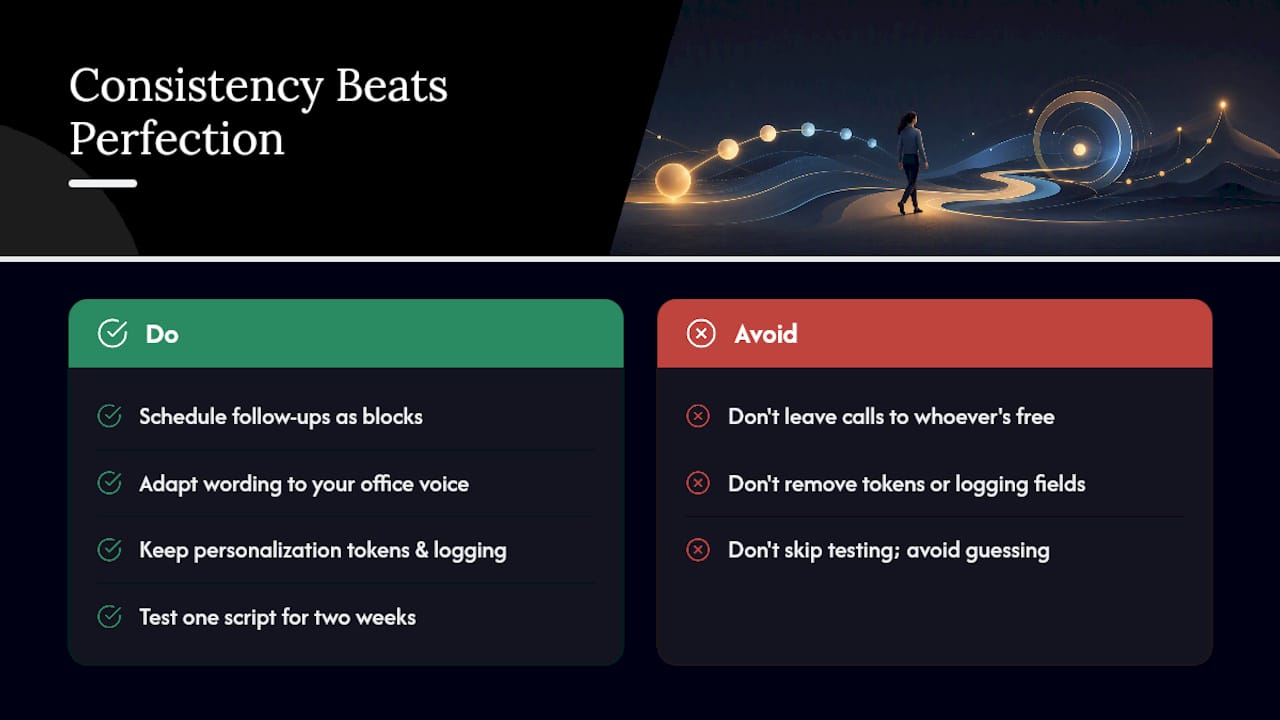
Adapt every script here to how your office actually talks. If "I understand" sounds stiff coming from your staff, change it. What you should not cut is the personalization tokens and the logging fields, those are what keep the workflow from falling apart when someone's out sick.
Pick one script, run it for two weeks, and track how many calls turn into rebooked visits. That's a better test than any theory about what should work.
— Collin
Where to Learn More About Follow-Up Workflows
For deeper reading on cadence and workflow design, Front's guide to customer service follow-up covers the five core principles behind effective follow-ups. Intercom's customer follow-up guide breaks down how segmentation improves retention, and MyBCAT's front desk recall workflow walks through the weekly time-block model in more detail. For ready-to-send templates outside healthcare, FlexLeague+'s email template library offers useful formatting examples.
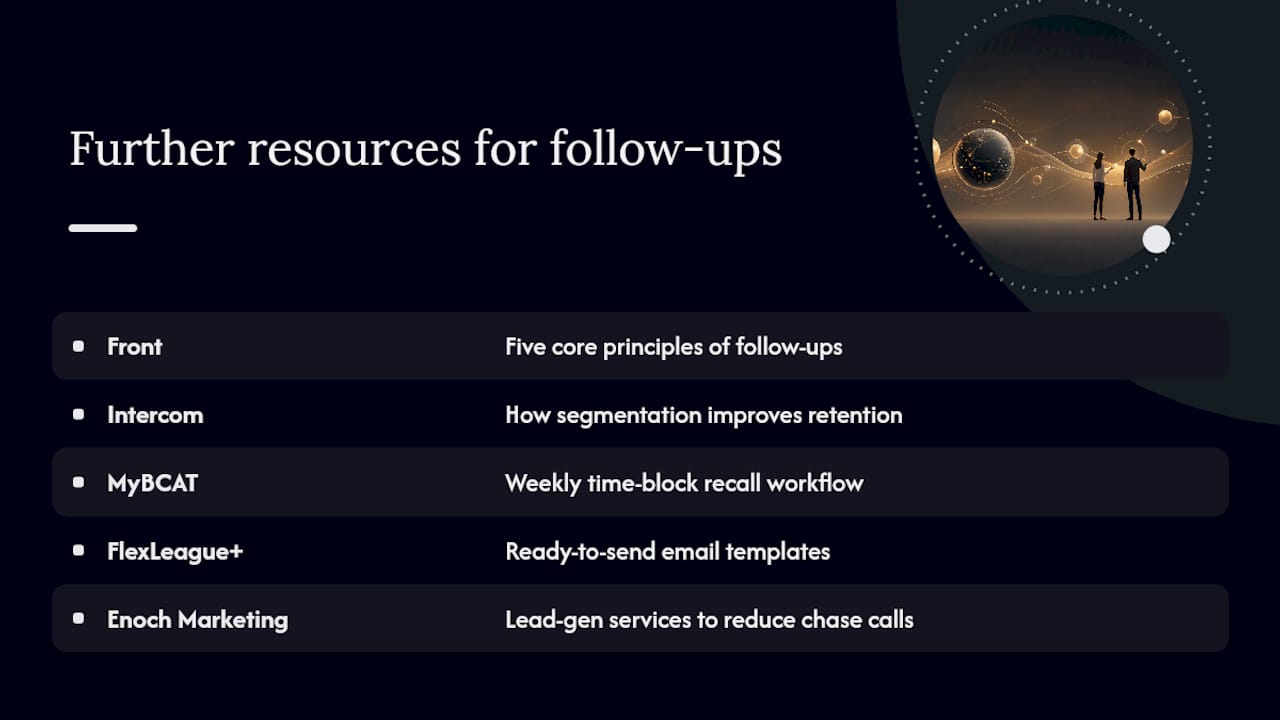
Running follow-up scripts well takes staff time that gym and studio front desks often don't have to spare. If your team is stretched between member calls and everything else on the front desk, Enoch Marketing's lead generation services are built to reduce the volume of chase-down calls in the first place by improving the quality of leads coming in the door. You can see the full range of support, from paid ads to CRM automation, on the Enoch Marketing services page.
Sources
- Customer service follow-up: Examples and best practices — Front
- Front desk recall workflow — MyBCAT
- Customer follow-up — Intercom
- Medical office phone scripts: Free templates for front desk, scheduling, and after-hours calls — ClinicFlowAI