
A client acquisition funnel is defined as the structured system that moves prospects from first awareness of your fitness business through to becoming paying members. Most gym owners treat marketing as a series of disconnected tactics. A funnel replaces that chaos with a repeatable process, each stage filtering out poor fits and building trust with the right people. Understanding this system is the foundation of any real client acquisition strategy, and it matters more in fitness than almost any other service industry because the decision to join a gym is personal, emotional, and rarely made in one step.
What is a client acquisition funnel in fitness businesses?
A client acquisition funnel is not a single ad or landing page. It is a system guiding prospects through deliberate stages, filtering out unqualified leads and steadily building trust. That distinction matters because gym owners often mistake one campaign for a full funnel. A campaign generates attention. A funnel converts that attention into revenue.
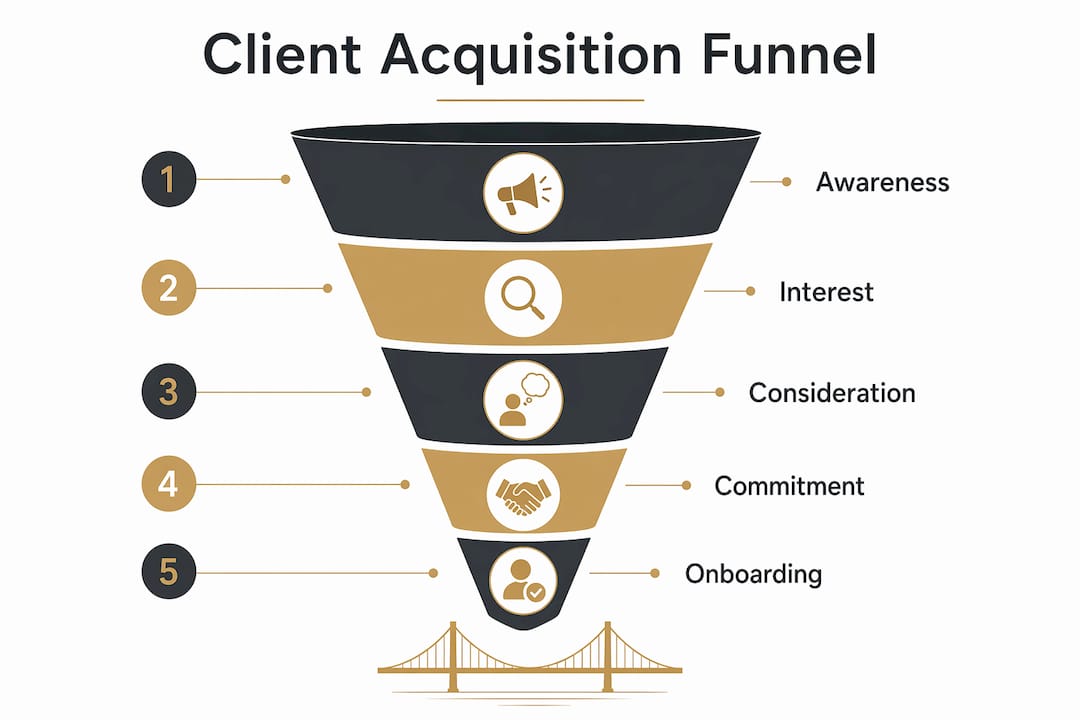
The standard funnel follows five stages: Awareness, Interest, Consideration, Commitment, and Onboarding. Each stage has a specific job.
- Awareness is where prospects first encounter your gym, through a Meta ad, a Google search, or a friend's recommendation.
- Interest is where they engage, watching your content, visiting your website, or following your social accounts.
- Consideration is where they evaluate, reading reviews, comparing your offer, or booking a free class.
- Commitment is the conversion point, where they sign up, pay, or agree to a trial.
- Onboarding is the first 30 days of membership, where retention begins and referrals are born.
The table below shows how conversion rates typically behave across these stages in a fitness context.
| Funnel Stage | Typical Conversion Rate | Key Tactic |
|---|---|---|
| Awareness to Interest | 5%–15% | Paid ads, organic content |
| Interest to Consideration | 20%–35% | Free class offer, lead magnet |
| Consideration to Commitment | 10%–25% | Consultation, follow-up sequence |
| Commitment to Onboarding | 80%–95% | Welcome sequence, check-in calls |
Two metrics define funnel health: Customer Acquisition Cost (CAC) and Customer Lifetime Value (LTV). CAC measures what you spend to win one client. LTV measures what that client is worth over their full membership. A healthy LTV:CAC ratio sits at 3:1 or higher for coaching-based businesses. If you spend $200 to acquire a client worth $600, your funnel is working. If those numbers flip, your funnel has a leak.
How does a client acquisition funnel differ from a sales pipeline?
Gym owners often confuse the funnel with the sales pipeline. They are related but not the same. The funnel describes the prospect's experience. The pipeline describes your team's internal process for managing those prospects.

A sales pipeline serves as a clarity tool that helps trainers see exactly where leads are stuck. Rather than guessing why someone went quiet after a free class, a pipeline shows you the stage, the last contact date, and the next action required. That visibility replaces pressure tactics with structured support.
Lead generation sits at the top of the funnel. It fills the pipeline with names. But lead generation alone does not produce clients. The gap between a lead and a paying member is where most fitness businesses lose money. Decision-pending leads drop off primarily because of a lack of structured follow-up. Automating that follow-up is the most direct way to recover lost revenue.
Pro Tip: Build a simple five-stage pipeline in a spreadsheet or CRM before investing in any paid ads. Knowing where leads stall tells you exactly where to fix the funnel first.
The best practice for pipeline management in fitness businesses includes three habits:
- Review your pipeline weekly, not monthly.
- Assign a follow-up task to every lead within 24 hours of first contact.
- Remove leads who have not responded in 60 days to keep your data clean and your focus sharp.
What are the most effective client acquisition channels for gyms?
The most effective acquisition channels for fitness businesses are referrals, targeted outbound outreach, content marketing, local partnerships, and paid media. Each has a different cost structure and conversion profile.
Referral systems are the most cost-efficient channel available. Referral acquisition costs run between $0 and $50 per client, with close rates of 40%–60%. That performance reflects trust. A referred prospect arrives pre-sold by someone they already believe. Enochmarketing builds gym referral programs specifically designed to turn happy members into a consistent lead source.
Meta ads cost between $75 and $300 per acquisition for service businesses, with average conversion rates of 5%–15%. Google Ads perform slightly better at 10%–20% for service models, but require higher intent keywords to work efficiently. Paid channels scale fast but punish weak messaging.
| Channel | Avg. CAC | Close Rate | Time to Results |
|---|---|---|---|
| Referrals | $0–$50 | 40%–60% | Immediate |
| Meta Ads | $75–$300 | 5%–15% | 2–4 weeks |
| Google Ads | $100–$400 | 10%–20% | 3–6 weeks |
| Content Marketing | $20–$80 | 15%–30% | 3–6 months |
| Local Partnerships | $10–$60 | 20%–40% | 1–3 months |
The most common mistake fitness business owners make is spreading effort across too many channels at once. Focusing deeply on 2–3 channels for 12–18 months produces compounding results. Shallow effort across six channels produces noise.
Pro Tip: Before spending a dollar on paid ads, test your offer through direct outreach and organic posts. If people do not respond to free messaging, paid amplification will not fix it.
This principle matters because testing messaging organically before scaling paid campaigns is what separates gyms that grow from gyms that burn budget. Paid ads amplify your message. They do not fix a broken one.
How do you measure and improve funnel performance?
Measuring funnel performance starts with four numbers: CAC, LTV, LTV:CAC ratio, and stage-by-stage conversion rates. These four metrics tell you whether your funnel is healthy, where it leaks, and what to fix first.
Retaining an existing client costs 5–7 times less than acquiring a new one. That fact reframes how you think about funnel performance. The back end of the funnel, onboarding and retention, directly reduces your effective CAC over time. A client who stays 18 months and refers two friends costs far less per revenue dollar than a client who churns in 60 days.
To diagnose funnel drop-offs, track these metrics by stage:
- Awareness to Interest: Click-through rate on ads and organic content.
- Interest to Consideration: Landing page conversion rate (website visitors typically convert to leads at 1%–3%).
- Consideration to Commitment: Show-up rate for consultations and free trials.
- Commitment to Onboarding: First-week attendance and 30-day retention rate.
When a stage underperforms, the fix is usually one of three things: the message is wrong, the offer is weak, or the follow-up is missing. Most of the time, it is the follow-up. Automating follow-up sequences for leads stuck in the decision stage recovers revenue that would otherwise disappear quietly.
Pro Tip: Set a 90-day review cycle for your funnel metrics. Short cycles let you catch problems before they compound into months of wasted spend.
For fitness businesses, CRM tools like GoHighLevel or simple email automation platforms work well for tracking leads and triggering follow-up sequences. The tool matters less than the habit of reviewing the data consistently. A well-built gym sales funnel reviewed monthly outperforms a sophisticated one that nobody checks.
Key Takeaways
A client acquisition funnel works when each stage has a clear tactic, a tracked metric, and a structured follow-up that prevents leads from going cold.
| Point | Details |
|---|---|
| Define the five stages | Map Awareness, Interest, Consideration, Commitment, and Onboarding before building any campaign. |
| Track CAC and LTV | A healthy LTV:CAC ratio of 3:1 or higher confirms your funnel is generating sustainable revenue. |
| Focus on 2–3 channels | Deep effort on a few channels for 12–18 months outperforms spreading thin across many. |
| Fix follow-up first | Most funnel drop-offs happen because of missing follow-up, not a bad offer or weak ads. |
| Retention lowers CAC | Keeping clients longer and generating referrals reduces your effective acquisition cost over time. |
Why most gym funnels fail before they start
The most common funnel failure I see with fitness businesses is not a bad ad or a weak landing page. It is the absence of a system entirely. Gym owners run a promotion, get some leads, and then follow up manually for a few days before moving on. That is not a funnel. That is a campaign with no infrastructure behind it.
The second mistake is treating every channel as equally worth pursuing. I have watched gym owners run Meta ads, post daily on Instagram, cold email local businesses, host events, and ask for referrals all at once. None of it works well because none of it gets enough attention to compound. Picking two channels and mastering them over a year builds something real.
The insight that changed how I think about fitness funnels is this: a funnel is a support system, not a pressure system. Its job is to give the right prospect enough information, enough trust, and enough opportunity to say yes on their own timeline. When you build it that way, you stop chasing and start attracting. That shift is what makes client acquisition for fitness studios feel less like sales and more like service.
— Collin
How Enochmarketing builds funnels that fill gyms
Enochmarketing works exclusively with CrossFit gyms and fitness brands across the United States, building the full acquisition system from top to bottom.
The agency runs paid media on Meta and Google, builds lead funnels, manages follow-up automation, and handles local SEO so your gym shows up when someone nearby searches for a place to train. Every campaign starts with an audit of your current funnel to find the leaks before spending a dollar on ads. If you want a system that consistently brings in new members rather than a one-off promotion, the gym growth services at Enochmarketing are built for exactly that. You can also review pricing options to find the right fit for your gym's stage and budget.
FAQ
What is a client acquisition funnel?
A client acquisition funnel is a structured system that moves prospects from first awareness of your business through to becoming paying clients. It typically includes five stages: Awareness, Interest, Consideration, Commitment, and Onboarding.
What is a trainer client acquisition funnel?
A trainer client acquisition funnel is the same five-stage process applied specifically to personal trainers or gym coaches. It uses consultations, free sessions, and follow-up sequences to convert prospects into long-term training clients.
How does a client acquisition funnel differ from a sales funnel?
A sales funnel and a client acquisition funnel describe the same concept. "Sales funnel" is the broader marketing term, while "client acquisition funnel" is used more specifically in service-based and fitness businesses to emphasize the relationship-building process.
What metrics should I track in my acquisition funnel?
Track Customer Acquisition Cost (CAC), Customer Lifetime Value (LTV), your LTV:CAC ratio, and conversion rates at each funnel stage. A healthy LTV:CAC ratio for fitness businesses sits at 3:1 or higher.
How many acquisition channels should a gym focus on?
Fitness businesses get the best results by focusing deeply on 2–3 channels for at least 12–18 months. Spreading effort across too many channels at once produces weak results across all of them.