
For multi-location gyms, the single priority is one verified Google Business Profile per physical site plus a unique, hyperlocal location landing page tied to a master data source. Everything else, from local pack rankings to AI-driven recommendations, compounds from that foundation. Start with an audit: list every location against its claimed GBP and live URL, and flag the gaps before touching keywords or content.
TL;DR:
- Ensuring each gym location has a verified, accurate Google Business Profile and a unique location page with consistent NAP data is essential for local visibility.
- Location pages must include real photos, local-specific content, current hours, and schema markup to avoid filtering or ranking penalties.
- Managing hundreds of locations requires a master data source, standardized processes, and role-based governance to prevent data drift and duplicate listings.
- Tracking location-specific metrics like review volume, conversions, and local search queries is crucial for measuring SEO success and guiding content updates.
- Long-term SEO gains depend on disciplined data management and local content, with tools serving as orchestration aids rather than sole solutions.
Table of Contents
- Why Multi Location Gym SEO Needs a Four-Pillar Framework
- What Belongs on Every Gym Location Page?
- How Do You Manage Listings Across Dozens of Locations?
- Who Should Own What in a Multi-Site Governance Model?
- Which Tools Actually Fit Multi-Location Gym SEO?
- What Should You Actually Measure Across Locations?
- How an Agency Rolls Out Multi-Location Gym SEO
- Why Local Competitors Look Different in Every Market
- Do Local Promotions Actually Move Local Rankings?
- How Do You Win Voice Search and "Near Me" Queries by Location?
- Is Your Multi-Location Site Actually Built for Mobile?
- Should Paid Local Ads Reinforce Your SEO Work?
- How Do AI Tools Decide Which Gym to Recommend?
- How Do You Research Keywords for Each Individual Location?
- Local SEO at Scale Rewards Discipline, Not Tools
- How Enoch Marketing Handles Multi-Location Gym SEO for You
- Sources
- FAQ
Why Multi Location Gym SEO Needs a Four-Pillar Framework
Multi location gym SEO fails for one predictable reason: gyms treat it like single-site SEO copied twelve times. It isn't. Chains that actually win local visibility, both in Google's map pack and in AI tools recommending "the best gym near me," organize the work around four pillars: business data, location pages, governance, and measurement.
Business data comes first because it's the input every other system reads from. Google Business Profile, your CRM, your website footer, and every directory listing all need to agree on the same name, address, and phone number for each club. Get this wrong and you're not just losing rankings, you're actively confusing the systems that decide whether to recommend you at all. Search Engine Journal frames this as the shift toward "becoming the business AI recommends," where accurate data and review quality carry as much weight as traditional ranking signals.
Location pages turn that clean data into something a searcher (or an AI model) can actually read and trust. Governance is the unglamorous layer that keeps the first two pillars from decaying the moment a local manager updates hours without telling anyone. Measurement closes the loop, connecting SEO work to trial signups and membership revenue instead of vanity traffic.
Ownership splits naturally along these lines:
- Corporate marketing owns the master location dataset, URL structure, schema templates, and the reporting dashboard.
- Local managers own photos, class schedule accuracy, review responses, and hyperlocal facts (parking, transit, staff bios).
- A shared ticketing system connects the two so nothing gets updated in one place and forgotten in another.
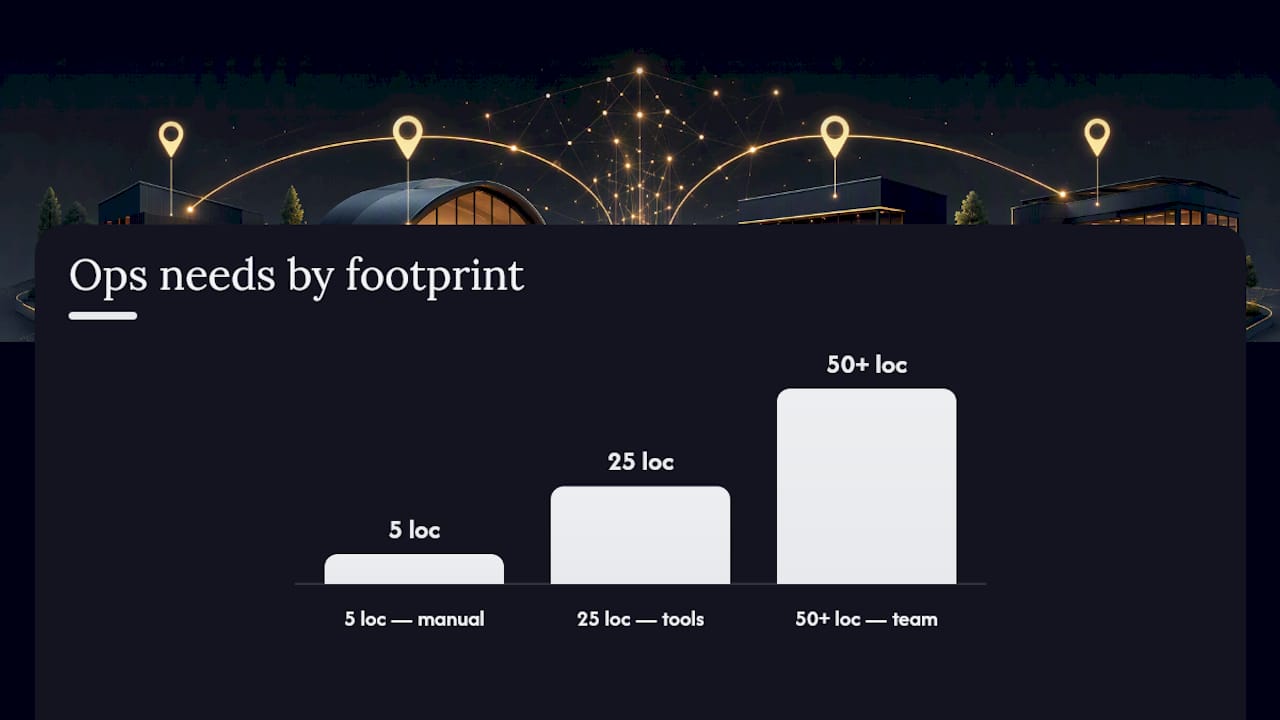
Prioritization depends on footprint size. A five-location gym can run this manually with a shared spreadsheet and a monthly audit. A 25-location chain needs a bulk-verification workflow and a dedicated citation tool. Beyond 50 locations, you're really running a small data-operations team that happens to report into marketing.
Pro Tip: Before building a single location page, build the master spreadsheet first. Every field on every page should trace back to one row in one source file, never to a page someone edited by hand six months ago.
What Belongs on Every Gym Location Page?
A location page earns its ranking by proving it's real, not by repeating your brand's boilerplate with a city name swapped in. Google and franchise SEO guides agree on this point: duplicate or near-identical location pages get filtered as doorway pages, and the risk only grows as chains scale past a handful of clubs.
Every location page needs these elements, non-negotiable:
- Full NAP (name, address, phone) matching the GBP listing exactly, character for character.
- An embedded map and driving/transit directions specific to that address.
- Current hours, including holiday exceptions, pulled from the same source feeding your GBP.
- Real photos of that facility, not stock images or shots from your flagship location.
- A short bio and photo for the location manager or head coach.
- The actual class schedule for that club, updated on the same cadence as the whiteboard.
- At least one piece of local proof: a member spotlight, a nearby landmark reference, or a note about the neighborhood.
The hyperlocal content is where most chains cut corners, and it's the cheapest place to differentiate. A sentence about the parking situation behind a strip mall, a mention of the light rail stop two blocks away, a quote from a member who works at the hospital across the street. None of that costs money. It just requires someone local to write two paragraphs once a quarter.
Schema matters here too. LocalBusiness markup with the correct address, geo, openingHours, and sameAs fields gives both Google and AI models a structured, verifiable version of facts your prose only implies. Google's own SEO starter guide still treats structured data and crawlability as foundational, not optional extras for advanced sites.
One franchise SEO guide found that a single-domain subdirectory structure (think
/locations/city-name/) paired with consistent LocalBusiness schema and a master dataset is one of the highest-leverage technical investments a multi-site brand can make, according to SEO Brothers.
Templating rules: layout, navigation, and schema structure can be templated freely. Hours, staff, photos, class schedules, and at least one paragraph of genuinely local narrative cannot. If you can copy a section of the page to another location and it still reads true, delete it and write something that isn't.
How Do You Manage Listings Across Dozens of Locations?
Google Business Profile requires a distinct listing for every physical address, and Google's own help documentation confirms bulk verification is available for accounts managing many locations at once, which matters the moment you cross roughly ten sites.
Run through this checklist for every location:
- Confirm the business name matches your legal trade name exactly, with no keyword-stuffed additions like "CrossFit Downtown Best Gym."
- Complete every category field, not just the primary one. Secondary categories like "Personal trainer" or "Weightlifting area" widen the queries you can surface for.
- Upload at least ten current photos per location and refresh them quarterly.
- Verify hours weekly during the first month after opening a new club, then monthly after.
- Enable messaging and Q&A, and assign a local staff member to respond within 24 hours.
Bulk verification kicks in once your account structure signals you're managing a chain rather than a single storefront. Prepare for it by getting your legal business name, address format, and phone number standardized across every location before you request it. Inconsistent formatting is the most common reason bulk requests stall.
Citation management works the same way in miniature: apps like Yelp, Apple Maps, and fitness-specific directories all need the identical NAP string your GBP uses. Run an audit every 90 days, fix mismatches in your master file, then re-export to every platform.
Pro Tip: Duplicate GBP listings are the silent killer of local rankings, especially after a rebrand or ownership change. Search your brand name plus each city before assuming a "new" listing means a clean slate. It usually means a stale one competing against the live listing.
Who Should Own What in a Multi-Site Governance Model?
NAP drift doesn't happen because people are careless. It happens because nobody owns the decision about who's allowed to change what. A governance model fixes that by drawing clear lines before problems start, not after a location's phone number has been wrong for six months.
- Corporate owns the master location dataset, the URL and schema template, and any change that touches brand-wide standards.
- Local managers own day-to-day accuracy: class times, photos, review responses, and staff bios.
- Nobody outside corporate gets direct GBP edit access; local input flows through a request, never a direct login.
- Every change request carries a unique club ID that ties back to the master dataset, so updates are idempotent rather than duplicative.
- CMS access for location pages is role-based: local managers can edit approved fields (hours, bios, schedule) but not templates, meta tags, or schema structure.
That club ID matters more than it sounds. One review of fitness chain SEO operations named a master spreadsheet with a stable, unique identifier per club as the single most useful artifact for preventing data drift across dozens of disconnected systems.
Set service-level expectations in writing. A reasonable standard: respond to new reviews within 48 hours, upload new facility photos monthly, and confirm schedule accuracy weekly. Put these in the same document that defines who has access to what, so accountability and permission live together instead of scattered across separate onboarding materials.
Which Tools Actually Fit Multi-Location Gym SEO?
Tool shopping for a gym chain gets confusing fast because vendors blur categories that solve genuinely different problems. Separate them by job before you separate them by price.
Distribution or push networks blast your NAP data out to dozens of directories at once. They're built for chains that need to correct listings across 20+ locations without manually logging into each platform.
Audit and citation tools find where your data has already gone wrong: mismatched addresses, duplicate listings, outdated hours across the directories you don't check often. One comparison of gym-specific SEO tooling recommends keeping audit tools separate from push networks, since the two solve opposite problems.
Enterprise crawlers check technical site health across every location page at once, catching broken schema, slow load times, or thin content before Google does.
A decision tree by size:
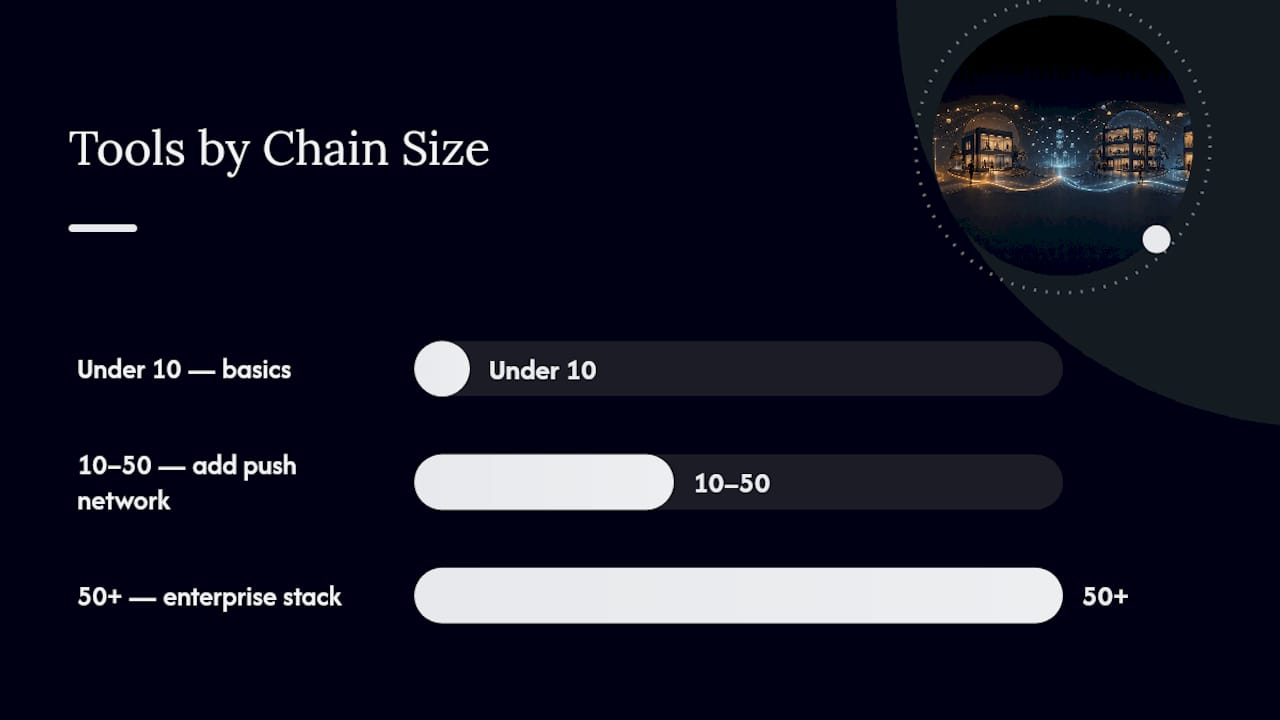
- Under 10 locations: a spreadsheet, a quarterly manual audit, and one citation-audit tool is enough.
- 10 to 50 locations: add a push network for bulk NAP correction and light workflow automation.
- 50-plus locations: you need enterprise crawling, an orchestration layer, and dedicated staff time.
The practical automation pattern that scales cleanly is export, diff, ticket, publish. Pull your master dataset, compare it against what's live on each platform, generate a ticket for every mismatch, then publish the fix. No-code orchestration platforms can automate the diff and ticket steps without custom engineering.
Pro Tip: Don't buy a tool that overwrites local page content automatically. One franchise SEO analysis found the smarter pattern treats tooling as an orchestration problem that integrates with your CMS and flags changes for review, rather than pushing edits live unsupervised.
What Should You Actually Measure Across Locations?
Measurement for multi-location gym SEO needs a floor, a minimum set of metrics every location reports on the same schedule, or comparisons across your footprint become meaningless.
Track these at minimum:
- GBP actions per location: calls, direction requests, website clicks, and messages.
- Google Search Console impressions and clicks segmented by location URL.
- Location page conversions: trial signups, class bookings, or contact form submissions.
- Review velocity (new reviews per month) and sentiment trend per club.
Attribution ties this to revenue. Use consistent UTM parameters across every location's ads and listings, assign each club its own tracked phone number, and map both into your CRM so a lead can be traced back to the specific location page or GBP listing that generated it.
Industry research on fitness chain local SEO points to review volume and recency as major drivers of local consumer trust, reinforcing why review velocity belongs on every location's dashboard, not just the corporate rollup.
Report weekly at the local level (hours, reviews, photo freshness) and monthly at the corporate level (rankings, conversions, revenue attribution). Expect visibility gains within 60 to 90 days of fixing data and page quality, with conversion lift typically trailing rankings by another month or two as trust signals accumulate.
How an Agency Rolls Out Multi-Location Gym SEO
A structured rollout for a 12-club gym chain typically starts with an audit that surfaces the same handful of problems every time: NAP mismatches between GBP and the website footer, templated location pages with one sentence swapped per city, and class schedules that haven't matched reality in months.
A realistic 12-location timeline breaks into phases:
- Weeks 1 to 2: full data audit, master spreadsheet build, GBP claim verification across all clubs.
- Weeks 3 to 5: rebuild location pages with unique content, schema, and current schedules.
- Weeks 6 to 7: citation cleanup across major directories and duplicate listing suppression.
- Weeks 8 and beyond: measurement dashboard goes live, review response SLAs kick in, ongoing governance handoff to local managers.
This is close to how Enoch Marketing structures rollouts for CrossFit and fitness chains: audit first, clean the data, rebuild the pages, then hand off a governance model the client's own team can maintain. Results and timelines vary by starting condition, since a chain with clean GBP data moves through this faster than one untangling years of duplicate listings.
Why Local Competitors Look Different in Every Market
The gym three blocks from your downtown location and the gym near your suburban location are rarely competing for the same searcher, even if they share your brand's national competitor list. Multi location gym SEO demands a market-by-market competitive read, not one national scan.
Pull the local pack results for your core terms (gym, CrossFit, personal training) separately for each location's zip code. You'll often find a boutique studio dominating one neighborhood's map pack while a big-box chain owns another, three miles away. That difference should shape what each location page emphasizes: a club competing against boutique studios might lean on affordability and community, while one competing against a 24-hour chain might lean on class variety and coaching quality.
Check review counts and ratings for the top three local competitors at each address, not just your brand's national average. A location sitting at 4.6 stars with 200 reviews looks strong nationally but weak if the studio next door has 4.9 stars and 500. That local gap tells you exactly where to focus review generation effort.
Search volume and intent shift by neighborhood too. A location near a business district sees more "gym near office" and lunch-hour class searches. A location near a residential suburb sees more "gym for beginners" and family-oriented queries. Pull each location's top queries in Search Console quarterly and let them inform which classes and offers get featured on that specific page, not the corporate default.
Do Local Promotions Actually Move Local Rankings?
Location-specific promotions do more than fill classes. Google Business Profile treats posts about events and offers as fresh content signals, and fresh, engagement-driving content tends to correlate with stronger local visibility over time.
The mistake most chains make is running the same national promotion across every GBP listing with a city name swapped in. That's the GBP version of a templated location page, and it wastes an opportunity. A location running a "bring a friend" event tied to a local 5K or a neighborhood festival gives Google (and searchers) something specific to that address, not a copy-pasted discount code.
Practical moves that work at the location level:
- Post GBP updates for every local event, class launch, or seasonal promotion, with photos from that specific club.
- Tie offers to genuinely local occasions: a back-to-school fitness challenge near a school district, a New Year's promotion timed to local gym-closure competitors.
- Update the location landing page's schedule section whenever a temporary class or event runs, then revert it, rather than leaving stale promotional banners live for months.
Event and promotion history also feeds review generation. A well-run community event tends to generate a spike in reviews within the following week, since attendees are primed to talk about the experience. Local managers should treat post-event review requests as part of the event checklist, not an afterthought.
How Do You Win Voice Search and "Near Me" Queries by Location?
Voice search and "near me" queries share one trait that matters enormously for gyms: they assume proximity is already decided, and they're asking which specific option answers a specific, often conversational question. "Gym open right now near me" and "24 hour gym near me" behave differently in search than typed queries, and they lean harder on GBP data than on your website.
Hours accuracy is the single biggest lever here. A voice assistant or "near me" search pulls straight from your GBP hours field, and if that field is wrong, you lose the click before the searcher ever sees your location page. This is another reason the master dataset matters: hours drift is the most common data error across multi-location chains, and it directly breaks voice and proximity search performance.
Conversational, question-based content on location pages helps too. A section answering "Is there parking at [location]?" or "What classes run in the morning at [location]?" mirrors how people phrase voice queries, and it gives search engines a direct match to surface.
Mobile page speed matters disproportionately for near-me searches, since most happen on a phone, often while someone is already moving toward a decision. A location page that loads slowly on mobile loses searchers who are standing outside deciding between your club and the one across the street.
Structured FAQ schema on location pages, paired with genuinely local answers rather than generic brand copy, gives voice assistants a cleaner source to pull from when answering proximity-based questions.
Is Your Multi-Location Site Actually Built for Mobile?
Most searches for a gym near a specific address happen on a phone, frequently on a spotty connection in a parking lot or on a treadmill break at a competitor's gym. A location page that loads slowly or renders badly on mobile loses that visitor before they see your class schedule.
Test every location page individually, not just your homepage template. A chain with 15 locations can have one page loading fine and another choking under unoptimized photo uploads a local manager added without compressing them first. Image weight is the most common mobile-speed killer on gym location pages, since facility photos and staff bios get uploaded at full resolution by well-meaning non-technical staff.
Tap targets matter more than they get credit for. Class schedule tables, "call now" buttons, and map embeds all need to work cleanly on a five-inch screen, not just look fine on a designer's laptop. A map that requires zooming and pinching to find directions is a conversion leak specific to mobile, and it hits every location equally if the template is broken.
Check Core Web Vitals scores per location URL, not as a site-wide average. An average can mask three locations with genuinely bad mobile performance dragging down conversions while the rest perform fine. Google's SEO starter guide still lists mobile performance among its core, non-negotiable technical practices, and that hasn't shifted as AI-driven search has grown.
Should Paid Local Ads Reinforce Your SEO Work?
Multi-location gym SEO and paid local advertising aren't competing budgets, they're the same budget solving two speeds of the same problem. SEO builds the compounding, long-term visibility. Paid ads fill the gap while that visibility is still building, especially for a location that just opened and has no organic history yet.
The integration that actually works: run geo-targeted Google and Meta ads pointed at the same location landing page your SEO work is optimizing, never a generic brand landing page. That reinforces the same URL's relevance signals and gives you a controlled way to test which local messaging converts before baking it into organic content.
Use paid search data as a keyword research shortcut. If a location's Google Ads account shows a specific search term converting well, that's a strong signal to build organic content around that same phrase on the location page. The reverse works too: a location page ranking well organically for "CrossFit classes for beginners" tells you which audience to target with paid creative.
Budget allocation should shift by location maturity. New locations lean harder on paid to generate the review volume and traffic that eventually support organic rankings. Established locations with strong organic visibility can shift more budget toward retention-focused campaigns rather than pure acquisition, since the SEO work is already doing the top-of-funnel job.
How Do AI Tools Decide Which Gym to Recommend?
Ask an AI assistant "what's the best gym near downtown" and it isn't running a live crawl of every gym's website. It's synthesizing signals it already trusts: consistent business data, review volume and sentiment, and third-party corroboration across sources it considers reliable.
That's a meaningfully different game than ranking in a traditional search results page, and Search Engine Journal's framing of "becoming the business AI recommends" captures the shift accurately. AI recommendability rewards the exact fundamentals this article has covered: accurate NAP, complete GBP profiles, and location pages with genuine local substance, but it adds a layer that pure SEO tactics can't fake.
Third-party corroboration matters more here than it ever did for traditional rankings. If your GBP says a location is open until 10 PM, but three review sites and a local news mention say it closes at 9, that inconsistency doesn't just confuse Google, it actively degrades an AI model's confidence in recommending you at all. Entity signals, meaning your business name, address, and category showing up consistently across independent sources, function as a trust triangle that AI systems lean on when traditional ranking signals alone aren't enough to decide.
Reviews carry outsized weight in this system too, not just their star rating but their specificity. A review mentioning a named coach, a specific class, or a concrete detail about the facility reads as more corroborating to both human searchers and AI systems than a generic five-star rating with no text. Encourage detail, not just stars.
How Do You Research Keywords for Each Individual Location?
National keyword research tells you gym operators generally chase terms like "CrossFit gym" or "personal training near me." It tells you almost nothing about what a searcher three miles from your Riverside location actually types compared to a searcher near your Midtown club.
Build keyword maps per location, not one master list applied everywhere. Start with Google Search Console's per-page query data once a location page has been live long enough to generate impressions, since it shows you the actual language local searchers use, including neighborhood names, nearby landmarks, and transit references you'd never guess from a national keyword tool.
Layer in the searches specific to what that location's neighborhood actually needs. A club near a hospital campus might see real volume for "gym for shift workers" or "24 hour gym near [hospital name]." A club near a university might see volume for "student gym membership" or "affordable gym near [campus name]." These aren't keywords you'll find in a generic fitness keyword list, they surface only when you look at that specific location's search behavior.
Map each location's top ten queries to specific sections of that location's page: a neighborhood-specific FAQ answer, a class schedule callout, or a paragraph addressing the exact concern the query implies. This is also where the earlier competitive analysis pays off twice, since a location competing against boutique studios will show different query patterns than one competing against a 24-hour chain, and the page content should reflect that difference directly.
Local SEO at Scale Rewards Discipline, Not Tools
The gyms winning multi location gym SEO right now aren't the ones with the fanciest tool stack. They're the ones with the boring discipline to keep one dataset accurate and let local managers add real texture on top of it. Chase the perfect platform and you'll still lose to a competitor with a messy spreadsheet and clean data. Pilot this in one market first, prove the governance model works, then scale it. The moat isn't the tool. It's the data and the local content nobody else bothered to write.
— Collin
How Enoch Marketing Handles Multi-Location Gym SEO for You
Running this playbook across ten or twenty locations while also coaching classes and managing staff isn't realistic for most operators, and that's the gap Enoch Marketing exists to close. As a marketing partner built exclusively for CrossFit gyms and fitness brands, Enoch maps directly onto the work this article covers: Local SEO and Reputation for the GBP and citation cleanup, Gym Local SEO Services for building location pages that don't trip doorway filters, and Paid Advertising for the geo-targeted campaigns that reinforce those same pages while organic visibility builds.
A free strategy session starts with the same audit outlined above: your GBP data against your live location URLs, checked for the mismatches that quietly cap your visibility. You walk away with a prioritized roadmap, not a generic pitch. If you want the ongoing version of that work, the Growth Engine plan runs $4,500 per month and bundles local SEO, paid media, and lead follow-up into one accountable system instead of three disconnected vendors. Book a session and get the audit first.
Sources
- Multi-Location SEO: How To Win Google & AI Search Visibility At Scale — Search Engine Journal
- Manage multiple locations — Google Business Profile Help
- Multi-location SEO strategy: Stop competing with your own content — Search Engine Land
FAQ
How Do You Do Local SEO for Multiple Locations?
Start with one verified Google Business Profile and one unique landing page per physical location, all pulling from a single master data source for name, address, and phone. Layer in citation cleanup, a governance model to prevent data drift, and location-level measurement, in that order, since skipping the data foundation undermines everything built on top of it.
Is SEO Still Worth It for Gyms?
Local SEO remains one of the highest-leverage channels for gyms because most membership searches start with a proximity query like "gym near me," and AI tools now factor in the same business data and review signals that traditional rankings do. Chains that keep their GBP and location data accurate tend to outperform competitors relying purely on paid acquisition.
What Are Good SEO Keywords for Gyms?
Strong gym keywords combine intent with location and category specificity: "CrossFit gym near [neighborhood]," "personal training for beginners," or "24 hour gym near [landmark]." The best keywords for a multi-location chain come from each location's own Search Console query data, not a single national list applied everywhere.
What Is the 80/20 Rule in SEO for Gyms?
Applied to multi-location gym SEO, focusing first on business data accuracy and location page quality addresses the foundational work that drives most visibility gains. Chasing advanced tactics before that foundation is solid usually wastes effort on problems the data itself is still causing.
Does Enoch Marketing Handle Multi-Location Gym SEO?
Yes, Enoch Marketing specializes exclusively in marketing for CrossFit gyms and fitness brands, including local SEO and reputation management across multiple locations. Current pricing and plan details are listed on the pricing page.