
Here's the verdict: a complete digital marketing audit covers ten domains, from technical performance to attribution modeling, and a focused marketer can run the quick version in a single day. The output should be a prioritized action list, not a folder of screenshots.
- Website and technical health
- SEO (on-page, technical, backlinks)
- Content quality and decay
- Paid media (Google, Meta)
- Social and reputation
- Email and CRM
- Analytics and MarTech
- CRO and landing pages
- Competitive benchmarking
- Governance and reporting
A one-day scan hits the high-priority items in each domain. A full analyst-level audit, the kind Smart Insights frames around the RACE model, usually takes three to five days when you include backlink cleanup and content inventory. Most teams find at least two or three quick wins that cost nothing but attention.
Key Takeaways
A digital marketing audit works only when every finding gets a priority tag, an owner, and a deadline before the audit session ends.
| Point | Details |
|---|---|
| Fix tracking first | Reconcile GA4 and CRM lead counts before touching budget or creative. |
| Use the quick win filter | Sort every finding by impact versus effort before building the roadmap. |
| Build the 30/60/90 plan | Quick wins in 30 days, medium fixes by 60, strategic work by 90. |
| Refresh content on a cadence | Update top-traffic pages quarterly instead of leaving them to decay. |
| Get a fitness-specific audit | Enoch Marketing runs this checklist for gyms and turns findings into paid media and local SEO fixes. |
Table of Contents
- How to Use This Digital Marketing Audit Checklist
- Website and Technical Audit Checklist
- SEO Audit Checklist: On-Page, Technical, and Links
- Content Audit Checklist: Keep, Update, Merge, or Delete
- Paid Media Audit Checklist for Search and Social
- Social Media and Reputation Audit Checklist
- Email and CRM Audit Checklist
- Analytics, Tracking, and MarTech Audit (GA4-First)
- CRO and Landing Page Audit Checklist
- Turning Findings Into a Prioritized Action Plan
- Deliverables: Templates and Reporting the Audit
- A Quick 10-Question Self-Assessment
- Auditing Local SEO and Your Google Business Profile
- Assessing Video Marketing and YouTube Performance
- Evaluating Influencer Marketing and Partnerships
- Reviewing Affiliate Programs and Their Effectiveness
- Examining Marketing Automation Beyond Email
- Analyzing Customer Journey Mapping and Attribution
- How Enoch Marketing Turns This Checklist Into Growth
- Sources
How to Use This Digital Marketing Audit Checklist
Scope the audit before you open a single tab. A 1-day scan works for a solo marketer or small business owner checking for red flags; a full audit needs an owner, an analyst, and a developer on standby for technical fixes.
- Pull access to GA4, Google Search Console, PageSpeed Insights, your ad accounts, and your CRM before you start.
- Work channel by channel using this checklist, not tool by tool.
- Log every finding with a severity tag as you go, not at the end.
- Assign an owner and a deadline to each item before closing the session.
Recommended cadence: weekly quick checks on paid spend and rankings, quarterly full audits for anyone running active ad budgets.
Pro Tip: Book the follow-up meeting to review findings before you start the audit, not after. Teams that skip this step almost always let the report sit untouched.
Website and Technical Audit Checklist
Technical debt hides in plain sight, and it usually costs more in lost conversions than any creative problem does. Start with speed: Google's Core Web Vitals set the bar at an LCP under 2.5 seconds and a responsive INP score, both checkable in PageSpeed Insights. Mobile performance deserves its own pass since most gym and local-service traffic now arrives on a phone.
Run these checks in order:
- Confirm HTTPS is active sitewide with no mixed-content warnings.
- Check the XML sitemap and robots.txt for accidental blocks.
- Review the Coverage report in Search Console for indexation errors.
- Verify canonical tags on duplicate or near-duplicate pages.
- Test structured data with Google's Rich Results Test.
- Scan for broken links and oversized, uncompressed images.
- Check server response time under load.
- Run an accessibility scan for missing alt text and contrast issues.
Flag broken links and missing HTTPS as quick wins. Flag server migrations and full accessibility remediation as strategic projects that need a developer and a timeline.
Pro Tip: A single 4-second homepage load time can undo months of paid traffic. Fix speed before you spend another dollar on ads pointing to that page.
SEO Audit Checklist: On-Page, Technical, and Links
Meta titles and descriptions still drive click-through rate directly from the search results page, so check every priority page for length, uniqueness, and a clear value proposition. Pages with generic or duplicate titles are an immediate fix.
Work through this list:
- Confirm meta titles and descriptions are unique across top-traffic pages.
- Check indexation status and crawl errors in Search Console.
- Map each priority page to a single search intent (informational, navigational, transactional).
- Audit internal linking to confirm your most important pages get the most internal links.
- Pull a backlink report and flag toxic or spammy domains for disavow.
- Rank issues by severity: broken canonical tags and missing titles first, backlink cleanup second.
Digital Marketing Institute frames this correctly: an audit only earns its keep when it moves from diagnosis to an actual fix list, not a static report nobody opens again. A local SEO checklist for fitness brands gives a useful template for structuring these checks by priority.
Content Audit Checklist: Keep, Update, Merge, or Delete
Pull a full URL inventory with traffic, conversions, and publish date for every page. Content decay shows up fast this way: pages that ranked well a year ago but have lost a significant portion of their organic traffic need attention now, not next quarter.
Tag every page with one of four actions:
- Keep — performing well, no changes needed.
- Update — outdated stats, thin sections, or a stale angle on a topic that still gets traffic.
- Merge — two or three pages competing for the same keyword and audience.
- Delete — zero traffic, zero backlinks, no strategic value.
| Point | Details |
|---|---|
| URL | Page path being audited |
| Traffic (12mo) | Organic sessions, trend direction |
| Action tag | Keep, update, merge, or delete |
| Owner | Who executes the fix |
Refresh top-performing pages on a quarterly cadence to keep them ahead of competitors chasing the same terms.
Paid Media Audit Checklist for Search and Social
Open the account structure first. Campaigns should map to specific business goals, not just "brand" and "generic" buckets that blur budget attribution. Pull the search term report and look for wasted spend on irrelevant queries; this is often the fastest fix in the entire audit.
- Verify conversion tracking fires correctly on every campaign, not just the top spender.
- Check ROAS or CPA against your actual margin, not an industry average.
- Review impression share to spot budget-capped campaigns losing volume to competitors.
- Audit ad creative rotation; anything running unchanged for an extended period needs a refresh test.
Digitaso Media treats the audit as a financial document, one that identifies waste and reroutes spend toward the channels actually driving revenue. A closer look at PPC structure for local businesses shows how tight campaign segmentation avoids this waste from the start.
Pro Tip: Add negative keywords weekly, not quarterly. It's the single fastest way to cut wasted spend without touching creative or bids.
Social Media and Reputation Audit Checklist
Check profile completeness first: bio, link-in-bio destination, contact info, and business category should match across every platform. Inconsistent handles or dead links cost trust before a single post gets seen.
- Compare engagement rate (likes, comments, saves, shares divided by reach) against follower count; growing followers with flat engagement is a warning sign, not a win.
- Run a quick sentiment check on recent comments and reviews for recurring complaints.
- Score your content mix: value and education posts versus pure promotion should lean toward the former.
A profile with many followers and low engagement rate is weaker than one with fewer followers but higher engagement. Reach without engagement rarely converts.
Email and CRM Audit Checklist
Pull deliverability metrics first; a high bounce rate or spam complaints signal a sender reputation problem that needs a warm-up plan before you send another campaign.
- Review list health and remove hard bounces and inactive subscribers older than 12 months.
- Audit automation flows: welcome series, abandoned lead follow-up, and re-engagement sequences.
- Check segmentation logic; one blanket send to the entire list is a red flag.
Benchmark open rates and click rates against your own historical average, not a generic industry number. A gym-specific email audit guide walks through the automation gaps most fitness businesses miss.
Analytics, Tracking, and MarTech Audit (GA4-First)
Start with GA4 itself. Confirm the tracking snippet fires on every page template, not just the homepage, and check that conversion events match what your CRM actually records as a lead or sale.
- Verify GA4 event definitions match business-critical actions (form submit, purchase, call click).
- Cross-check GA4 conversion counts against CRM lead counts for the same date range.
- Audit Google Tag Manager for duplicate or orphaned tags.
- Confirm UTM parameters follow a consistent naming convention across every campaign.
- Check consent mode settings for compliance and data accuracy.
- Look for double-firing conversion tags, a common cause of inflated ROAS.
- Check for missing events on new page templates launched since the last audit.
- Review first-party data collection points (forms, CRM sync) for gaps.
Pro Tip: If GA4 and your CRM disagree significantly on lead counts, stop and fix tracking before you touch budget allocation. Every decision downstream depends on that number being right.
CRO and Landing Page Audit Checklist
Check message match first: does the headline on the landing page match the ad or email that drove the click? Mismatched messaging is one of the most common, and most fixable, conversion leaks.
- Confirm the primary CTA is visible without scrolling on mobile.
- Count form fields; every field beyond the essentials costs completions.
- Review heatmap and session recordings for scroll depth and rage clicks.
- Pull funnel drop-off data to find the single worst-performing step.
- Write a one-line hypothesis for the top issue found.
- Pick one metric to move (form completion rate, not vague "conversions").
- Note the traffic volume needed before results become reliable.
A CRO audit built for fitness lead pages shows how small form changes moved completion rates without a full redesign.
Turning Findings Into a Prioritized Action Plan
Score every finding on two axes: impact and effort. High impact, low effort items are quick wins, fix them this week. High impact, high effort items are strategic projects that need a scoped timeline and a budget line.
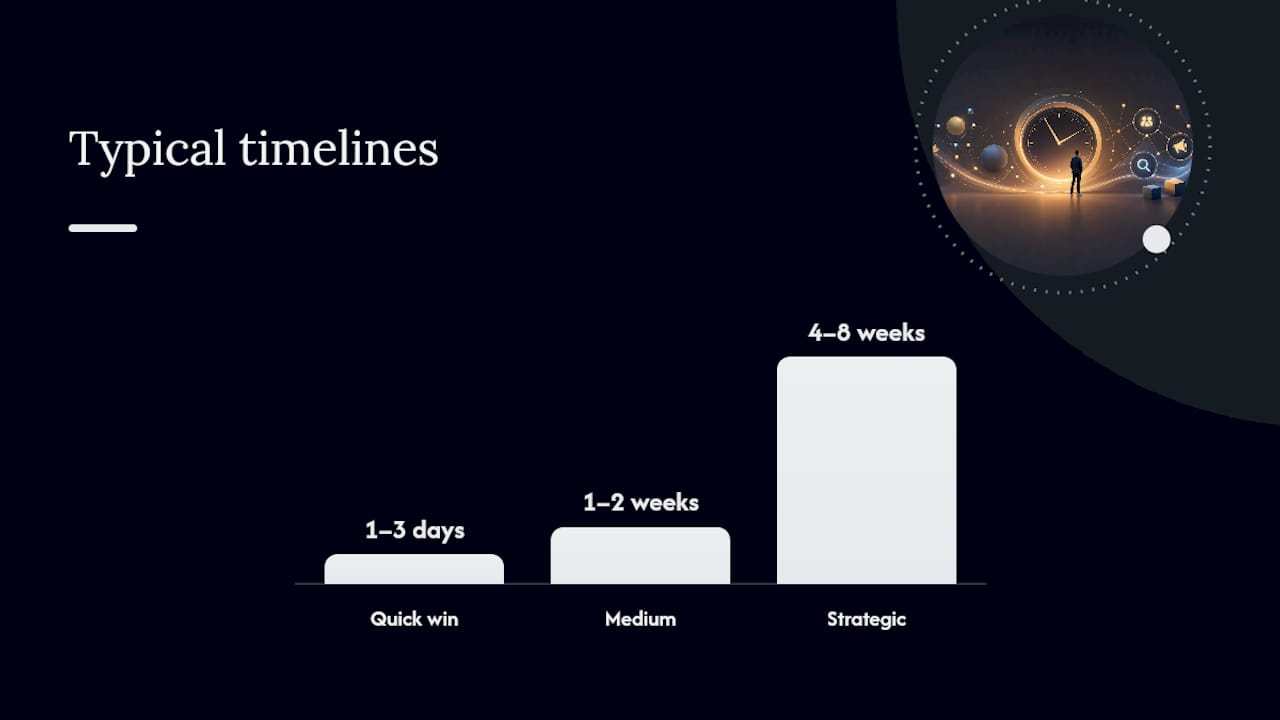
| Priority | Example fix | Typical timeline |
|---|---|---|
| Quick win | Broken canonical tags, negative keywords | 1 to 3 days |
| Medium | Landing page CTA and form redesign | 1 to 2 weeks |
| Strategic | Site speed overhaul, backlink cleanup | 4 to 8 weeks |
Roll every item into a 30/60/90 roadmap: quick wins in the first 30 days, medium projects by day 60, strategic work by day 90. The SMB Hub's core warning holds up here: teams that skip owner and deadline assignment fall into audit paralysis, where findings pile up and nothing ships. Tracking gym-specific marketing metrics after each fix confirms whether the change actually moved the number you targeted.
Deliverables: Templates and Reporting the Audit
A usable audit deliverable lists each finding with evidence, a priority tag, an owner, and a deadline, not a wall of screenshots. ClickMinded's downloadable audit template is built exactly for this: a client-ready format that turns findings into a repeatable report.
- Include a one-page executive summary at the top with the top three findings.
- Attach data exports (GA4 screenshots, Search Console tables) as supporting evidence, not the main content.
- List every recommendation with a rough cost or time estimate.
| Section | What goes in it |
|---|---|
| Executive summary | Top 3 findings, one line each |
| Findings by domain | Evidence, severity, owner |
| 30/60/90 roadmap | Prioritized fixes with deadlines |
A Quick 10-Question Self-Assessment
Score yourself 0 to 2 on each domain: technical, SEO, content, paid, social, email, analytics, CRO, MarTech, and attribution. Ten questions, twenty points total. Short self-assessments like this work well because they give an immediate directional read rather than requiring a full audit before you know where to start.
- Does your homepage load under 2.5 seconds on mobile?
- Are your top 10 pages indexed with unique titles?
- Has your top content been updated in the last 6 months?
- Do your paid campaigns have verified conversion tracking?
- Is your engagement rate above 1% on your main social platform?
- Is your email bounce rate under 2%?
- Does GA4 match your CRM lead count within 10%?
- Does your landing page headline match your ad copy?
- Do you have a documented 30/60/90 action plan from your last audit?
- Can you name your last content or campaign A/B test result?
Score 0 to 8: start with technical and analytics fixes. Score 9 to 14: focus on content and paid optimization. Score 15 and up: move to attribution modeling and competitive benchmarking. Feed your weakest three domains directly into the roadmap from the prioritization section above.
Auditing Local SEO and Your Google Business Profile
For any business with a physical location, local search often drives more qualified traffic than the main website. Start by claiming and verifying the Google Business Profile, then confirm every field is filled out: hours, categories, service area, and a phone number that matches what's on the website.
Check the primary and secondary business categories against competitor listings in the same area. Mismatched or missing categories are a common reason a business shows up on page two of the map pack instead of the top three. Photos matter more than most owners realize: profiles with recent, real photos get more clicks than ones running default images from years ago.

Review recent posts and Q&A activity. A profile that hasn't posted an update in six months signals inactivity to both Google and potential customers browsing the map pack. Pull the review count and average rating, then check response rate; unanswered negative reviews sitting for weeks do more damage than the review itself.
Confirm NAP consistency (name, address, phone) across the website footer, the Google Business Profile, and any directory listings. A mismatched phone number on even one major directory can quietly suppress local rankings. For gyms and fitness studios specifically, a dedicated local SEO playbook covers the category-selection and review-response tactics that move map pack rankings fastest. Flag any missing categories or unanswered reviews as quick wins; a full citation cleanup across directories is a strategic project.
Assessing Video Marketing and YouTube Performance
Video content earns attention differently than a blog post or an ad, so audit it on its own terms. Start with the channel basics: is the banner, description, and About section filled out with a clear value proposition and a link back to the main site?
Pull watch time and average view duration for the last 10 to 15 videos. A video with high views but a 15% average view duration is a hook problem, not a distribution problem; the thumbnail and first ten seconds need work before you publish more content. Compare subscriber growth against view count trends. Flat subscribers with rising views usually means content is reaching new audiences who aren't converting into a returning audience, which points to a call-to-action gap at the end of each video.
Check whether videos include end screens and cards directing viewers to a next step, a playlist, a landing page, or a subscribe prompt. Missing end screens are one of the most common oversights in an otherwise solid video strategy. Audit titles and descriptions for basic search optimization the same way you would a webpage; YouTube functions as a search engine in its own right, and untitled or vague video names lose discoverability.
If short-form content (Reels, Shorts, TikTok-style clips) feeds into the channel strategy, check whether it's repurposed consistently or treated as an afterthought. Channels that batch-produce short clips from longer videos tend to see steadier growth than ones posting long-form content alone. Flag any missing end screens or About sections as immediate fixes; a full content calendar overhaul belongs in the strategic bucket.
Evaluating Influencer Marketing and Partnerships
Start by pulling a list of every active or past influencer relationship and checking whether each one has a documented goal: brand awareness, lead generation, or direct sales. Partnerships without a stated goal are nearly impossible to evaluate honestly after the fact.
Compare the cost of each partnership (cash, product, or free membership) against a measurable outcome: referral code redemptions, unique landing page visits, or a tracked discount code. If a partnership can't be tied to at least one trackable metric, that's a structural gap to fix before renewing it, not a reason to assume it worked.
Check audience overlap and relevance rather than follower count alone. A local influencer with 3,000 highly engaged, geographically relevant followers often outperforms one with 50,000 followers scattered across the country for a location-based business like a gym or studio. Review engagement quality on sponsored posts specifically, since sponsored content typically sees lower engagement than organic posts from the same account, and a steep drop-off signals audience fatigue with paid placements.
Audit contract terms and content usage rights. Confirm whether the business can repurpose influencer content on its own channels and ads, since many partnerships leave this unaddressed and lose valuable creative assets as a result. Flag any partnership with no tracking mechanism as an immediate fix: add a unique code or link before the next payment goes out. Building a documented partnership scorecard, cost against attributed outcome, turns a scattered set of relationships into a channel you can actually evaluate quarter over quarter.
Reviewing Affiliate Programs and Their Effectiveness
If an affiliate or referral program exists, start by checking whether tracking actually works: does every affiliate link or code correctly attribute a sale or sign-up back to the right partner? Broken or inconsistent tracking is the single most common reason affiliate programs quietly underperform.
Pull a list of active affiliates and rank them by attributed revenue over the last quarter. Most affiliate programs follow a steep pattern where a small handful of partners drive the majority of results, while a long tail contributes almost nothing. Identify which partners fall into that long tail and decide whether to reactivate them with better creative assets or cut them loose.
Check the commission structure against actual margin. A commission rate set years ago without revisiting product margins can quietly erode profitability on every affiliate sale. Review the onboarding materials given to affiliates, banners, product descriptions, and sample copy, since partners with better assets typically convert their own audiences at a noticeably higher rate.
Audit compliance too: are affiliates disclosing the relationship per FTC guidelines, and are they representing the brand accurately in their content? A single affiliate making exaggerated claims can create liability that outweighs the revenue they generate. Flag broken tracking links as an immediate fix; renegotiating commission structures and refreshing affiliate assets belongs in the medium-term bucket of the roadmap.
Examining Marketing Automation Beyond Email
Automation extends well past a welcome email series, and most audits stop looking too early. Check whether lead scoring is active: are new leads ranked by engagement level (page visits, email opens, form fills) so sales or follow-up staff know who to contact first?
Review any workflow automation tied to the CRM: does a new lead automatically get tagged, routed to the right follow-up sequence, and assigned to a staff member, or does that still happen manually? Manual routing is where leads go cold fastest, especially for a business like a gym where a same-day follow-up dramatically changes trial-to-membership conversion.
Audit SMS automation separately from email if it's in use; open and response rates on SMS typically run higher than email, so a missing SMS follow-up sequence for hot leads is often a bigger gap than an email flow.
Check whether automation workflows have any dead ends, sequences that fire but never lead to a scored action or a handoff to a human. A workflow that sends five emails and then simply stops, with no re-engagement or disqualification logic, wastes the lead without ever formally losing them. Flag any lead sitting untouched for more than 24 hours as an immediate process fix; building out a full lead-scoring model is a strategic project worth scoping separately.
Analyzing Customer Journey Mapping and Attribution
Map the actual path a customer takes, first touch, research phase, comparison, and conversion, against the channels active in your account, not the path you assume they take. Most businesses discover a mismatch here: paid search gets credited with sales that social media or referral actually influenced earlier in the journey.
Check which attribution model is currently active in GA4 (data-driven, last-click, or first-click) and understand what it does and doesn't capture. Data-driven attribution tends to give a more accurate revenue picture than last-click, but it needs enough conversion volume to work reliably; low-volume accounts may default back to a simpler model without anyone noticing.
Review whether offline touchpoints, phone calls, in-person visits, walk-in inquiries, get folded into the attribution picture at all. For a local business, a phone call that closes a sale but never touches a tracked digital form disappears from every report unless call tracking is in place.
Audit the assisted-conversion data in GA4 to see which channels support the funnel even when they don't get final credit. A social channel showing low direct conversions but high assist value is often underfunded relative to its actual contribution. Flag any channel with zero tracked attribution data as an immediate fix; building a full multi-touch model that includes offline conversion data is strategic work worth scoping with whoever owns analytics.
A Practitioner's Take on Where Audits Actually Fail
Most audits die in the tracking section. Teams spend hours debating ad creative while GA4 and the CRM disagree on lead counts, which makes every other finding suspect. Fix measurement first, chase quick wins second, and save the strategic rebuild for when the numbers can actually prove it worked.
How Enoch Marketing Turns This Checklist Into Growth
Running this checklist manually takes a full day. Enoch Marketing runs it for CrossFit gyms and fitness studios as a starting point, then builds the paid media, local SEO, and conversion fixes it surfaces into an ongoing program, without asking a gym owner to become a part-time analyst.

That specialization matters here: generic agencies audit every industry the same way, while a fitness-only focus means the benchmarks, ad angles, and landing page fixes are already calibrated to what actually moves memberships. If this checklist turned up more red flags than you have time to fix, scope a paid audit and growth plan through Enoch Marketing's gym marketing services and get a prioritized action plan built specifically for a fitness business, not a template borrowed from an unrelated industry.
Sources
- The RACE digital marketing audit checklist - Smart Insights
- How to Conduct a Successful Digital Marketing Audit
- Digital Marketing Audit Checklist: Evaluate Your Online Presence | The SMB Hub
- A Complete Checklist for Digital Marketing Audit in 2026