
Yes, a focused reactivation program aimed at leads and members lapsed 30 to 120 days is one of the highest-ROI moves a gym can make. Pull your cancelled and unconverted-lead list this week, validate the contact info, and start a three-touch cadence across phone, text, and email before the window closes.
TL;DR:
- Target high-recovery segments such as members who last visited within 30 to 90 days and previously engaged heavily, using personal calls for the best chances of reactivation.
- Clean contact lists by removing members who moved, requested no contact, or are on medical holds, to avoid compliance issues and wasted effort.
- Use a consistent, low-pressure outreach cadence, including calls, texts, and emails over several months, rather than relying on single aggressive campaigns.
- Focus on personalized messaging referencing specific past classes, coaches, or reasons for leaving, which significantly increases engagement rates.
- Implement robust automation and identity matching to prevent errors like targeting re-enrolled members or missed cancellations, ensuring timely and relevant contact.
Table of Contents
- Why Lost Lead Reactivation Matters for Gyms
- Who to Target: Segmenting Lost Leads Into Actionable Tiers
- What's the Right Cadence for Reactivation Outreach?
- Automation and Identity Reconciliation: The Plumbing Behind the Results
- Offers and Messaging: What to Say Without Sounding Desperate
- Metrics and Benchmarks: What a Reactivation Pilot Should Prove
- Re-Onboarding: Keeping Reactivated Members From Lapsing Again
- Handling Objections and the Real Reasons Members Churn
- Personalization Techniques That Actually Move the Needle
- Integrating Social Proof Into Your Win-Back Campaigns
- Enoch Marketing's Perspective on Running Reactivation Projects
- How Enoch Marketing Helps Gyms Reactivate Lost Leads
- Sources
- FAQ
Why Lost Lead Reactivation Matters for Gyms
Reactivating a former member almost always costs less than acquiring a new one, because you skip the awareness and trust-building stages entirely. This person already knows your floor, your coaches, and your class schedule. Structured, automated win-back campaigns that branch by the member's actual cancellation reason recover 12 to 18 percent of cancelled members, compared with just 3 to 5 percent for generic manual outreach that treats every lapsed member the same.
The Math: A 300-member gym losing 8 to 10 members a month accumulates roughly 100 recoverable leads a year. At a 15% reactivation rate and a $150 average monthly membership, that's a meaningful revenue stream sitting untouched in a spreadsheet.
Operators on forums like Reddit's r/gymowner repeat a similar theme: most former members didn't quit because they hated the gym. They moved, got injured, or their schedule changed. That distinction shapes everything about how you approach them.
Who to Target: Segmenting Lost Leads Into Actionable Tiers
Not every lapsed contact deserves the same phone call. Gyms that segment lapsed members into tiers by recency and prior visit frequency convert better because they route the right message through the right channel instead of blasting everyone with the same email.
Use three tiers, built around a 30 to 120 day sweet spot where memory of your gym is still fresh but enough time has passed that a fresh offer feels relevant:
- Tier A (30–90 days, high-frequency former visitors): These are your best bets. They trained 3+ times a week before lapsing. Call them personally.
- Tier B (90–180 days, moderate frequency): Text and email first, escalate to a call only if they engage.
- Tier C (180+ days or low-frequency, never-converted leads): Automated email sequences only, low cost, low expectation.
Before any of this runs, clean the list. Strip out anyone who moved out of your service area, is on a documented medical hold, or has requested no further contact. Sending a win-back text to someone who asked you to stop calling isn't just sloppy, it's a compliance risk.
What's the Right Cadence for Reactivation Outreach?
Once your tiers are built, the cadence matters more than the offer. A steady, low-pressure rhythm consistently outperforms a single aggressive push. Operators using a three-times-per-year outreach pattern with light, no-pressure check-ins see better long-term reactivation than gyms that fire one big "WE MISS YOU" blast and move on.
Here's a sequence that works for most boutique studios and CrossFit boxes:
- Day 1: Personal text or call for Tier A, automated email for Tier B/C. Lead with a question, not an offer ("Hey, haven't seen you in a while, everything okay?").
- Day 7: Second touch. Offer a specific, low-friction action, like a free class or a quick 10-minute call with a coach.
- Day 30: Third touch with a concrete incentive if there's been no response.
- Day 90: Final check-in, then move to a quarterly nurture list rather than continued daily/weekly pressure.
Multi-channel sequences that include an actual phone call consistently beat email-only approaches for high-value Tier A targets. Email is cheap, but a five-minute human conversation converts at a completely different rate.
Pro Tip: Move anyone from Tier A who opens three emails without responding into a human-call queue immediately. Engagement without action usually means they need a real person to close the loop, not another automated nudge.
Automation and Identity Reconciliation: The Plumbing Behind the Results
The clever offer means nothing if your system sends a "we miss you" email to someone who re-enrolled last week. Identity reconciliation, meaning matching a contact reliably across email, phone, and name, is the most common failure point in reactivation campaigns, and it's almost always invisible until it embarrasses you in front of a member.
Before launching anything, confirm these safeguards are in place:
- Your CRM matches by multiple identifiers (email, phone, name) and flags ambiguous duplicates for manual review instead of guessing.
- Automation flows include a suppression rule that immediately pulls someone out the moment they re-enroll.
- Webhook triggers have retry logic and an audit trail, so a dropped signup or missed cancellation event doesn't silently break the entire flow.
Responding to abandoned signups within one hour, paired with an immediate multi-touch recovery sequence, can recover roughly 8 to 12 percentage points of early churn that would otherwise disappear before a human even notices. Tools like gym CRM automation exist specifically to close that gap between signup and stalled lead.
Practically, that means capturing structured cancellation reasons at the point of exit (price, schedule, injury, moving, other), holding new cancellations for 7 to 10 days before starting outreach, and building hard stop rules so no one gets touched more than three times in a two-week window.
Offers and Messaging: What to Say Without Sounding Desperate
The opener matters more than the offer. A simple permission-to-bug line, something like "Mind if I check in occasionally about classes?", sets expectations and dramatically lowers the odds someone blocks your number. Map your messaging to the actual reason someone left instead of defaulting to a blanket discount:
- Price objection: Offer a punch card or a shorter-commitment option, not just a flat discount.
- Schedule conflict: Highlight a new class time or an on-demand option they may not know exists.
- Moved away: Offer a referral to a partner gym or simply thank them and close the file.
- "Wasn't using it": Lead with accountability support, a coach check-in, or a small-group challenge.
- Switched gyms: Ask for honest feedback, sometimes that reopens the door more than any offer.
For SMS specifically, follow TCPA rules closely: get documented consent before texting, include a clear opt-out on every message, and honor "STOP" requests immediately. Cap total touches and don't lean on discounts as your only lever, they train people to wait for the next sale instead of coming back for the gym itself.
Metrics and Benchmarks: What a Reactivation Pilot Should Prove
Run a 14 to 30 day pilot before scaling anything. Track these five numbers so you know whether the program actually works or just feels productive:
| KPI | What it tells you | Realistic pilot range |
|---|---|---|
| Time-to-first-contact | Speed after cancellation or stalled lead | Under 1 hour for automated triggers |
| Day-3 booking rate | Early engagement signal | 15 to 18% of contacted leads |
| Touch-to-close ratio | Effort required per conversion | 3 to 5 touches average |
| 90-day reactivation rate | Overall program health | 12 to 18% with structured automation |
| Stalled-lead count | Contacts stuck mid-sequence | Should trend toward zero weekly |
For a 300-member gym running a $50 win-back incentive against 100 lapsed contacts, a 15% reactivation rate yields 15 recovered members. At a $150 average monthly membership, that's $2,250 in recovered monthly revenue against maybe $750 in incentive cost, a return most acquisition channels can't touch.
Re-Onboarding: Keeping Reactivated Members From Lapsing Again
Winning someone back and then losing them a second time is worse than never winning them back at all, because it confirms their decision to leave. Build a real 60 to 90 day re-onboarding flow instead of just re-adding them to your regular member list.
- Book a short re-entry consultation within the first week to reset goals and address whatever caused the original drop-off.
- Recommend two or three specific classes based on their prior attendance pattern, not a generic schedule link.
- Remove every point of friction: pre-fill their profile, skip redundant paperwork, and have a coach greet them by name on day one.
- Assign a short 21 to 30 day challenge to rebuild the habit loop before it has a chance to break again.
Track attendance at the 2-week and 6-week marks specifically. A reactivated member who skips week three is a flashing warning sign, not a wait-and-see situation. A quick coach text at that point often prevents a second cancellation entirely. Pairing this with broader member engagement tactics built for CrossFit boxes and studios keeps the momentum from fading after the initial win-back conversation.
Pro Tip: Assign re-onboarding to whichever coach the member had the strongest relationship with previously, not whoever's on shift. Familiarity closes more retention gaps than any automated check-in ever will.
Handling Objections and the Real Reasons Members Churn
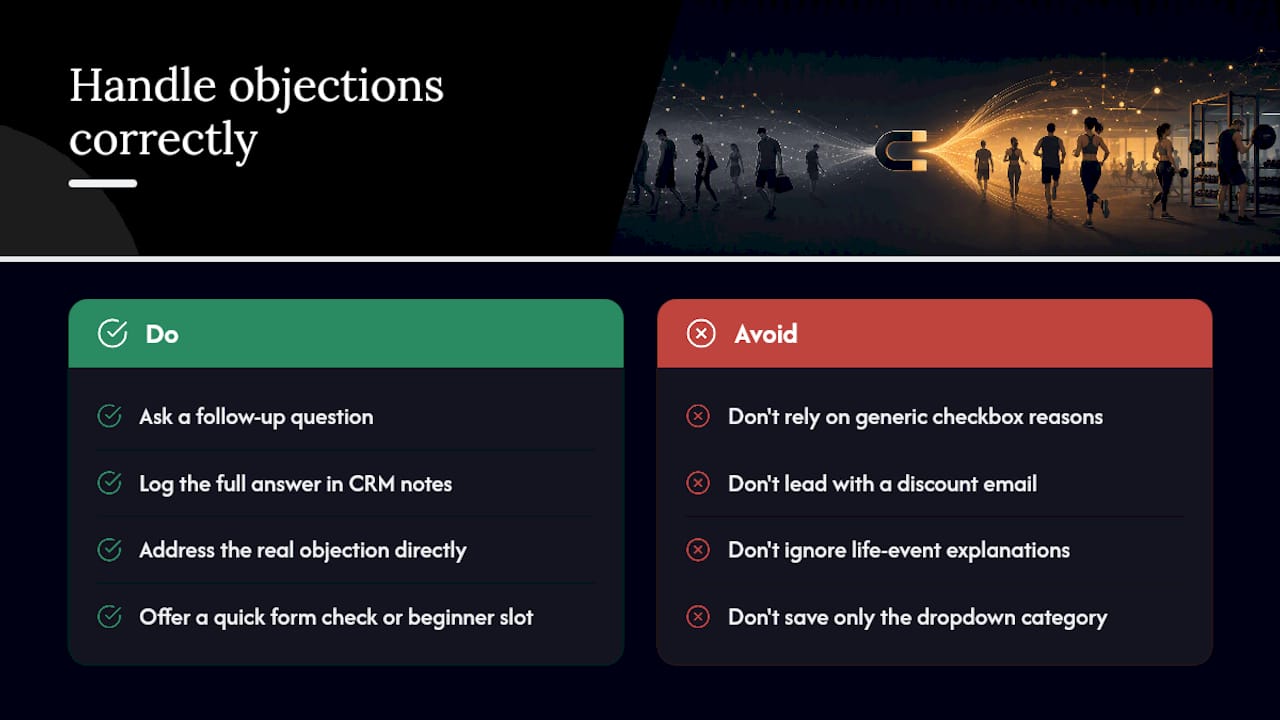
Most cancellation forms say "financial reasons" or "schedule conflict," but those categories usually hide the real story. Someone who says price was the issue often actually stopped seeing results, or felt intimidated walking into a class where they'd fallen behind. Someone who cites scheduling often just lost the habit after one missed week and never restarted.
That's why the exit conversation matters as much as the reactivation call. If your front desk or online cancellation flow only offers four generic checkboxes, you're capturing noise, not insight. Ask a follow-up question, even a simple "what would have made this work better for you?", and log the actual answer in your CRM notes field, not just the dropdown category.
When you reach out later, address the real objection instead of the checkbox one. If someone stopped attending because they felt lost in group classes, don't lead with a discount, lead with an offer for a quick form check or a beginner-friendly time slot. If they left because a life event derailed their routine (a new baby, a job change, an injury), acknowledge it directly rather than pretending three months didn't happen. "I know things got busy, no pressure, just wanted to check in" earns more trust than a templated "We Miss You, Here's 20% Off" email.
Price objections deserve particular care. Rarely is price the entire story, it's usually price relative to perceived value. Someone who felt like they were getting real coaching and community will rarely cite cost as the reason they left, even if money was tight. Someone who felt like just another name on a check-in sheet will blame price every time, because nothing else justified the expense. Fix the value conversation before you touch the discount lever.
Personalization Techniques That Actually Move the Needle
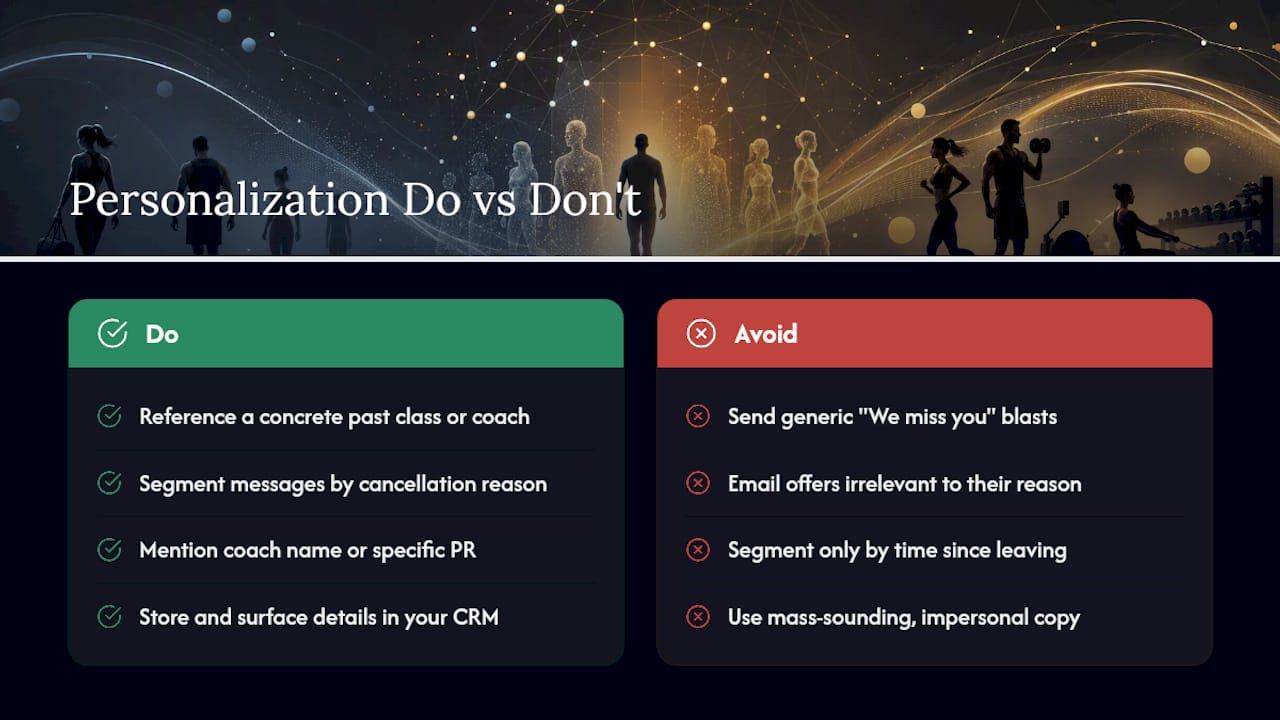
Generic "we miss you" messaging gets ignored because it could apply to literally anyone who ever canceled a membership anywhere. Real personalization uses what you already know: their old class schedule, their favorite coach, their goals from the initial intake form, and their specific cancellation reason.
Reference something concrete. "You used to crush the 6am Olympic lifting class with Coach Sarah, she's still running it Tuesdays and Thursdays" lands completely differently than "We have new class times available." The first message proves you remember them as a person. The second could be a mass send to 500 people, and the recipient knows it.
Timing personalization matters too. A member who canceled right after a nagging shoulder injury shouldn't get an email about a new heavy-lifting competition. A parent who left because of childcare conflicts should hear about your new evening or weekend childcare options before anything else. Segment your messaging by the actual reason on file, not just by how long ago someone left.
Small details compound. Using a coach's name, referencing a specific PR they hit, or mentioning a friend who still trains there all signal that this isn't an automated blast, even when much of the sequence genuinely is automated behind the scenes. The goal isn't to hide the automation, it's to make sure the automation says something worth reading. A tool like a gym CRM can store and surface these personal details automatically so no one on staff has to remember them manually.
Integrating Social Proof Into Your Win-Back Campaigns
A lapsed member deciding whether to come back is asking themselves one quiet question: has anything actually changed since I left? Social proof answers that question faster than any offer can.
Include a brief, specific mention of what's new since they left; a renovated space, a new coach, a schedule overhaul, or a member success story that mirrors their own situation. If a former member who once struggled with consistency recently hit a major milestone, that story resonates far more with a lapsed lead than a generic "join now" push, because it shows the path back is realistic, not just aspirational.
Reviews matter here too, particularly for leads who never converted in the first place rather than former members. A lapsed lead who booked a tour but never signed up is essentially starting the trust-building process over. A current Google rating, a recent testimonial, or even a mention of "we've added 40 new members this year" gives them a reason to believe the decision to return is a good one, not just a hopeful one.
Keep it brief and specific. One well-placed detail beats three vague claims about being "the best gym in town." Specificity is what makes social proof feel real instead of like marketing copy.
Enoch Marketing's Perspective on Running Reactivation Projects
When Enoch Marketing takes on a reactivation project for a CrossFit box or studio, the audit almost always surfaces the same three gaps: missing or vague cancellation reasons, identity drift between the CRM and the payment system, and webhook failures nobody noticed because no one was checking the audit trail. Fixing the plumbing comes before writing a single script. The audit, strategy, launch, and scale sequence exists specifically because clever messaging on broken data produces embarrassing results, not revenue.
— Collin
How Enoch Marketing Helps Gyms Reactivate Lost Leads
Enoch Marketing is built exclusively for CrossFit boxes and fitness studios, which means the reactivation systems above aren't theory, they're the same CRM automation, lead follow-up, and landing page work Enoch builds into every client engagement. Where a generalist agency treats your lapsed-lead list as an afterthought, Enoch treats it as connected infrastructure: paid media, local SEO, and lead follow-up and booking all feeding one identity-reconciled system instead of five disconnected tools.
If your gym needs help building the segmentation, cadence, and automation described here without hiring an internal ops team, Enoch's Fill the Floor plan at $2,500 per month is built around exactly this kind of lead follow-up and booking system. Book a free strategy session to get an audit of your current lapsed-lead pipeline and see where the plumbing is leaking revenue.
Sources
- Gym Reactivation: Recover 15% of Lost Members Tested
- Gym Member Reactivation: The Complete Guide for Multi-Location Fitness Brands | Winback Engine Blog
- How to Run a Reactivation Campaign for Former Gym Members | PushPress
- Recover 8–12% More Abandoned Signups in a 14–30 day pilot
FAQ
Are gym memberships declining?
Overall gym membership demand has stayed resilient industrywide, but individual clubs regularly lose 30 to 50% of members annually to normal churn from moving, injury, or lifestyle changes. That constant turnover is exactly why a lost lead reactivation program for gyms matters so much for revenue stability.
Is Planet Fitness in trouble?
There's no evidence supporting that Planet Fitness as a brand is in financial distress. Individual location performance varies by market and management, which is true across the entire gym industry, not specific to any one chain.
What is the failure rate of gyms?
Independent gyms and boutique studios face a high closure rate in their first few years, similar to other small business categories, driven mainly by thin margins and heavy reliance on new-member acquisition instead of retention. Building a structured process to reactivate gym members lowers that risk by recovering revenue that would otherwise require costly new acquisition to replace.
Who is the CEO of Gym Group?
Gym Group plc's leadership has changed over time and current executive details are not publicly confirmed here; check the company's official investor relations page for the current CEO. This question falls outside the reactivation strategy focus of this guide.
How much does gym lead reactivation cost with Enoch Marketing?
Enoch Marketing's plans start at $1,500 per month for the Get Found plan, with Fill the Floor at $2,500 per month built specifically around lead follow-up and booking systems like the ones described here. Custom Growth pricing is available on request for gyms needing a broader scope.